

304
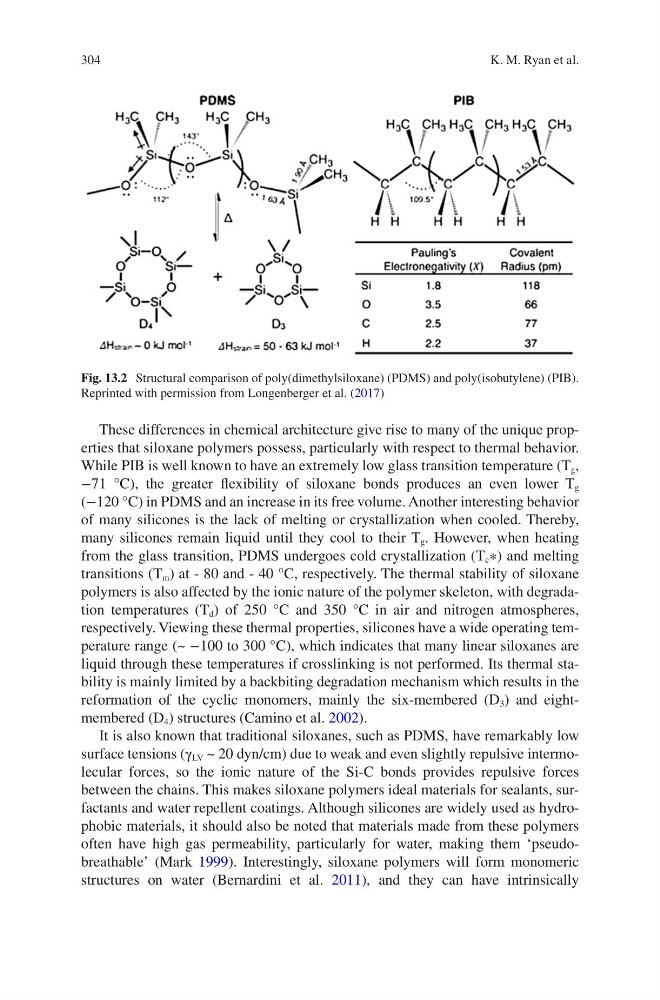
These differences in chemical architecture give rise to many of the unique properties that siloxane polymers possess, particularly with respect to thermal behavior.
While PIB is well known to have an extremely low glass transition temperature (T g ,
−71 °C), the greater flexibility of siloxane bonds produces an even lower T g
(−120 °C) in PDMS and an increase in its free volume. Another interesting behavior
of many silicones is the lack of melting or crystallization when cooled. Thereby,
many silicones remain liquid until they cool to their T g . However, when heating
from the glass transition, PDMS undergoes cold crystallization (T c ∗) and melting
transitions (T m ) at - 80 and - 40 °C, respectively. The thermal stability of siloxane
polymers is also affected by the ionic nature of the polymer skeleton, with degradation temperatures (T d ) of 250 °C and 350 °C in air and nitrogen atmospheres,
respectively. Viewing these thermal properties, silicones have a wide operating temperature range (~ −100 to 300 °C), which indicates that many linear siloxanes are
liquid through these temperatures if crosslinking is not performed. Its thermal stability is mainly limited by a backbiting degradation mechanism which results in the
reformation of the cyclic monomers, mainly the six-membered (D 3 ) and eightmembered (D 4 ) structures (Camino et al. 2002).
It is also known that traditional siloxanes, such as PDMS, have remarkably low
surface tensions (γ LV ~ 20 dyn/cm) due to weak and even slightly repulsive intermolecular forces, so the ionic nature of the Si-C bonds provides repulsive forces
between the chains. This makes siloxane polymers ideal materials for sealants, surfactants and water repellent coatings. Although silicones are widely used as hydrophobic materials, it should also be noted that materials made from these polymers
often have high gas permeability, particularly for water, making them ‘pseudobreathable’ (Mark 1999). Interestingly, siloxane polymers will form monomeric
structures on water (Bernardini et al. 2011), and they can have intrinsically
Fig. 13.2 Structural comparison of poly(dimethylsiloxane) (PDMS) and poly(isobutylene) (PIB).
Reprinted with permission from Longenberger et al. (2017)
K. M. Ryan et al.
These differences in chemical architecture give rise to many of the unique properties that siloxane polymers possess, particularly with respect to thermal behavior.
While PIB is well known to have an extremely low glass transition temperature (T g ,
−71 °C), the greater flexibility of siloxane bonds produces an even lower T g
(−120 °C) in PDMS and an increase in its free volume. Another interesting behavior
of many silicones is the lack of melting or crystallization when cooled. Thereby,
many silicones remain liquid until they cool to their T g . However, when heating
from the glass transition, PDMS undergoes cold crystallization (T c ∗) and melting
transitions (T m ) at - 80 and - 40 °C, respectively. The thermal stability of siloxane
polymers is also affected by the ionic nature of the polymer skeleton, with degradation temperatures (T d ) of 250 °C and 350 °C in air and nitrogen atmospheres,
respectively. Viewing these thermal properties, silicones have a wide operating temperature range (~ −100 to 300 °C), which indicates that many linear siloxanes are
liquid through these temperatures if crosslinking is not performed. Its thermal stability is mainly limited by a backbiting degradation mechanism which results in the
reformation of the cyclic monomers, mainly the six-membered (D 3 ) and eightmembered (D 4 ) structures (Camino et al. 2002).
It is also known that traditional siloxanes, such as PDMS, have remarkably low
surface tensions (γ LV ~ 20 dyn/cm) due to weak and even slightly repulsive intermolecular forces, so the ionic nature of the Si-C bonds provides repulsive forces
between the chains. This makes siloxane polymers ideal materials for sealants, surfactants and water repellent coatings. Although silicones are widely used as hydrophobic materials, it should also be noted that materials made from these polymers
often have high gas permeability, particularly for water, making them ‘pseudobreathable’ (Mark 1999). Interestingly, siloxane polymers will form monomeric
structures on water (Bernardini et al. 2011), and they can have intrinsically
Fig. 13.2 Structural comparison of poly(dimethylsiloxane) (PDMS) and poly(isobutylene) (PIB).
Reprinted with permission from Longenberger et al. (2017)
K. M. Ryan et al.