

303
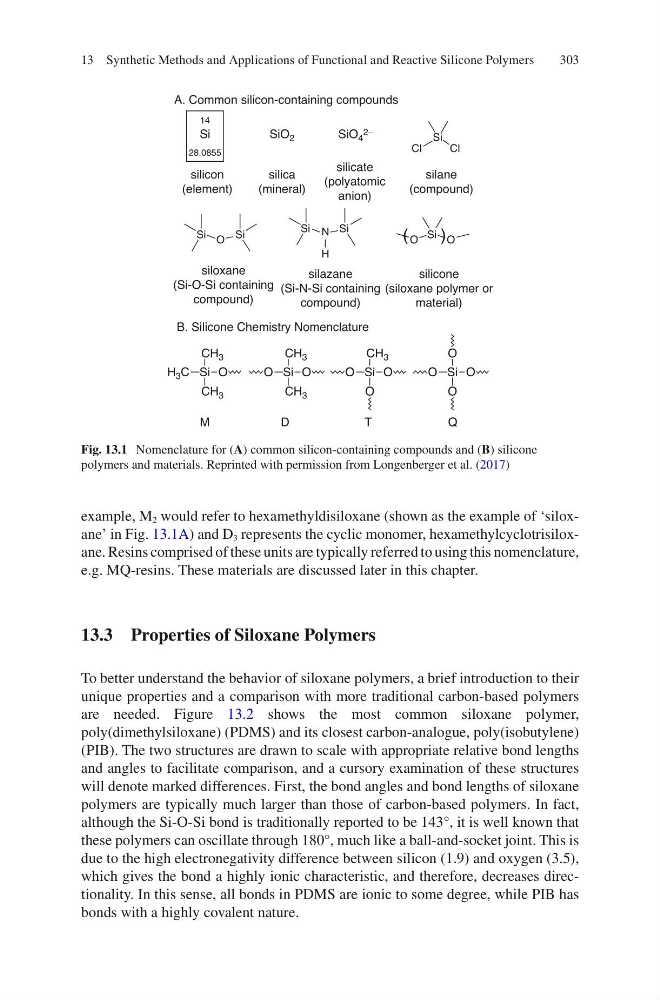
example, M 2 would refer to hexamethyldisiloxane (shown as the example of ‘siloxane’ in Fig. 13.1A) and D 3 represents the cyclic monomer, hexamethylcyclotrisiloxane. Resins comprised of these units are typically referred to using this nomenclature,
e.g. MQ-resins. These materials are discussed later in this chapter.
13.3 Properties of Siloxane Polymers
To better understand the behavior of siloxane polymers, a brief introduction to their
unique properties and a comparison with more traditional carbon-based polymers
are needed. Figure 13.2 shows the most common siloxane polymer,
poly(dimethylsiloxane) (PDMS) and its closest carbon-analogue, poly(isobutylene)
(PIB). The two structures are drawn to scale with appropriate relative bond lengths
and angles to facilitate comparison, and a cursory examination of these structures
will denote marked differences. First, the bond angles and bond lengths of siloxane
polymers are typically much larger than those of carbon-based polymers. In fact,
although the Si-O-Si bond is traditionally reported to be 143°, it is well known that
these polymers can oscillate through 180°, much like a ball-and-socket joint. This is
due to the high electronegativity difference between silicon (1.9) and oxygen (3.5),
which gives the bond a highly ionic characteristic, and therefore, decreases directionality. In this sense, all bonds in PDMS are ionic to some degree, while PIB has
bonds with a highly covalent nature.
A. Common silicon-containing compounds
silicon
(element)
Si
SiO 2
Si
Si
Si
Si
Si
Si
O
(
( O
N
H
O
Cl
Cl
SiO 4
2
14
28.0855
siloxane
(Si-O-Si containing
compound)
B. Silicone Chemistry Nomenclature
M
D
T
Q
silazane
(Si-N-Si containing
compound)
silicone
(siloxane polymer or
material)
silica
(mineral)
silicate
(polyatomic
anion)
silane
(compound)
H 3 C
CH 3
CH 3
Si O
CH 3
CH 3
Si O
O
O
CH 3
Si O
O
O
O
Si O
O
Fig. 13.1 Nomenclature for (A) common silicon- containing compounds and (B) silicone
polymers and materials. Reprinted with permission from Longenberger et al. (2017)
13 Synthetic Methods and Applications of Functional and Reactive Silicone Polymers
example, M 2 would refer to hexamethyldisiloxane (shown as the example of ‘siloxane’ in Fig. 13.1A) and D 3 represents the cyclic monomer, hexamethylcyclotrisiloxane. Resins comprised of these units are typically referred to using this nomenclature,
e.g. MQ-resins. These materials are discussed later in this chapter.
13.3 Properties of Siloxane Polymers
To better understand the behavior of siloxane polymers, a brief introduction to their
unique properties and a comparison with more traditional carbon-based polymers
are needed. Figure 13.2 shows the most common siloxane polymer,
poly(dimethylsiloxane) (PDMS) and its closest carbon-analogue, poly(isobutylene)
(PIB). The two structures are drawn to scale with appropriate relative bond lengths
and angles to facilitate comparison, and a cursory examination of these structures
will denote marked differences. First, the bond angles and bond lengths of siloxane
polymers are typically much larger than those of carbon-based polymers. In fact,
although the Si-O-Si bond is traditionally reported to be 143°, it is well known that
these polymers can oscillate through 180°, much like a ball-and-socket joint. This is
due to the high electronegativity difference between silicon (1.9) and oxygen (3.5),
which gives the bond a highly ionic characteristic, and therefore, decreases directionality. In this sense, all bonds in PDMS are ionic to some degree, while PIB has
bonds with a highly covalent nature.
A. Common silicon-containing compounds
silicon
(element)
Si
SiO 2
Si
Si
Si
Si
Si
Si
O
(
( O
N
H
O
Cl
Cl
SiO 4
2
14
28.0855
siloxane
(Si-O-Si containing
compound)
B. Silicone Chemistry Nomenclature
M
D
T
Q
silazane
(Si-N-Si containing
compound)
silicone
(siloxane polymer or
material)
silica
(mineral)
silicate
(polyatomic
anion)
silane
(compound)
H 3 C
CH 3
CH 3
Si O
CH 3
CH 3
Si O
O
O
CH 3
Si O
O
O
O
Si O
O
Fig. 13.1 Nomenclature for (A) common silicon- containing compounds and (B) silicone
polymers and materials. Reprinted with permission from Longenberger et al. (2017)
13 Synthetic Methods and Applications of Functional and Reactive Silicone Polymers