

242
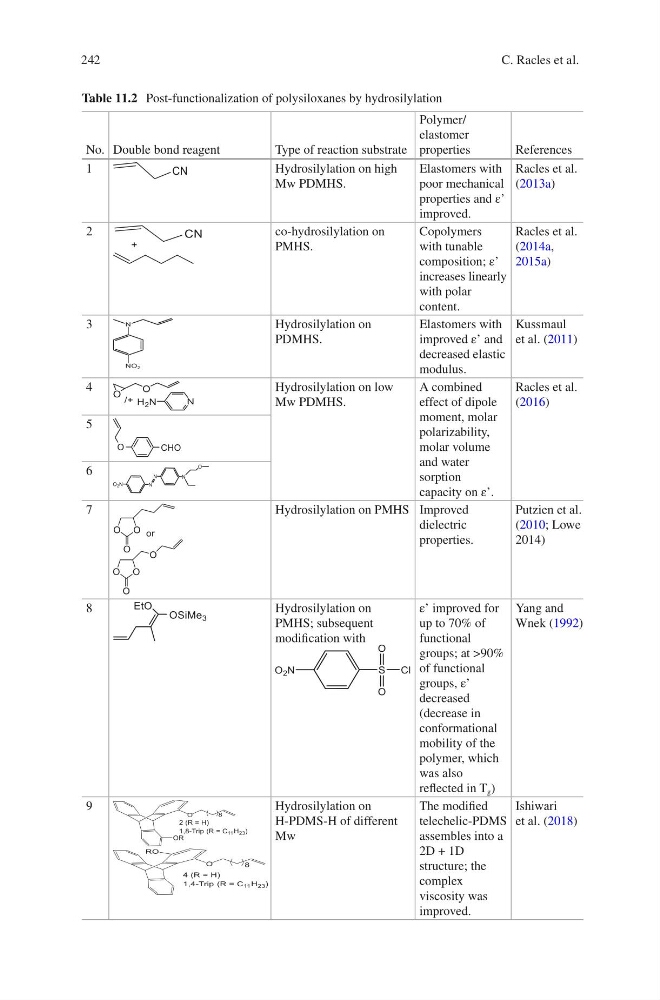
Table 11.2 Post-functionalization of polysiloxanes by hydrosilylation
No. Double bond reagent
Type of reaction substrate
Polymer/
elastomer
properties
References
1
Hydrosilylation on high
Mw PDMHS.
Elastomers with
poor mechanical
properties and ε’
improved.
Racles et al.
(2013a)
2
co-hydrosilylation on
PMHS.
Copolymers
with tunable
composition; ε’
increases linearly
with polar
content.
Racles et al.
(2014a,
2015a)
3
Hydrosilylation on
PDMHS.
Elastomers with
improved ε’ and
decreased elastic
modulus.
Kussmaul
et al. (2011)
4
Hydrosilylation on low
Mw PDMHS.
A combined
effect of dipole
moment, molar
polarizability,
molar volume
and water
sorption
capacity on ε’.
Racles et al.
(2016)
5
6
7
Hydrosilylation on PMHS Improved
dielectric
properties.
Putzien et al.
(2010; Lowe
2014)
8
Hydrosilylation on
PMHS; subsequent
modification with
ε’ improved for
up to 70% of
functional
groups; at >90%
of functional
groups, ε’
decreased
(decrease in
conformational
mobility of the
polymer, which
was also
reflected in T g )
Yang and
Wnek (1992)
9
Hydrosilylation on
H-PDMS-H of different
Mw
The modified
telechelic-PDMS
assembles into a
2D + 1D
structure; the
complex
viscosity was
improved.
Ishiwari
et al. (2018)
C. Racles et al.
Table 11.2 Post-functionalization of polysiloxanes by hydrosilylation
No. Double bond reagent
Type of reaction substrate
Polymer/
elastomer
properties
References
1
Hydrosilylation on high
Mw PDMHS.
Elastomers with
poor mechanical
properties and ε’
improved.
Racles et al.
(2013a)
2
co-hydrosilylation on
PMHS.
Copolymers
with tunable
composition; ε’
increases linearly
with polar
content.
Racles et al.
(2014a,
2015a)
3
Hydrosilylation on
PDMHS.
Elastomers with
improved ε’ and
decreased elastic
modulus.
Kussmaul
et al. (2011)
4
Hydrosilylation on low
Mw PDMHS.
A combined
effect of dipole
moment, molar
polarizability,
molar volume
and water
sorption
capacity on ε’.
Racles et al.
(2016)
5
6
7
Hydrosilylation on PMHS Improved
dielectric
properties.
Putzien et al.
(2010; Lowe
2014)
8
Hydrosilylation on
PMHS; subsequent
modification with
ε’ improved for
up to 70% of
functional
groups; at >90%
of functional
groups, ε’
decreased
(decrease in
conformational
mobility of the
polymer, which
was also
reflected in T g )
Yang and
Wnek (1992)
9
Hydrosilylation on
H-PDMS-H of different
Mw
The modified
telechelic-PDMS
assembles into a
2D + 1D
structure; the
complex
viscosity was
improved.
Ishiwari
et al. (2018)
C. Racles et al.