

241
Polysiloxanes with terminal or pendant hydrosilyl or vinyl groups are the most
commonly used as siloxane substrates for post-polymerization modifications using
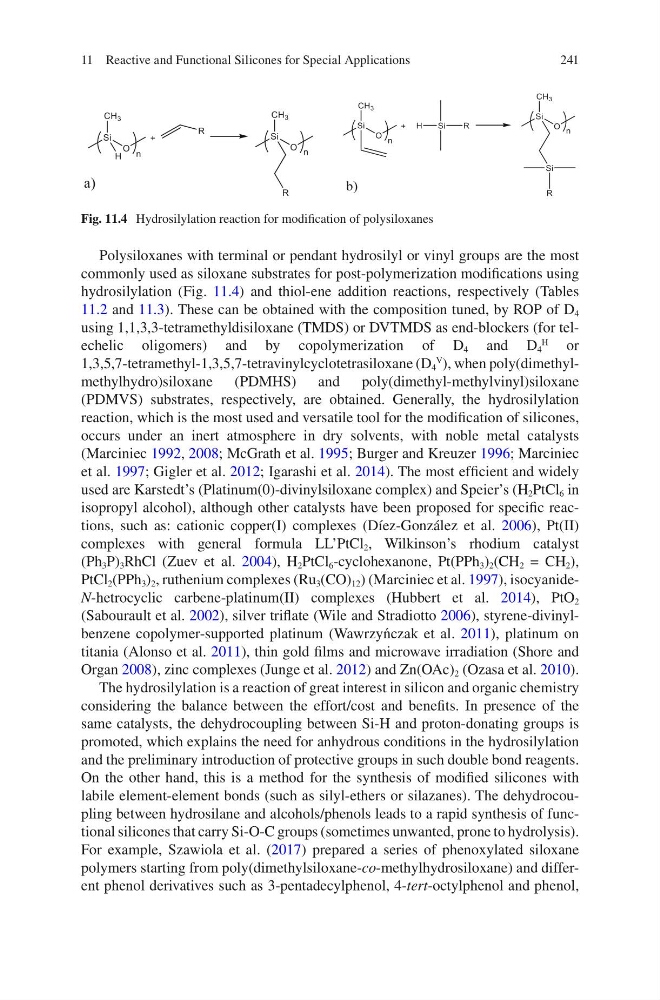
hydrosilylation (Fig. 11.4) and thiol-ene addition reactions, respectively (Tables
11.2 and 11.3). These can be obtained with the composition tuned, by ROP of D 4
using 1,1,3,3-tetramethyldisiloxane (TMDS) or DVTMDS as end-blockers (for telechelic oligomers) and by copolymerization of D 4 and D 4
H
or
1,3,5,7-tetramethyl- 1,3,5,7-tetravinylcyclotetrasiloxane (D 4
V
), when poly(dimethylmethylhydro)siloxane (PDMHS) and poly(dimethyl-methylvinyl)siloxane
(PDMVS) substrates, respectively, are obtained. Generally, the hydrosilylation
reaction, which is the most used and versatile tool for the modification of silicones,
occurs under an inert atmosphere in dry solvents, with noble metal catalysts
(Marciniec 1992, 2008; McGrath et al. 1995; Burger and Kreuzer 1996; Marciniec
et al. 1997; Gigler et al. 2012; Igarashi et al. 2014). The most efficient and widely
used are Karstedt’s (Platinum(0)-divinylsiloxane complex) and Speier’s (H 2 PtCl 6 in
isopropyl alcohol), although other catalysts have been proposed for specific reactions, such as: cationic copper(I) complexes (Díez-González et al. 2006), Pt(II)
complexes with general formula LL’PtCl 2 , Wilkinson’s rhodium catalyst
(Ph 3 P) 3 RhCl (Zuev et al. 2004), H 2 PtCl 6 - cyclohexanone, Pt(PPh 3 ) 2 (CH 2 = CH 2 ),
PtCl 2 (PPh 3 ) 2 , ruthenium complexes (Ru 3 (CO) 12 ) (Marciniec et al. 1997), isocyanideN- hetrocyclic carbene-platinum(II) complexes (Hubbert et al. 2014), PtO 2
(Sabourault et al. 2002), silver triflate (Wile and Stradiotto 2006), styrene-divinylbenzene copolymer-supported platinum (Wawrzyńczak et al. 2011), platinum on
titania (Alonso et al. 2011), thin gold films and microwave irradiation (Shore and
Organ 2008), zinc complexes (Junge et al. 2012) and Zn(OAc) 2 (Ozasa et al. 2010).
The hydrosilylation is a reaction of great interest in silicon and organic chemistry
considering the balance between the effort/cost and benefits. In presence of the
same catalysts, the dehydrocoupling between Si-H and proton-donating groups is
promoted, which explains the need for anhydrous conditions in the hydrosilylation
and the preliminary introduction of protective groups in such double bond reagents.
On the other hand, this is a method for the synthesis of modified silicones with
labile element-element bonds (such as silyl-ethers or silazanes). The dehydrocoupling between hydrosilane and alcohols/phenols leads to a rapid synthesis of functional silicones that carry Si-O-C groups (sometimes unwanted, prone to hydrolysis).
For example, Szawiola et al. (2017) prepared a series of phenoxylated siloxane
polymers starting from poly(dimethylsiloxane-co-methylhydrosiloxane) and different phenol derivatives such as 3-pentadecylphenol, 4-tert-octylphenol and phenol,
Fig. 11.4 Hydrosilylation reaction for modification of polysiloxanes
11 Reactive and Functional Silicones for Special Applications
Polysiloxanes with terminal or pendant hydrosilyl or vinyl groups are the most
commonly used as siloxane substrates for post-polymerization modifications using
hydrosilylation (Fig. 11.4) and thiol-ene addition reactions, respectively (Tables
11.2 and 11.3). These can be obtained with the composition tuned, by ROP of D 4
using 1,1,3,3-tetramethyldisiloxane (TMDS) or DVTMDS as end-blockers (for telechelic oligomers) and by copolymerization of D 4 and D 4
H
or
1,3,5,7-tetramethyl- 1,3,5,7-tetravinylcyclotetrasiloxane (D 4
V
), when poly(dimethylmethylhydro)siloxane (PDMHS) and poly(dimethyl-methylvinyl)siloxane
(PDMVS) substrates, respectively, are obtained. Generally, the hydrosilylation
reaction, which is the most used and versatile tool for the modification of silicones,
occurs under an inert atmosphere in dry solvents, with noble metal catalysts
(Marciniec 1992, 2008; McGrath et al. 1995; Burger and Kreuzer 1996; Marciniec
et al. 1997; Gigler et al. 2012; Igarashi et al. 2014). The most efficient and widely
used are Karstedt’s (Platinum(0)-divinylsiloxane complex) and Speier’s (H 2 PtCl 6 in
isopropyl alcohol), although other catalysts have been proposed for specific reactions, such as: cationic copper(I) complexes (Díez-González et al. 2006), Pt(II)
complexes with general formula LL’PtCl 2 , Wilkinson’s rhodium catalyst
(Ph 3 P) 3 RhCl (Zuev et al. 2004), H 2 PtCl 6 - cyclohexanone, Pt(PPh 3 ) 2 (CH 2 = CH 2 ),
PtCl 2 (PPh 3 ) 2 , ruthenium complexes (Ru 3 (CO) 12 ) (Marciniec et al. 1997), isocyanideN- hetrocyclic carbene-platinum(II) complexes (Hubbert et al. 2014), PtO 2
(Sabourault et al. 2002), silver triflate (Wile and Stradiotto 2006), styrene-divinylbenzene copolymer-supported platinum (Wawrzyńczak et al. 2011), platinum on
titania (Alonso et al. 2011), thin gold films and microwave irradiation (Shore and
Organ 2008), zinc complexes (Junge et al. 2012) and Zn(OAc) 2 (Ozasa et al. 2010).
The hydrosilylation is a reaction of great interest in silicon and organic chemistry
considering the balance between the effort/cost and benefits. In presence of the
same catalysts, the dehydrocoupling between Si-H and proton-donating groups is
promoted, which explains the need for anhydrous conditions in the hydrosilylation
and the preliminary introduction of protective groups in such double bond reagents.
On the other hand, this is a method for the synthesis of modified silicones with
labile element-element bonds (such as silyl-ethers or silazanes). The dehydrocoupling between hydrosilane and alcohols/phenols leads to a rapid synthesis of functional silicones that carry Si-O-C groups (sometimes unwanted, prone to hydrolysis).
For example, Szawiola et al. (2017) prepared a series of phenoxylated siloxane
polymers starting from poly(dimethylsiloxane-co-methylhydrosiloxane) and different phenol derivatives such as 3-pentadecylphenol, 4-tert-octylphenol and phenol,
Fig. 11.4 Hydrosilylation reaction for modification of polysiloxanes
11 Reactive and Functional Silicones for Special Applications