

240
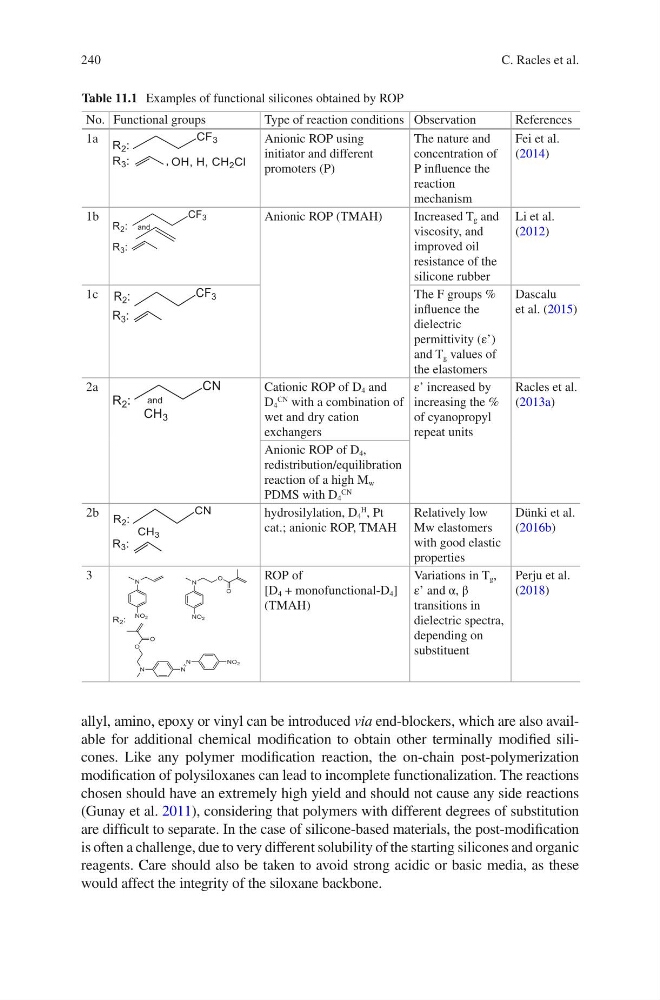
Table 11.1 Examples of functional silicones obtained by ROP
No. Functional groups
Type of reaction conditions Observation
References
1a
Anionic ROP using
initiator and different
promoters (P)
The nature and
concentration of
P influence the
reaction
mechanism
Fei et al.
(2014)
1b
Anionic ROP (TMAH)
Increased T g and
viscosity, and
improved oil
resistance of the
silicone rubber
Li et al.
(2012)
1c
The F groups %
influence the
dielectric
permittivity (ε’)
and T g values of
the elastomers
Dascalu
et al. (2015)
2a
Cationic ROP of D 4 and
D 4
CN with a combination of
wet and dry cation
exchangers
ε’ increased by
increasing the %
of cyanopropyl
repeat units
Racles et al.
(2013a)
Anionic ROP of D 4 ,
redistribution/equilibration
reaction of a high M w
PDMS with D 4
CN
2b
hydrosilylation, D 4
H
, Pt
cat.; anionic ROP, TMAH
Relatively low
Mw elastomers
with good elastic
properties
Dünki et al.
(2016b)
3
ROP of
[D 4 + monofunctional-D 4 ]
(TMAH)
Variations in T g ,
ε’ and α, β
transitions in
dielectric spectra,
depending on
substituent
Perju et al.
(2018)
allyl, amino, epoxy or vinyl can be introduced via end-blockers, which are also available for additional chemical modification to obtain other terminally modified silicones. Like any polymer modification reaction, the on-chain post- polymerization
modification of polysiloxanes can lead to incomplete functionalization. The reactions
chosen should have an extremely high yield and should not cause any side reactions
(Gunay et al. 2011), considering that polymers with different degrees of substitution
are difficult to separate. In the case of silicone- based materials, the post-modification
is often a challenge, due to very different solubility of the starting silicones and organic
reagents. Care should also be taken to avoid strong acidic or basic media, as these
would affect the integrity of the siloxane backbone.
C. Racles et al.
Table 11.1 Examples of functional silicones obtained by ROP
No. Functional groups
Type of reaction conditions Observation
References
1a
Anionic ROP using
initiator and different
promoters (P)
The nature and
concentration of
P influence the
reaction
mechanism
Fei et al.
(2014)
1b
Anionic ROP (TMAH)
Increased T g and
viscosity, and
improved oil
resistance of the
silicone rubber
Li et al.
(2012)
1c
The F groups %
influence the
dielectric
permittivity (ε’)
and T g values of
the elastomers
Dascalu
et al. (2015)
2a
Cationic ROP of D 4 and
D 4
CN with a combination of
wet and dry cation
exchangers
ε’ increased by
increasing the %
of cyanopropyl
repeat units
Racles et al.
(2013a)
Anionic ROP of D 4 ,
redistribution/equilibration
reaction of a high M w
PDMS with D 4
CN
2b
hydrosilylation, D 4
H
, Pt
cat.; anionic ROP, TMAH
Relatively low
Mw elastomers
with good elastic
properties
Dünki et al.
(2016b)
3
ROP of
[D 4 + monofunctional-D 4 ]
(TMAH)
Variations in T g ,
ε’ and α, β
transitions in
dielectric spectra,
depending on
substituent
Perju et al.
(2018)
allyl, amino, epoxy or vinyl can be introduced via end-blockers, which are also available for additional chemical modification to obtain other terminally modified silicones. Like any polymer modification reaction, the on-chain post- polymerization
modification of polysiloxanes can lead to incomplete functionalization. The reactions
chosen should have an extremely high yield and should not cause any side reactions
(Gunay et al. 2011), considering that polymers with different degrees of substitution
are difficult to separate. In the case of silicone- based materials, the post-modification
is often a challenge, due to very different solubility of the starting silicones and organic
reagents. Care should also be taken to avoid strong acidic or basic media, as these
would affect the integrity of the siloxane backbone.
C. Racles et al.