

239
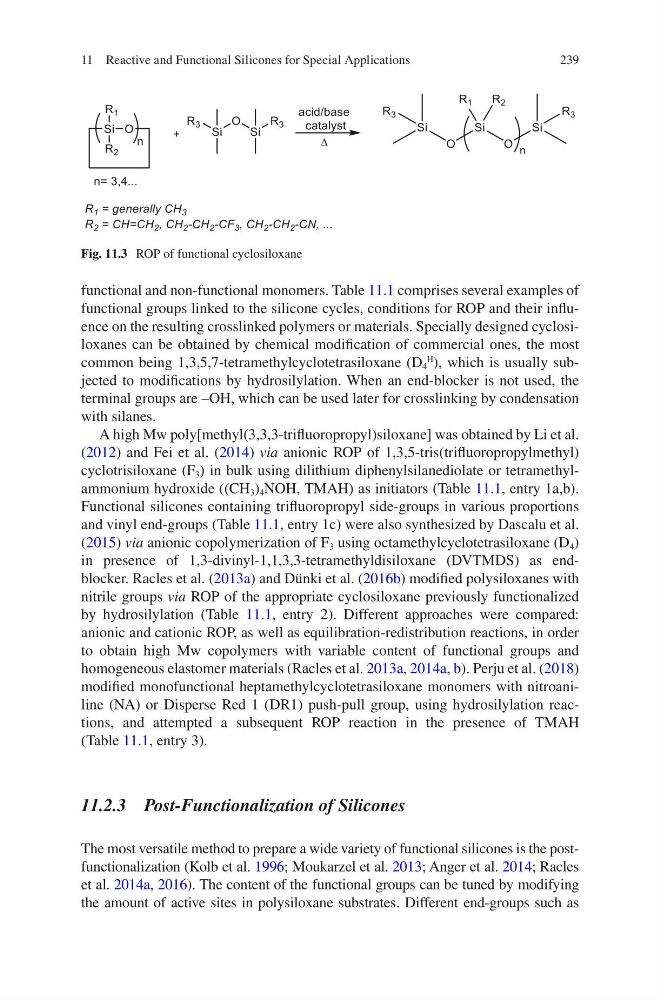
functional and non-functional monomers. Table 11.1 comprises several examples of
functional groups linked to the silicone cycles, conditions for ROP and their influence on the resulting crosslinked polymers or materials. Specially designed cyclosiloxanes can be obtained by chemical modification of commercial ones, the most
common being 1,3,5,7-tetramethylcyclotetrasiloxane (D 4
H
), which is usually subjected to modifications by hydrosilylation. When an end-blocker is not used, the
terminal groups are –OH, which can be used later for crosslinking by condensation
with silanes.
A high Mw poly[methyl(3,3,3-trifluoropropyl)siloxane] was obtained by Li et al.
(2012) and Fei et al. (2014) via anionic ROP of 1,3,5-tris(trifluoropropylmethyl)
cyclotrisiloxane (F 3 ) in bulk using dilithium diphenylsilanediolate or tetramethylammonium hydroxide ((CH 3 ) 4 NOH, TMAH) as initiators (Table 11.1, entry 1a,b).
Functional silicones containing trifluoropropyl side-groups in various proportions
and vinyl end-groups (Table 11.1, entry 1c) were also synthesized by Dascalu et al.
(2015) via anionic copolymerization of F 3 using octamethylcyclotetrasiloxane (D 4 )
in presence of 1,3-divinyl-1,1,3,3-tetramethyldisiloxane (DVTMDS) as endblocker. Racles et al. (2013a) and Dünki et al. (2016b) modified polysiloxanes with
nitrile groups via ROP of the appropriate cyclosiloxane previously functionalized
by hydrosilylation (Table 11.1, entry 2). Different approaches were compared:
anionic and cationic ROP, as well as equilibration-redistribution reactions, in order
to obtain high Mw copolymers with variable content of functional groups and
homogeneous elastomer materials (Racles et al. 2013a, 2014a, b). Perju et al. (2018)
modified monofunctional heptamethylcyclotetrasiloxane monomers with nitroaniline (NA) or Disperse Red 1 (DR1) push-pull group, using hydrosilylation reactions, and attempted a subsequent ROP reaction in the presence of TMAH
(Table 11.1, entry 3).
11.2.3 Post-Functionalization of Silicones
The most versatile method to prepare a wide variety of functional silicones is the postfunctionalization (Kolb et al. 1996; Moukarzel et al. 2013; Anger et al. 2014; Racles
et al. 2014a, 2016). The content of the functional groups can be tuned by modifying
the amount of active sites in polysiloxane substrates. Different end- groups such as
Fig. 11.3 ROP of functional cyclosiloxane
11 Reactive and Functional Silicones for Special Applications
functional and non-functional monomers. Table 11.1 comprises several examples of
functional groups linked to the silicone cycles, conditions for ROP and their influence on the resulting crosslinked polymers or materials. Specially designed cyclosiloxanes can be obtained by chemical modification of commercial ones, the most
common being 1,3,5,7-tetramethylcyclotetrasiloxane (D 4
H
), which is usually subjected to modifications by hydrosilylation. When an end-blocker is not used, the
terminal groups are –OH, which can be used later for crosslinking by condensation
with silanes.
A high Mw poly[methyl(3,3,3-trifluoropropyl)siloxane] was obtained by Li et al.
(2012) and Fei et al. (2014) via anionic ROP of 1,3,5-tris(trifluoropropylmethyl)
cyclotrisiloxane (F 3 ) in bulk using dilithium diphenylsilanediolate or tetramethylammonium hydroxide ((CH 3 ) 4 NOH, TMAH) as initiators (Table 11.1, entry 1a,b).
Functional silicones containing trifluoropropyl side-groups in various proportions
and vinyl end-groups (Table 11.1, entry 1c) were also synthesized by Dascalu et al.
(2015) via anionic copolymerization of F 3 using octamethylcyclotetrasiloxane (D 4 )
in presence of 1,3-divinyl-1,1,3,3-tetramethyldisiloxane (DVTMDS) as endblocker. Racles et al. (2013a) and Dünki et al. (2016b) modified polysiloxanes with
nitrile groups via ROP of the appropriate cyclosiloxane previously functionalized
by hydrosilylation (Table 11.1, entry 2). Different approaches were compared:
anionic and cationic ROP, as well as equilibration-redistribution reactions, in order
to obtain high Mw copolymers with variable content of functional groups and
homogeneous elastomer materials (Racles et al. 2013a, 2014a, b). Perju et al. (2018)
modified monofunctional heptamethylcyclotetrasiloxane monomers with nitroaniline (NA) or Disperse Red 1 (DR1) push-pull group, using hydrosilylation reactions, and attempted a subsequent ROP reaction in the presence of TMAH
(Table 11.1, entry 3).
11.2.3 Post-Functionalization of Silicones
The most versatile method to prepare a wide variety of functional silicones is the postfunctionalization (Kolb et al. 1996; Moukarzel et al. 2013; Anger et al. 2014; Racles
et al. 2014a, 2016). The content of the functional groups can be tuned by modifying
the amount of active sites in polysiloxane substrates. Different end- groups such as
Fig. 11.3 ROP of functional cyclosiloxane
11 Reactive and Functional Silicones for Special Applications