

238
2013; Kupareva et al. 2013; Chen et al. 2014; Hanamura and Nemoto 2014;
Hanamura et al. 2014; Kaneko et al. 2014; Lee et al. 2014; Liu et al. 2014; Tokunaga
et al. 2015; Kowalewska and Nowacka 2015). It has been established from the literature that: (i) acid catalysts are appropriate for the condensation of silanols with
electron-donating groups, while the basic catalysts for the condensation of silanols
with electron-withdrawing groups (Williams et al. 1976), (ii) the highly diluted
solution favors formation of cyclic oligosiloxanes, (iii) the microstructure of the
co- condensing products of the differently substituted silanes is difficult to control.
However, polycondensation is an important method for the synthesis of high molecular weight (Mw) siloxane homopolymers and block-copolymers from preformed
siloxane oligomers properly end-functionalized with hydroxyl, halogen or alkoxy
groups. This reaction is also important in the synthesis of modified siloxane polymers when organic sequences are inserted into the polymer chain (Noll 1968;
Dvornic and Lenz 1990). An example illustrating this reaction pathway is found in
Stepp et al. (2015) who obtained copolymers with chloromethyl side- and vinyl
end-groups by polycondensation of dichloro(chloromethyl)methylsilane and
dimethyldichlorosilane, using vinyldimethylchlorosilane as end-blocker.
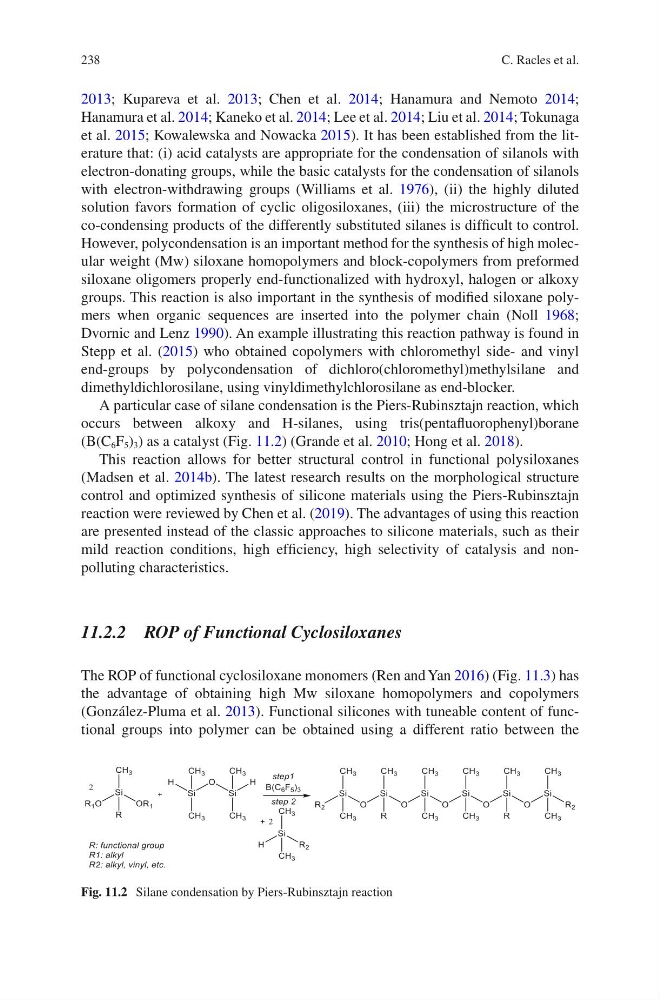
A particular case of silane condensation is the Piers-Rubinsztajn reaction, which
occurs between alkoxy and H-silanes, using tris(pentafluorophenyl)borane
(B(C 6 F 5 ) 3 ) as a catalyst (Fig. 11.2) (Grande et al. 2010; Hong et al. 2018).
This reaction allows for better structural control in functional polysiloxanes
(Madsen et al. 2014b). The latest research results on the morphological structure
control and optimized synthesis of silicone materials using the Piers-Rubinsztajn
reaction were reviewed by Chen et al. (2019). The advantages of using this reaction
are presented instead of the classic approaches to silicone materials, such as their
mild reaction conditions, high efficiency, high selectivity of catalysis and nonpolluting characteristics.
11.2.2 ROP of Functional Cyclosiloxanes
The ROP of functional cyclosiloxane monomers (Ren and Yan 2016) (Fig. 11.3) has
the advantage of obtaining high Mw siloxane homopolymers and copolymers
(González-Pluma et al. 2013). Functional silicones with tuneable content of functional groups into polymer can be obtained using a different ratio between the
Fig. 11.2 Silane condensation by Piers-Rubinsztajn reaction
C. Racles et al.
2013; Kupareva et al. 2013; Chen et al. 2014; Hanamura and Nemoto 2014;
Hanamura et al. 2014; Kaneko et al. 2014; Lee et al. 2014; Liu et al. 2014; Tokunaga
et al. 2015; Kowalewska and Nowacka 2015). It has been established from the literature that: (i) acid catalysts are appropriate for the condensation of silanols with
electron-donating groups, while the basic catalysts for the condensation of silanols
with electron-withdrawing groups (Williams et al. 1976), (ii) the highly diluted
solution favors formation of cyclic oligosiloxanes, (iii) the microstructure of the
co- condensing products of the differently substituted silanes is difficult to control.
However, polycondensation is an important method for the synthesis of high molecular weight (Mw) siloxane homopolymers and block-copolymers from preformed
siloxane oligomers properly end-functionalized with hydroxyl, halogen or alkoxy
groups. This reaction is also important in the synthesis of modified siloxane polymers when organic sequences are inserted into the polymer chain (Noll 1968;
Dvornic and Lenz 1990). An example illustrating this reaction pathway is found in
Stepp et al. (2015) who obtained copolymers with chloromethyl side- and vinyl
end-groups by polycondensation of dichloro(chloromethyl)methylsilane and
dimethyldichlorosilane, using vinyldimethylchlorosilane as end-blocker.
A particular case of silane condensation is the Piers-Rubinsztajn reaction, which
occurs between alkoxy and H-silanes, using tris(pentafluorophenyl)borane
(B(C 6 F 5 ) 3 ) as a catalyst (Fig. 11.2) (Grande et al. 2010; Hong et al. 2018).
This reaction allows for better structural control in functional polysiloxanes
(Madsen et al. 2014b). The latest research results on the morphological structure
control and optimized synthesis of silicone materials using the Piers-Rubinsztajn
reaction were reviewed by Chen et al. (2019). The advantages of using this reaction
are presented instead of the classic approaches to silicone materials, such as their
mild reaction conditions, high efficiency, high selectivity of catalysis and nonpolluting characteristics.
11.2.2 ROP of Functional Cyclosiloxanes
The ROP of functional cyclosiloxane monomers (Ren and Yan 2016) (Fig. 11.3) has
the advantage of obtaining high Mw siloxane homopolymers and copolymers
(González-Pluma et al. 2013). Functional silicones with tuneable content of functional groups into polymer can be obtained using a different ratio between the
Fig. 11.2 Silane condensation by Piers-Rubinsztajn reaction
C. Racles et al.