

237
oligomeric polyhedral silsequioxanes or functional silica are materials with a
diverse architecture (1D, 2D, 3D) which can be considered as functional silicones.
Such materials are commercially available, but their diversity is innumerable and
almost any organic group can be attached to a polysiloxane chain.
The best-known applications of functional silicones are summarized here, beginning with a brief description of their synthetic methods and focusing on selected
examples in the field of biomedical materials, electromechanical transducers,
ligands, liquid crystals (LCs) and surfactants. Other applications in catalysis and
material science are also briefly summarized. Functional silicone resins are not discussed, as these have been recently reviewed by Robeyns et al. (2018).
11.2 Synthesis of Functional Silicones: Classic
and Modern Approaches
There are different approaches that can be followed in order to chemically modify
polysiloxanes, thus obtaining materials with the desired properties. The most commonly used methods are described, focusing on: condensation of functional silanes,
ring opening polymerization (ROP) of functional cyclosiloxanes and postpolymerization chemical modification of polysiloxanes containing reactive groups.
11.2.1 Synthesis of Functional Polysiloxanes
From Silane Monomers
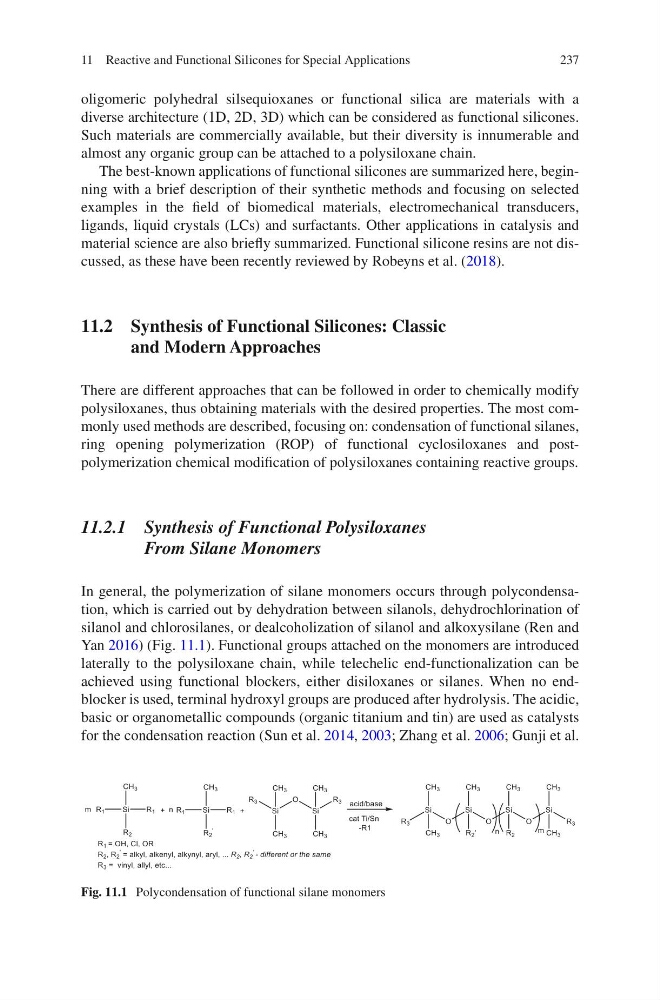
In general, the polymerization of silane monomers occurs through polycondensation, which is carried out by dehydration between silanols, dehydrochlorination of
silanol and chlorosilanes, or dealcoholization of silanol and alkoxysilane (Ren and
Yan 2016) (Fig. 11.1). Functional groups attached on the monomers are introduced
laterally to the polysiloxane chain, while telechelic end-functionalization can be
achieved using functional blockers, either disiloxanes or silanes. When no endblocker is used, terminal hydroxyl groups are produced after hydrolysis. The acidic,
basic or organometallic compounds (organic titanium and tin) are used as catalysts
for the condensation reaction (Sun et al. 2014, 2003; Zhang et al. 2006; Gunji et al.
Fig. 11.1 Polycondensation of functional silane monomers
11 Reactive and Functional Silicones for Special Applications
oligomeric polyhedral silsequioxanes or functional silica are materials with a
diverse architecture (1D, 2D, 3D) which can be considered as functional silicones.
Such materials are commercially available, but their diversity is innumerable and
almost any organic group can be attached to a polysiloxane chain.
The best-known applications of functional silicones are summarized here, beginning with a brief description of their synthetic methods and focusing on selected
examples in the field of biomedical materials, electromechanical transducers,
ligands, liquid crystals (LCs) and surfactants. Other applications in catalysis and
material science are also briefly summarized. Functional silicone resins are not discussed, as these have been recently reviewed by Robeyns et al. (2018).
11.2 Synthesis of Functional Silicones: Classic
and Modern Approaches
There are different approaches that can be followed in order to chemically modify
polysiloxanes, thus obtaining materials with the desired properties. The most commonly used methods are described, focusing on: condensation of functional silanes,
ring opening polymerization (ROP) of functional cyclosiloxanes and postpolymerization chemical modification of polysiloxanes containing reactive groups.
11.2.1 Synthesis of Functional Polysiloxanes
From Silane Monomers
In general, the polymerization of silane monomers occurs through polycondensation, which is carried out by dehydration between silanols, dehydrochlorination of
silanol and chlorosilanes, or dealcoholization of silanol and alkoxysilane (Ren and
Yan 2016) (Fig. 11.1). Functional groups attached on the monomers are introduced
laterally to the polysiloxane chain, while telechelic end-functionalization can be
achieved using functional blockers, either disiloxanes or silanes. When no endblocker is used, terminal hydroxyl groups are produced after hydrolysis. The acidic,
basic or organometallic compounds (organic titanium and tin) are used as catalysts
for the condensation reaction (Sun et al. 2014, 2003; Zhang et al. 2006; Gunji et al.
Fig. 11.1 Polycondensation of functional silane monomers
11 Reactive and Functional Silicones for Special Applications