

243
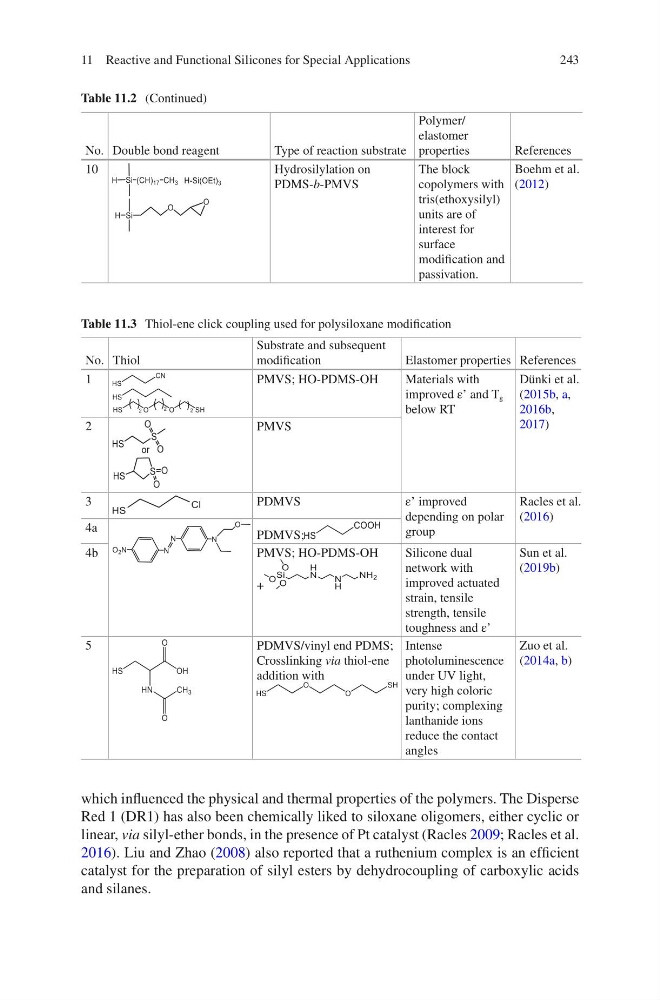
Table 11.3 Thiol-ene click coupling used for polysiloxane modification
No. Thiol
Substrate and subsequent
modification
Elastomer properties References
1
PMVS; HO-PDMS-OH
Materials with
improved ε’ and T g
below RT
Dünki et al.
(2015b, a,
2016b,
2017)
2
PMVS
3
PDMVS
ε’ improved
depending on polar
group
Racles et al.
(2016)
4a
PDMVS;
4b
PMVS; HO-PDMS-OH
+
Silicone dual
network with
improved actuated
strain, tensile
strength, tensile
toughness and ε’
Sun et al.
(2019b)
5
PDMVS/vinyl end PDMS;
Crosslinking via thiol-ene
addition with
Intense
photoluminescence
under UV light,
very high coloric
purity; complexing
lanthanide ions
reduce the contact
angles
Zuo et al.
(2014a, b)
No. Double bond reagent
Type of reaction substrate
Polymer/
elastomer
properties
References
10
Hydrosilylation on
PDMS-b-PMVS
The block
copolymers with
tris(ethoxysilyl)
units are of
interest for
surface
modification and
passivation.
Boehm et al.
(2012)
Table 11.2 (Continued)
which influenced the physical and thermal properties of the polymers. The Disperse
Red 1 (DR1) has also been chemically liked to siloxane oligomers, either cyclic or
linear, via silyl-ether bonds, in the presence of Pt catalyst (Racles 2009; Racles et al.
2016). Liu and Zhao (2008) also reported that a ruthenium complex is an efficient
catalyst for the preparation of silyl esters by dehydrocoupling of carboxylic acids
and silanes.
11 Reactive and Functional Silicones for Special Applications
Table 11.3 Thiol-ene click coupling used for polysiloxane modification
No. Thiol
Substrate and subsequent
modification
Elastomer properties References
1
PMVS; HO-PDMS-OH
Materials with
improved ε’ and T g
below RT
Dünki et al.
(2015b, a,
2016b,
2017)
2
PMVS
3
PDMVS
ε’ improved
depending on polar
group
Racles et al.
(2016)
4a
PDMVS;
4b
PMVS; HO-PDMS-OH
+
Silicone dual
network with
improved actuated
strain, tensile
strength, tensile
toughness and ε’
Sun et al.
(2019b)
5
PDMVS/vinyl end PDMS;
Crosslinking via thiol-ene
addition with
Intense
photoluminescence
under UV light,
very high coloric
purity; complexing
lanthanide ions
reduce the contact
angles
Zuo et al.
(2014a, b)
No. Double bond reagent
Type of reaction substrate
Polymer/
elastomer
properties
References
10
Hydrosilylation on
PDMS-b-PMVS
The block
copolymers with
tris(ethoxysilyl)
units are of
interest for
surface
modification and
passivation.
Boehm et al.
(2012)
Table 11.2 (Continued)
which influenced the physical and thermal properties of the polymers. The Disperse
Red 1 (DR1) has also been chemically liked to siloxane oligomers, either cyclic or
linear, via silyl-ether bonds, in the presence of Pt catalyst (Racles 2009; Racles et al.
2016). Liu and Zhao (2008) also reported that a ruthenium complex is an efficient
catalyst for the preparation of silyl esters by dehydrocoupling of carboxylic acids
and silanes.
11 Reactive and Functional Silicones for Special Applications