

219
hydrocarbons, as well as they have very low vapor pressures (Barca et al. 2014). The
low surface tension of silicone fluids gives them unique surface properties. They
also have antifoaming properties and have been used to suppress the foaming of
detergents in wastewater disposal plants. The low enthalpy of vaporization becomes
more attractive for personal care products, such as perspirants and skin care lotions
(Barca et al. 2014). Most fluids are low Mws containing polysiloxanes mixed with
higher Mw. Some cyclic silicones are formed during the preparation of the linear
polysiloxanes.
(ii) Silicone gels are the PDMS chain and some cross-links are also present in the
chain to give an open 3D network. After performing the crosslinking in silicone
fluid, it is poured together with a reactive group into a mold and heated in the presence of a small amount of catalyst to form crosslinking between the polymer chains.
This is a very effective technique for protecting sensitive electronic equipment from
vibrational damage and the polymer also acts as an electrical insulator. Silicone gels
are also used as shock absorbers in shoes, particularly in high-performance trainers
and running shoes (Puri and Talwar 2009).
(iii) Silicone elastomers are easily transformed into a 3D network and an elastomer via crosslinking reaction which allows the formation of chemical bonds between
adjacent chains (Shit and Shah 2013). The structure is somewhat similar to natural
rubber and they behave like elastomers. Its structure is determined by the amount of
crosslinking and the length of the chains. The efficient crosslinking in the presence
of radical initiator is achieved when there are some vinyl groups in the polymer
chains (Baquey et al. 2005). Although its strength is lower than that of natural rubber at ordinary and high temperatures (200–600 K), and silicone rubbers are more
stable than natural rubbers (Wu and Zhang 2019). They are generally more resistant
to chemical attack. Silica is added as a filler (unit 53) to make the elastomer stronger
mechanically and chemically (Pavlov and Khalatur 2016).
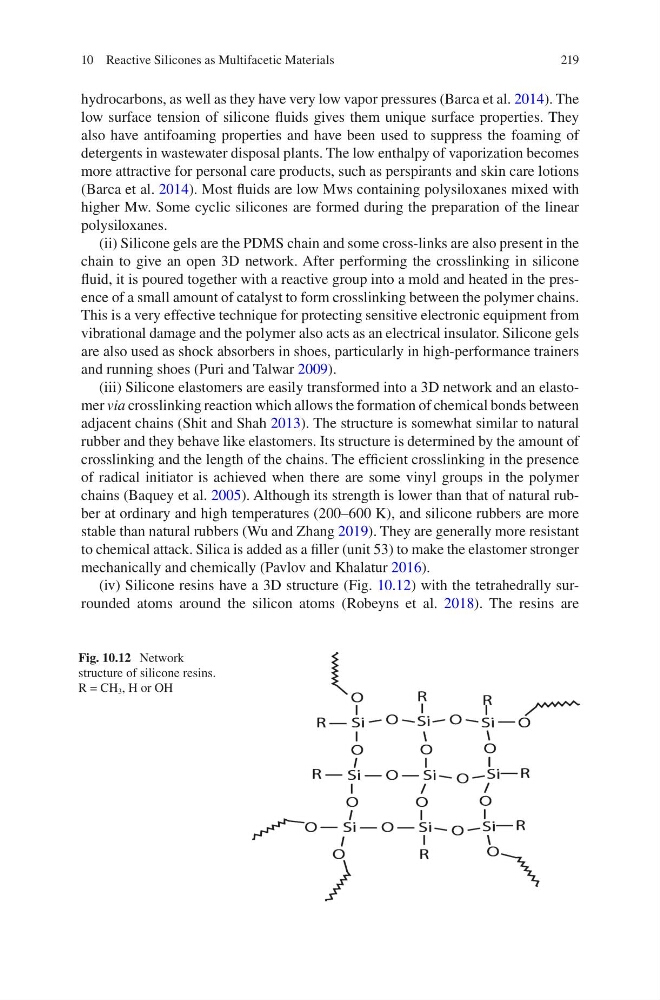
(iv) Silicone resins have a 3D structure (Fig. 10.12) with the tetrahedrally surrounded atoms around the silicon atoms (Robeyns et al. 2018). The resins are
Fig. 10.12 Network
structure of silicone resins.
R = CH 3 , H or OH
10 Reactive Silicones as Multifacetic Materials
hydrocarbons, as well as they have very low vapor pressures (Barca et al. 2014). The
low surface tension of silicone fluids gives them unique surface properties. They
also have antifoaming properties and have been used to suppress the foaming of
detergents in wastewater disposal plants. The low enthalpy of vaporization becomes
more attractive for personal care products, such as perspirants and skin care lotions
(Barca et al. 2014). Most fluids are low Mws containing polysiloxanes mixed with
higher Mw. Some cyclic silicones are formed during the preparation of the linear
polysiloxanes.
(ii) Silicone gels are the PDMS chain and some cross-links are also present in the
chain to give an open 3D network. After performing the crosslinking in silicone
fluid, it is poured together with a reactive group into a mold and heated in the presence of a small amount of catalyst to form crosslinking between the polymer chains.
This is a very effective technique for protecting sensitive electronic equipment from
vibrational damage and the polymer also acts as an electrical insulator. Silicone gels
are also used as shock absorbers in shoes, particularly in high-performance trainers
and running shoes (Puri and Talwar 2009).
(iii) Silicone elastomers are easily transformed into a 3D network and an elastomer via crosslinking reaction which allows the formation of chemical bonds between
adjacent chains (Shit and Shah 2013). The structure is somewhat similar to natural
rubber and they behave like elastomers. Its structure is determined by the amount of
crosslinking and the length of the chains. The efficient crosslinking in the presence
of radical initiator is achieved when there are some vinyl groups in the polymer
chains (Baquey et al. 2005). Although its strength is lower than that of natural rubber at ordinary and high temperatures (200–600 K), and silicone rubbers are more
stable than natural rubbers (Wu and Zhang 2019). They are generally more resistant
to chemical attack. Silica is added as a filler (unit 53) to make the elastomer stronger
mechanically and chemically (Pavlov and Khalatur 2016).
(iv) Silicone resins have a 3D structure (Fig. 10.12) with the tetrahedrally surrounded atoms around the silicon atoms (Robeyns et al. 2018). The resins are
Fig. 10.12 Network
structure of silicone resins.
R = CH 3 , H or OH
10 Reactive Silicones as Multifacetic Materials