

218
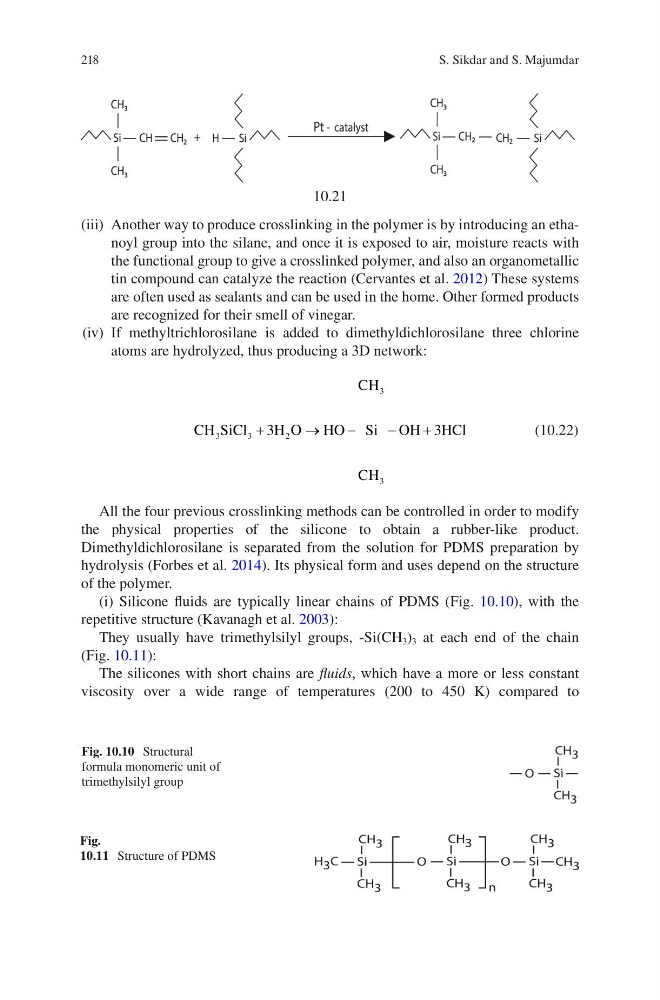
10.21
(iii) Another way to produce crosslinking in the polymer is by introducing an ethanoyl group into the silane, and once it is exposed to air, moisture reacts with
the functional group to give a crosslinked polymer, and also an organometallic
tin compound can catalyze the reaction (Cervantes et al. 2012) These systems
are often used as sealants and can be used in the home. Other formed products
are recognized for their smell of vinegar.
(iv) If methyltrichlorosilane is added to dimethyldichlorosilane three chlorine
atoms are hydrolyzed, thus producing a 3D network:
CH SiCl
H O HO
CH
Si
CH
OH HCl
3
3
2
3
3
3
3
+
→
−
−
+
(10.22)
All the four previous crosslinking methods can be controlled in order to modify
the physical properties of the silicone to obtain a rubber-like product.
Dimethyldichlorosilane is separated from the solution for PDMS preparation by
hydrolysis (Forbes et al. 2014). Its physical form and uses depend on the structure
of the polymer.
(i) Silicone fluids are typically linear chains of PDMS (Fig. 10.10), with the
repetitive structure (Kavanagh et al. 2003):
They usually have trimethylsilyl groups, -Si(CH 3 ) 3 at each end of the chain
(Fig. 10.11):
The silicones with short chains are fluids, which have a more or less constant
viscosity over a wide range of temperatures (200 to 450 K) compared to
Fig.
10.11 Structure of PDMS
Fig. 10.10 Structural
formula monomeric unit of
trimethylsilyl group
S. Sikdar and S. Majumdar
10.21
(iii) Another way to produce crosslinking in the polymer is by introducing an ethanoyl group into the silane, and once it is exposed to air, moisture reacts with
the functional group to give a crosslinked polymer, and also an organometallic
tin compound can catalyze the reaction (Cervantes et al. 2012) These systems
are often used as sealants and can be used in the home. Other formed products
are recognized for their smell of vinegar.
(iv) If methyltrichlorosilane is added to dimethyldichlorosilane three chlorine
atoms are hydrolyzed, thus producing a 3D network:
CH SiCl
H O HO
CH
Si
CH
OH HCl
3
3
2
3
3
3
3
+
→
−
−
+
(10.22)
All the four previous crosslinking methods can be controlled in order to modify
the physical properties of the silicone to obtain a rubber-like product.
Dimethyldichlorosilane is separated from the solution for PDMS preparation by
hydrolysis (Forbes et al. 2014). Its physical form and uses depend on the structure
of the polymer.
(i) Silicone fluids are typically linear chains of PDMS (Fig. 10.10), with the
repetitive structure (Kavanagh et al. 2003):
They usually have trimethylsilyl groups, -Si(CH 3 ) 3 at each end of the chain
(Fig. 10.11):
The silicones with short chains are fluids, which have a more or less constant
viscosity over a wide range of temperatures (200 to 450 K) compared to
Fig.
10.11 Structure of PDMS
Fig. 10.10 Structural
formula monomeric unit of
trimethylsilyl group
S. Sikdar and S. Majumdar