

217
A long-distributed chain is favored when working under vacuum or at elevated
temperatures to reduce the wastewater concentration (Maguire and Fulweiler 2017).
Acid catalysts are more efficient when organosilanol carries electron-donating
groups (EDG), base catalysts are efficient when it carries electron-withdrawing
groups (EWG). This will be important when a mixture of linear oligomers such as
dimethyl and methylphenyl-polysiloxanes are condensed (Eq.(10.18) (McCoy
et al. 2017).
Me SiOSiMe x Me SiO
Me SiO MeHSiO SiMe
cyclic Me SiO M
3
3
2
4
3
3
3
+ (
) +
(
)
→
+
y
e e SiO MeHSiO SiMe
z
w
2
3
(
) (
)
(10.18)
Apart from the above polymer (all methyl), a reactive polymer can also be prepared and obtained from polydimethyl- methylhydrogenosiloxane (MD Z DH W M).
This polymer can be further functionalized through addition reaction as follows:
Me SiO Me SiO MeHSiO SiMe H C CHR
Me SiO Me SiO Me CH
z
w
z
3
2
3
2
3
2
2
(
) (
)
+
=
→
(
)
C CH R SiO SiMe
w
2
3
(
)
(
)
(10.19)
where R = alkyl, polyglycol.
The above is all linear and made up of difunctional units instead of cyclics one.
When methyltrichlorosilane is hydrolyzed in the presence of trimethylchlorosilane
it leads to the formation of (Me 3 SiO 1/2 ) x (MeSiO 3/2 ) y or M x T y (Colas 1990) . Its physical form and uses depend on the structure of the polymer. To form silicone elastomers, gels and resins, the long siloxane chains are induced the crosslinking the
polymer (Gunatillake and Adhikari 2016). There are four ways to crosslink the
polymers:
(i) Crosslinking can be carried out by the functional group present in the silanes
that reacts most. For example, a vinyl group such as vinylmethyldichlorosilane
into silanes added to dimethyldichlorosilane induces crosslinking (De Cooke
and De Bruyn 1975). However, the vinyl groups into a chain can also undergo a
radical initiation reaction similar to the free radical polymerization reaction of
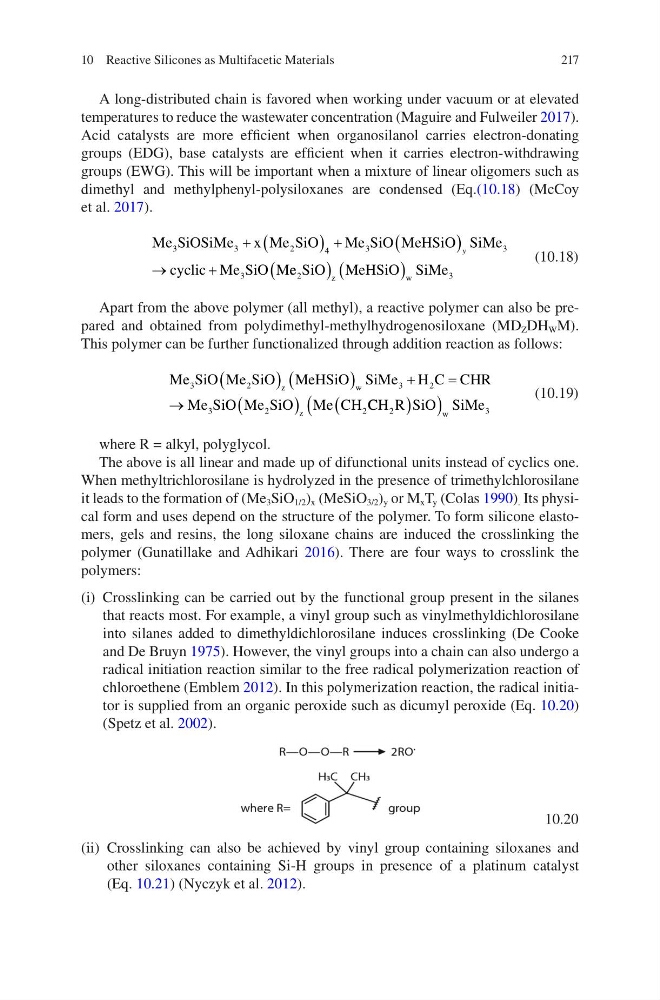
chloroethene (Emblem 2012). In this polymerization reaction, the radical initiator is supplied from an organic peroxide such as dicumyl peroxide (Eq. 10.20)
(Spetz et al. 2002).
10.20
(ii) Crosslinking can also be achieved by vinyl group containing siloxanes and
other siloxanes containing Si-H groups in presence of a platinum catalyst
(Eq. 10.21) (Nyczyk et al. 2012).
10 Reactive Silicones as Multifacetic Materials
A long-distributed chain is favored when working under vacuum or at elevated
temperatures to reduce the wastewater concentration (Maguire and Fulweiler 2017).
Acid catalysts are more efficient when organosilanol carries electron-donating
groups (EDG), base catalysts are efficient when it carries electron-withdrawing
groups (EWG). This will be important when a mixture of linear oligomers such as
dimethyl and methylphenyl-polysiloxanes are condensed (Eq.(10.18) (McCoy
et al. 2017).
Me SiOSiMe x Me SiO
Me SiO MeHSiO SiMe
cyclic Me SiO M
3
3
2
4
3
3
3
+ (
) +
(
)
→
+
y
e e SiO MeHSiO SiMe
z
w
2
3
(
) (
)
(10.18)
Apart from the above polymer (all methyl), a reactive polymer can also be prepared and obtained from polydimethyl- methylhydrogenosiloxane (MD Z DH W M).
This polymer can be further functionalized through addition reaction as follows:
Me SiO Me SiO MeHSiO SiMe H C CHR
Me SiO Me SiO Me CH
z
w
z
3
2
3
2
3
2
2
(
) (
)
+
=
→
(
)
C CH R SiO SiMe
w
2
3
(
)
(
)
(10.19)
where R = alkyl, polyglycol.
The above is all linear and made up of difunctional units instead of cyclics one.
When methyltrichlorosilane is hydrolyzed in the presence of trimethylchlorosilane
it leads to the formation of (Me 3 SiO 1/2 ) x (MeSiO 3/2 ) y or M x T y (Colas 1990) . Its physical form and uses depend on the structure of the polymer. To form silicone elastomers, gels and resins, the long siloxane chains are induced the crosslinking the
polymer (Gunatillake and Adhikari 2016). There are four ways to crosslink the
polymers:
(i) Crosslinking can be carried out by the functional group present in the silanes
that reacts most. For example, a vinyl group such as vinylmethyldichlorosilane
into silanes added to dimethyldichlorosilane induces crosslinking (De Cooke
and De Bruyn 1975). However, the vinyl groups into a chain can also undergo a
radical initiation reaction similar to the free radical polymerization reaction of
chloroethene (Emblem 2012). In this polymerization reaction, the radical initiator is supplied from an organic peroxide such as dicumyl peroxide (Eq. 10.20)
(Spetz et al. 2002).
10.20
(ii) Crosslinking can also be achieved by vinyl group containing siloxanes and
other siloxanes containing Si-H groups in presence of a platinum catalyst
(Eq. 10.21) (Nyczyk et al. 2012).
10 Reactive Silicones as Multifacetic Materials