

216
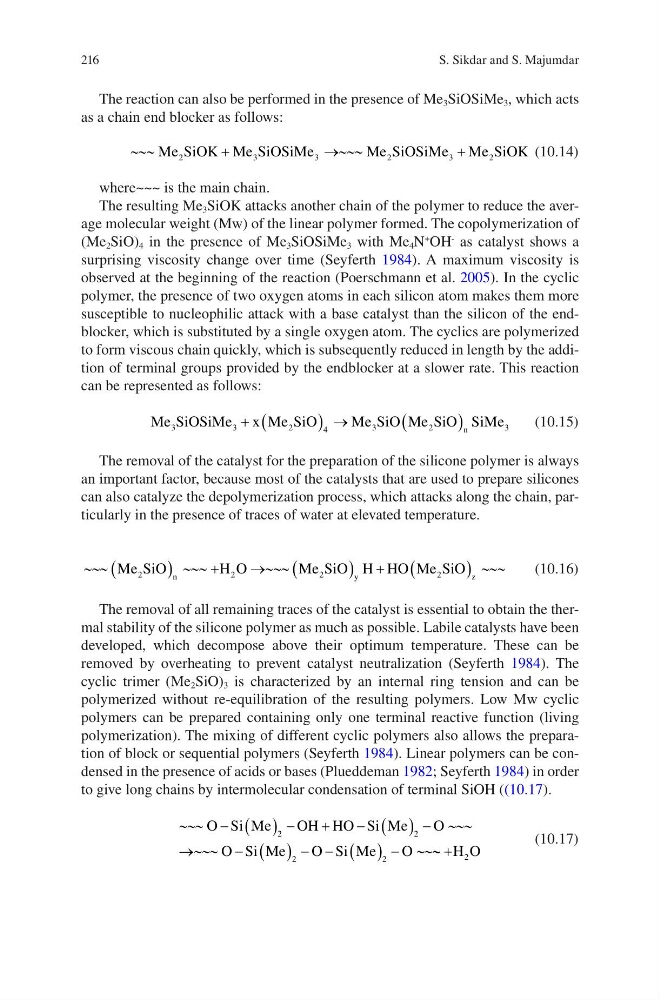
The reaction can also be performed in the presence of Me 3 SiOSiMe 3 , which acts
as a chain end blocker as follows:
∼∼∼
+
→ ∼∼∼
+
Me SiOK Me SiOSiMe
M e SiOSiMe Me SiOK
2
3
3
2
3
2
(10.14)
where~~~ is the main chain.
The resulting Me 3 SiOK attacks another chain of the polymer to reduce the average molecular weight (Mw) of the linear polymer formed. The copolymerization of
(Me 2 SiO) 4 in the presence of Me 3 SiOSiMe 3 with Me 4 N
+
OH
-
as catalyst shows a
surprising viscosity change over time (Seyferth 1984). A maximum viscosity is
observed at the beginning of the reaction (Poerschmann et al. 2005). In the cyclic
polymer, the presence of two oxygen atoms in each silicon atom makes them more
susceptible to nucleophilic attack with a base catalyst than the silicon of the endblocker, which is substituted by a single oxygen atom. The cyclics are polymerized
to form viscous chain quickly, which is subsequently reduced in length by the addition of terminal groups provided by the endblocker at a slower rate. This reaction
can be represented as follows:
Me SiOSiMe x Me SiO
Me SiO Me SiO SiMe
n
3
3
2
4
3
2
3
+ (
) →
(
)
(10.15)
The removal of the catalyst for the preparation of the silicone polymer is always
an important factor, because most of the catalysts that are used to prepare silicones
can also catalyze the depolymerization process, which attacks along the chain, particularly in the presence of traces of water at elevated temperature.
∼∼∼ (
) ∼∼∼ +
→∼∼∼ (
) + (
) ∼∼∼
Me SiO
HO
M e SiO H HO Me SiO
n
y
z
2
2
2
2
(10.16)
The removal of all remaining traces of the catalyst is essential to obtain the thermal stability of the silicone polymer as much as possible. Labile catalysts have been
developed, which decompose above their optimum temperature. These can be
removed by overheating to prevent catalyst neutralization (Seyferth 1984). The
cyclic trimer (Me 2 SiO) 3 is characterized by an internal ring tension and can be
polymerized without re-equilibration of the resulting polymers. Low Mw cyclic
polymers can be prepared containing only one terminal reactive function (living
polymerization). The mixing of different cyclic polymers also allows the preparation of block or sequential polymers (Seyferth 1984). Linear polymers can be condensed in the presence of acids or bases (Plueddeman 1982; Seyferth 1984) in order
to give long chains by intermolecular condensation of terminal SiOH ((10.17).
∼∼∼ − ( ) − + − ( ) − ∼∼∼
→∼∼∼ − ( ) − − ( ) − ∼∼
O Si Me
OH HO Si Me
O
O Si Me
O Si Me
O
2
2
2
2
∼ ∼ +H O
2
(10.17)
S. Sikdar and S. Majumdar
The reaction can also be performed in the presence of Me 3 SiOSiMe 3 , which acts
as a chain end blocker as follows:
∼∼∼
+
→ ∼∼∼
+
Me SiOK Me SiOSiMe
M e SiOSiMe Me SiOK
2
3
3
2
3
2
(10.14)
where~~~ is the main chain.
The resulting Me 3 SiOK attacks another chain of the polymer to reduce the average molecular weight (Mw) of the linear polymer formed. The copolymerization of
(Me 2 SiO) 4 in the presence of Me 3 SiOSiMe 3 with Me 4 N
+
OH
-
as catalyst shows a
surprising viscosity change over time (Seyferth 1984). A maximum viscosity is
observed at the beginning of the reaction (Poerschmann et al. 2005). In the cyclic
polymer, the presence of two oxygen atoms in each silicon atom makes them more
susceptible to nucleophilic attack with a base catalyst than the silicon of the endblocker, which is substituted by a single oxygen atom. The cyclics are polymerized
to form viscous chain quickly, which is subsequently reduced in length by the addition of terminal groups provided by the endblocker at a slower rate. This reaction
can be represented as follows:
Me SiOSiMe x Me SiO
Me SiO Me SiO SiMe
n
3
3
2
4
3
2
3
+ (
) →
(
)
(10.15)
The removal of the catalyst for the preparation of the silicone polymer is always
an important factor, because most of the catalysts that are used to prepare silicones
can also catalyze the depolymerization process, which attacks along the chain, particularly in the presence of traces of water at elevated temperature.
∼∼∼ (
) ∼∼∼ +
→∼∼∼ (
) + (
) ∼∼∼
Me SiO
HO
M e SiO H HO Me SiO
n
y
z
2
2
2
2
(10.16)
The removal of all remaining traces of the catalyst is essential to obtain the thermal stability of the silicone polymer as much as possible. Labile catalysts have been
developed, which decompose above their optimum temperature. These can be
removed by overheating to prevent catalyst neutralization (Seyferth 1984). The
cyclic trimer (Me 2 SiO) 3 is characterized by an internal ring tension and can be
polymerized without re-equilibration of the resulting polymers. Low Mw cyclic
polymers can be prepared containing only one terminal reactive function (living
polymerization). The mixing of different cyclic polymers also allows the preparation of block or sequential polymers (Seyferth 1984). Linear polymers can be condensed in the presence of acids or bases (Plueddeman 1982; Seyferth 1984) in order
to give long chains by intermolecular condensation of terminal SiOH ((10.17).
∼∼∼ − ( ) − + − ( ) − ∼∼∼
→∼∼∼ − ( ) − − ( ) − ∼∼
O Si Me
OH HO Si Me
O
O Si Me
O Si Me
O
2
2
2
2
∼ ∼ +H O
2
(10.17)
S. Sikdar and S. Majumdar