

215
Other chlorosilanes are prepared from an existing silane, e.g. methylvinyldichlorosilane is obtained by the addition of methyldichlorosilane in acetylene using a
platinum complex as a catalyst (Pohanish 2017).
MeHSiCl C H
Me CH CH SiCl
2
2 2
2
2
+
→
=
(
)
(10.10)
It is also possible to replace the chlorine groups by means of alcoholysis:
R SiCl ROH R SiOR HCl
3
3
+
→
+
(10.11)
In this way, several silanes with different functional groups (e.g. alkoxy and
vinyl) can be prepared (Matinlinna et al. 2004). This allows coupling reactions
between inorganic surfaces and polymers in the manufacture of composite materials
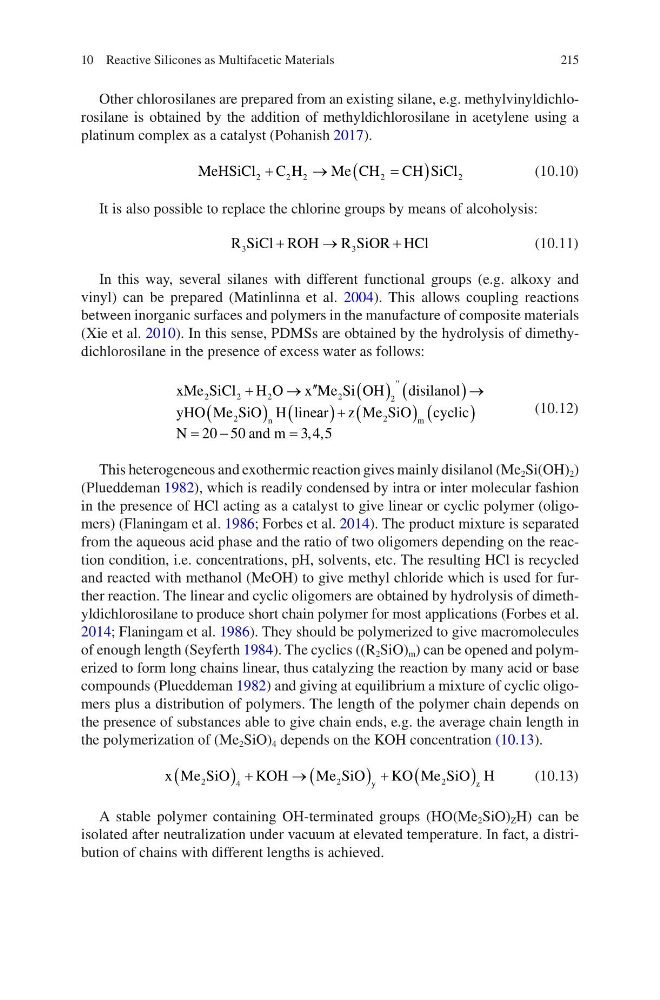
(Xie et al. 2010). In this sense, PDMSs are obtained by the hydrolysis of dimethydichlorosilane in the presence of excess water as follows:
xMe SiCl H O x Me Si OH
disilanol
yHO Me SiO H line
n
2
2
2
2
2
2
+
→
( ) (
)→
(
)
′′
′′
a ar z Me SiO cyclic
N
a nd m
m
(
)+ (
) (
)
= −
=
2
20 50
3 4 5
, ,
(10.12)
This heterogeneous and exothermic reaction gives mainly disilanol (Me 2 Si(OH) 2 )
(Plueddeman 1982), which is readily condensed by intra or inter molecular fashion
in the presence of HCl acting as a catalyst to give linear or cyclic polymer (oligomers) (Flaningam et al. 1986; Forbes et al. 2014). The product mixture is separated
from the aqueous acid phase and the ratio of two oligomers depending on the reaction condition, i.e. concentrations, pH, solvents, etc. The resulting HCl is recycled
and reacted with methanol (MeOH) to give methyl chloride which is used for further reaction. The linear and cyclic oligomers are obtained by hydrolysis of dimethyldichlorosilane to produce short chain polymer for most applications (Forbes et al.
2014; Flaningam et al. 1986). They should be polymerized to give macromolecules
of enough length (Seyferth 1984). The cyclics ((R 2 SiO) m ) can be opened and polymerized to form long chains linear, thus catalyzing the reaction by many acid or base
compounds (Plueddeman 1982) and giving at equilibrium a mixture of cyclic oligomers plus a distribution of polymers. The length of the polymer chain depends on
the presence of substances able to give chain ends, e.g. the average chain length in
the polymerization of (Me 2 SiO) 4 depends on the KOH concentration (10.13).
x Me SiO
KOH
Me SiO
KO Me SiO H
y
z
2
4
2
2
(
) +
→(
) + (
)
(10.13)
A stable polymer containing OH-terminated groups (HO(Me 2 SiO) Z H) can be
isolated after neutralization under vacuum at elevated temperature. In fact, a distribution of chains with different lengths is achieved.
10 Reactive Silicones as Multifacetic Materials
Other chlorosilanes are prepared from an existing silane, e.g. methylvinyldichlorosilane is obtained by the addition of methyldichlorosilane in acetylene using a
platinum complex as a catalyst (Pohanish 2017).
MeHSiCl C H
Me CH CH SiCl
2
2 2
2
2
+
→
=
(
)
(10.10)
It is also possible to replace the chlorine groups by means of alcoholysis:
R SiCl ROH R SiOR HCl
3
3
+
→
+
(10.11)
In this way, several silanes with different functional groups (e.g. alkoxy and
vinyl) can be prepared (Matinlinna et al. 2004). This allows coupling reactions
between inorganic surfaces and polymers in the manufacture of composite materials
(Xie et al. 2010). In this sense, PDMSs are obtained by the hydrolysis of dimethydichlorosilane in the presence of excess water as follows:
xMe SiCl H O x Me Si OH
disilanol
yHO Me SiO H line
n
2
2
2
2
2
2
+
→
( ) (
)→
(
)
′′
′′
a ar z Me SiO cyclic
N
a nd m
m
(
)+ (
) (
)
= −
=
2
20 50
3 4 5
, ,
(10.12)
This heterogeneous and exothermic reaction gives mainly disilanol (Me 2 Si(OH) 2 )
(Plueddeman 1982), which is readily condensed by intra or inter molecular fashion
in the presence of HCl acting as a catalyst to give linear or cyclic polymer (oligomers) (Flaningam et al. 1986; Forbes et al. 2014). The product mixture is separated
from the aqueous acid phase and the ratio of two oligomers depending on the reaction condition, i.e. concentrations, pH, solvents, etc. The resulting HCl is recycled
and reacted with methanol (MeOH) to give methyl chloride which is used for further reaction. The linear and cyclic oligomers are obtained by hydrolysis of dimethyldichlorosilane to produce short chain polymer for most applications (Forbes et al.
2014; Flaningam et al. 1986). They should be polymerized to give macromolecules
of enough length (Seyferth 1984). The cyclics ((R 2 SiO) m ) can be opened and polymerized to form long chains linear, thus catalyzing the reaction by many acid or base
compounds (Plueddeman 1982) and giving at equilibrium a mixture of cyclic oligomers plus a distribution of polymers. The length of the polymer chain depends on
the presence of substances able to give chain ends, e.g. the average chain length in
the polymerization of (Me 2 SiO) 4 depends on the KOH concentration (10.13).
x Me SiO
KOH
Me SiO
KO Me SiO H
y
z
2
4
2
2
(
) +
→(
) + (
)
(10.13)
A stable polymer containing OH-terminated groups (HO(Me 2 SiO) Z H) can be
isolated after neutralization under vacuum at elevated temperature. In fact, a distribution of chains with different lengths is achieved.
10 Reactive Silicones as Multifacetic Materials