

214
When R is a methyl group, it is a PDMS (McDonald and George 2002) (where
n = 20–50) which is not a useful silicones because of its small chains. Such types of
polymers are known as oligomers. In this reaction, some cyclic polymers
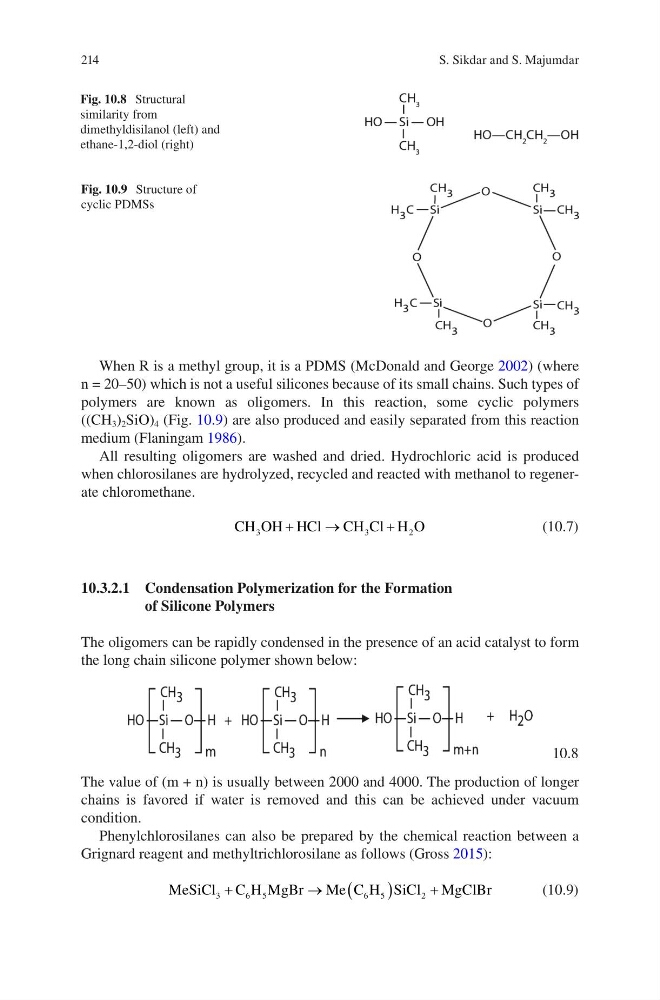
((CH 3 ) 2 SiO) 4 (Fig. 10.9) are also produced and easily separated from this reaction
medium (Flaningam 1986).
All resulting oligomers are washed and dried. Hydrochloric acid is produced
when chlorosilanes are hydrolyzed, recycled and reacted with methanol to regenerate chloromethane.
CH OH HCl CH Cl H O
3
3
2
+
→
+
(10.7)
10.3.2.1 Condensation Polymerization for the Formation
of Silicone Polymers
The oligomers can be rapidly condensed in the presence of an acid catalyst to form
the long chain silicone polymer shown below:
10.8
The value of (m + n) is usually between 2000 and 4000. The production of longer
chains is favored if water is removed and this can be achieved under vacuum
condition.
Phenylchlorosilanes can also be prepared by the chemical reaction between a
Grignard reagent and methyltrichlorosilane as follows (Gross 2015):
MeSiCl C H MgBr Me C H SiCl MgClBr
3
6 5
6 5
2
+
→
(
)
+
(10.9)
Fig. 10.8 Structural
similarity from
dimethyldisilanol (left) and
ethane-1,2-diol (right)
Fig. 10.9 Structure of
cyclic PDMSs
S. Sikdar and S. Majumdar
When R is a methyl group, it is a PDMS (McDonald and George 2002) (where
n = 20–50) which is not a useful silicones because of its small chains. Such types of
polymers are known as oligomers. In this reaction, some cyclic polymers
((CH 3 ) 2 SiO) 4 (Fig. 10.9) are also produced and easily separated from this reaction
medium (Flaningam 1986).
All resulting oligomers are washed and dried. Hydrochloric acid is produced
when chlorosilanes are hydrolyzed, recycled and reacted with methanol to regenerate chloromethane.
CH OH HCl CH Cl H O
3
3
2
+
→
+
(10.7)
10.3.2.1 Condensation Polymerization for the Formation
of Silicone Polymers
The oligomers can be rapidly condensed in the presence of an acid catalyst to form
the long chain silicone polymer shown below:
10.8
The value of (m + n) is usually between 2000 and 4000. The production of longer
chains is favored if water is removed and this can be achieved under vacuum
condition.
Phenylchlorosilanes can also be prepared by the chemical reaction between a
Grignard reagent and methyltrichlorosilane as follows (Gross 2015):
MeSiCl C H MgBr Me C H SiCl MgClBr
3
6 5
6 5
2
+
→
(
)
+
(10.9)
Fig. 10.8 Structural
similarity from
dimethyldisilanol (left) and
ethane-1,2-diol (right)
Fig. 10.9 Structure of
cyclic PDMSs
S. Sikdar and S. Majumdar