

220
usually applied as a solution in organic solvents and are used as an electrical insulating varnish or for paints where water repellence is desired to protect the masonry
(Righetti et al. 2016). The -OH groups present in resin react to the hydroxyl groups
which are present in the various inorganic surfaces, such as glass and silica gel, and
making the surface water repellent (Gurav et al. 2011). A large number of silanes,
known as coupling agents, have been developed to allow chemists to bond an inorganic substrate (such as glass, metals and minerals) to organic materials (e.g. organic
polymers, such as acrylics, polyamides, polyalkenes and urethanes) (Goyal 2006).
10.4 Uses and Benefits
Silicones impart a number of benefits to the products in which they are used, including greater flexibility and moisture, heat, cold and ultraviolet (UV) radiation resistance (Fischer et al. 2013). Silicones can be manufactured in many forms, such as
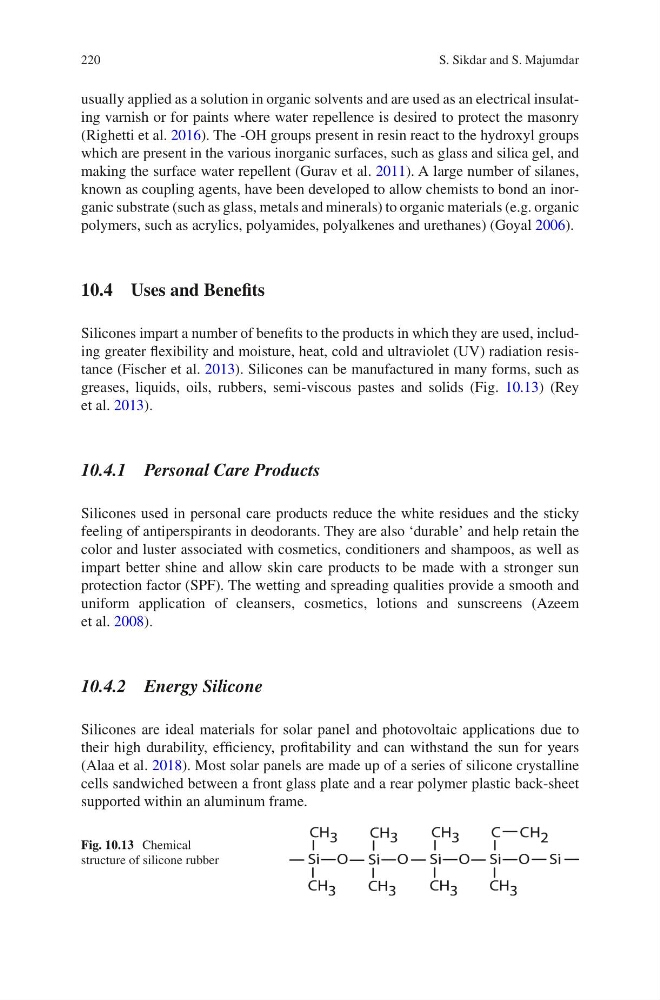
greases, liquids, oils, rubbers, semi-viscous pastes and solids (Fig. 10.13) (Rey
et al. 2013).
10.4.1 Personal Care Products
Silicones used in personal care products reduce the white residues and the sticky
feeling of antiperspirants in deodorants. They are also ‘durable’ and help retain the
color and luster associated with cosmetics, conditioners and shampoos, as well as
impart better shine and allow skin care products to be made with a stronger sun
protection factor (SPF). The wetting and spreading qualities provide a smooth and
uniform application of cleansers, cosmetics, lotions and sunscreens (Azeem
et al. 2008).
10.4.2 Energy Silicone
Silicones are ideal materials for solar panel and photovoltaic applications due to
their high durability, efficiency, profitability and can withstand the sun for years
(Alaa et al. 2018). Most solar panels are made up of a series of silicone crystalline
cells sandwiched between a front glass plate and a rear polymer plastic back-sheet
supported within an aluminum frame.
Fig. 10.13 Chemical
structure of silicone rubber
S. Sikdar and S. Majumdar
usually applied as a solution in organic solvents and are used as an electrical insulating varnish or for paints where water repellence is desired to protect the masonry
(Righetti et al. 2016). The -OH groups present in resin react to the hydroxyl groups
which are present in the various inorganic surfaces, such as glass and silica gel, and
making the surface water repellent (Gurav et al. 2011). A large number of silanes,
known as coupling agents, have been developed to allow chemists to bond an inorganic substrate (such as glass, metals and minerals) to organic materials (e.g. organic
polymers, such as acrylics, polyamides, polyalkenes and urethanes) (Goyal 2006).
10.4 Uses and Benefits
Silicones impart a number of benefits to the products in which they are used, including greater flexibility and moisture, heat, cold and ultraviolet (UV) radiation resistance (Fischer et al. 2013). Silicones can be manufactured in many forms, such as
greases, liquids, oils, rubbers, semi-viscous pastes and solids (Fig. 10.13) (Rey
et al. 2013).
10.4.1 Personal Care Products
Silicones used in personal care products reduce the white residues and the sticky
feeling of antiperspirants in deodorants. They are also ‘durable’ and help retain the
color and luster associated with cosmetics, conditioners and shampoos, as well as
impart better shine and allow skin care products to be made with a stronger sun
protection factor (SPF). The wetting and spreading qualities provide a smooth and
uniform application of cleansers, cosmetics, lotions and sunscreens (Azeem
et al. 2008).
10.4.2 Energy Silicone
Silicones are ideal materials for solar panel and photovoltaic applications due to
their high durability, efficiency, profitability and can withstand the sun for years
(Alaa et al. 2018). Most solar panels are made up of a series of silicone crystalline
cells sandwiched between a front glass plate and a rear polymer plastic back-sheet
supported within an aluminum frame.
Fig. 10.13 Chemical
structure of silicone rubber
S. Sikdar and S. Majumdar