

211
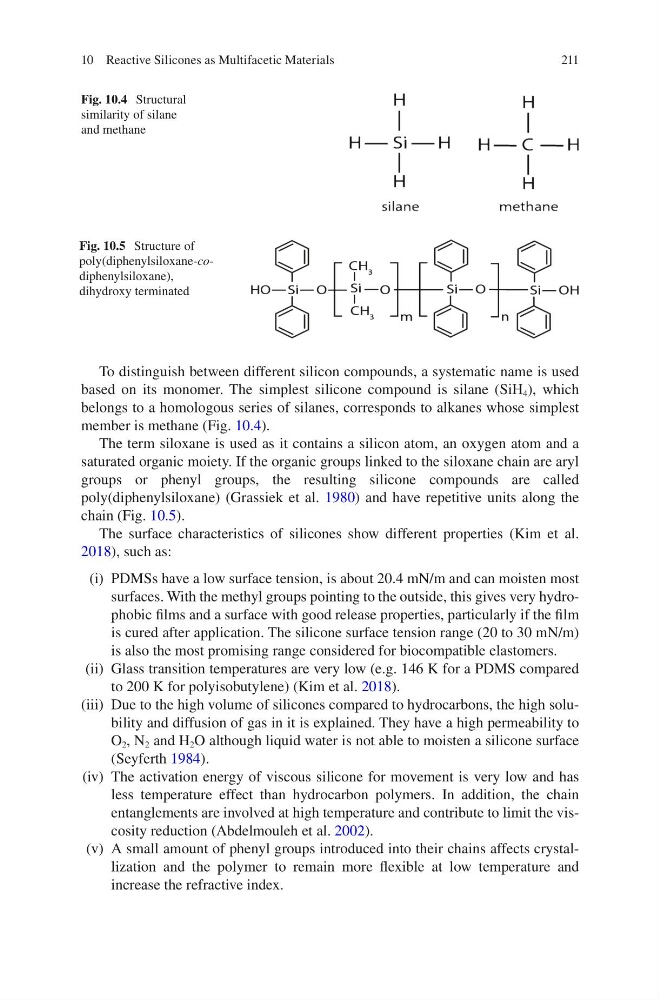
Fig. 10.5 Structure of
poly(diphenylsiloxane-codiphenylsiloxane),
dihydroxy terminated
Fig. 10.4 Structural
similarity of silane
and methane
To distinguish between different silicon compounds, a systematic name is used
based on its monomer. The simplest silicone compound is silane (SiH 4 ), which
belongs to a homologous series of silanes, corresponds to alkanes whose simplest
member is methane (Fig. 10.4).
The term siloxane is used as it contains a silicon atom, an oxygen atom and a
saturated organic moiety. If the organic groups linked to the siloxane chain are aryl
groups or phenyl groups, the resulting silicone compounds are called
poly(diphenylsiloxane) (Grassiek et al. 1980) and have repetitive units along the
chain (Fig. 10.5).
The surface characteristics of silicones show different properties (Kim et al.
2018), such as:
(i) PDMSs have a low surface tension, is about 20.4 mN/m and can moisten most
surfaces. With the methyl groups pointing to the outside, this gives very hydrophobic films and a surface with good release properties, particularly if the film
is cured after application. The silicone surface tension range (20 to 30 mN/m)
is also the most promising range considered for biocompatible elastomers.
(ii) Glass transition temperatures are very low (e.g. 146 K for a PDMS compared
to 200 K for polyisobutylene) (Kim et al. 2018).
(iii) Due to the high volume of silicones compared to hydrocarbons, the high solubility and diffusion of gas in it is explained. They have a high permeability to
O 2 , N 2 and H 2 O although liquid water is not able to moisten a silicone surface
(Seyferth 1984).
(iv) The activation energy of viscous silicone for movement is very low and has
less temperature effect than hydrocarbon polymers. In addition, the chain
entanglements are involved at high temperature and contribute to limit the viscosity reduction (Abdelmouleh et al. 2002).
(v) A small amount of phenyl groups introduced into their chains affects crystallization and the polymer to remain more flexible at low temperature and
increase the refractive index.
10 Reactive Silicones as Multifacetic Materials
Fig. 10.5 Structure of
poly(diphenylsiloxane-codiphenylsiloxane),
dihydroxy terminated
Fig. 10.4 Structural
similarity of silane
and methane
To distinguish between different silicon compounds, a systematic name is used
based on its monomer. The simplest silicone compound is silane (SiH 4 ), which
belongs to a homologous series of silanes, corresponds to alkanes whose simplest
member is methane (Fig. 10.4).
The term siloxane is used as it contains a silicon atom, an oxygen atom and a
saturated organic moiety. If the organic groups linked to the siloxane chain are aryl
groups or phenyl groups, the resulting silicone compounds are called
poly(diphenylsiloxane) (Grassiek et al. 1980) and have repetitive units along the
chain (Fig. 10.5).
The surface characteristics of silicones show different properties (Kim et al.
2018), such as:
(i) PDMSs have a low surface tension, is about 20.4 mN/m and can moisten most
surfaces. With the methyl groups pointing to the outside, this gives very hydrophobic films and a surface with good release properties, particularly if the film
is cured after application. The silicone surface tension range (20 to 30 mN/m)
is also the most promising range considered for biocompatible elastomers.
(ii) Glass transition temperatures are very low (e.g. 146 K for a PDMS compared
to 200 K for polyisobutylene) (Kim et al. 2018).
(iii) Due to the high volume of silicones compared to hydrocarbons, the high solubility and diffusion of gas in it is explained. They have a high permeability to
O 2 , N 2 and H 2 O although liquid water is not able to moisten a silicone surface
(Seyferth 1984).
(iv) The activation energy of viscous silicone for movement is very low and has
less temperature effect than hydrocarbon polymers. In addition, the chain
entanglements are involved at high temperature and contribute to limit the viscosity reduction (Abdelmouleh et al. 2002).
(v) A small amount of phenyl groups introduced into their chains affects crystallization and the polymer to remain more flexible at low temperature and
increase the refractive index.
10 Reactive Silicones as Multifacetic Materials