

210
the involvement of back bonding is questioned (Kim et al. 2018). Another example
of the difference between analogues is the tetravalent diphenyldisilanol (Gilman
and Diehl 1961), silicone compound such as (C 6 H 5 ) 2 Si(OH) 2 , which is more stable
than a gem-diol of carbon compounds (Tacke et al. 2000). The Si-H bond in silicone
compounds are weakly polarized, but the bond is more reactive than the C-H bond
in the carbon compounds. In general, there are few similarities between a silicone
polymer and a hydrocarbon polymer (Kim et al. 2018). Silicones show the unusual
combination of an inorganic chain similar to silicates and often associated with high
surface energy but with side methyl groups that are, on the contrary, very organic
and often associated with low surface energy (Kim et al. 2018). The Si-O bonds are
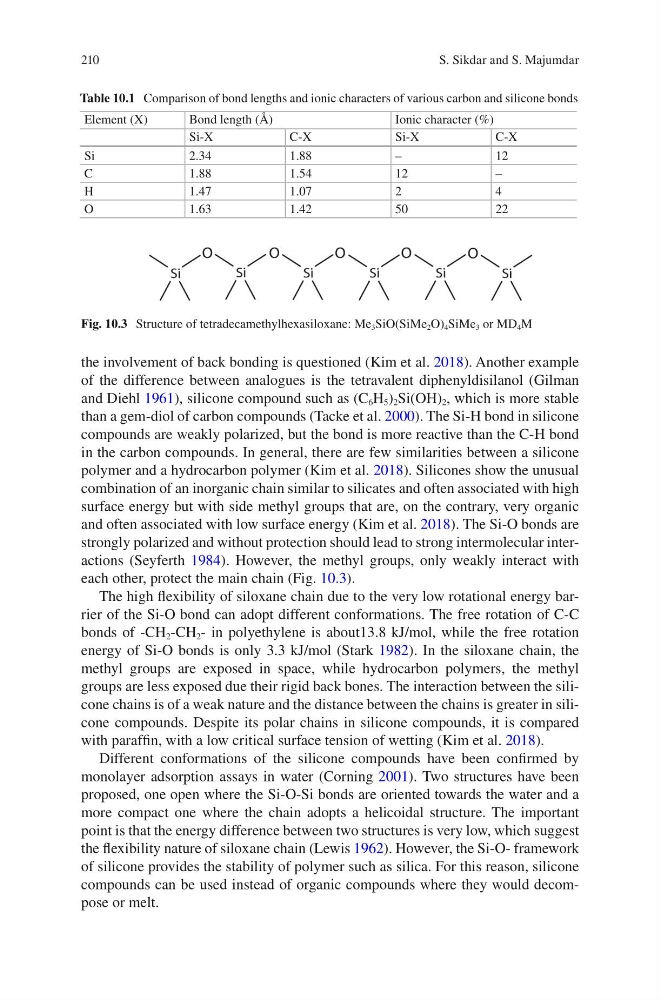
strongly polarized and without protection should lead to strong intermolecular interactions (Seyferth 1984). However, the methyl groups, only weakly interact with
each other, protect the main chain (Fig. 10.3).
The high flexibility of siloxane chain due to the very low rotational energy barrier of the Si-O bond can adopt different conformations. The free rotation of C-C
bonds of -CH 2 -CH 2 - in polyethylene is about13.8 kJ/mol, while the free rotation
energy of Si-O bonds is only 3.3 kJ/mol (Stark 1982). In the siloxane chain, the
methyl groups are exposed in space, while hydrocarbon polymers, the methyl
groups are less exposed due their rigid back bones. The interaction between the silicone chains is of a weak nature and the distance between the chains is greater in silicone compounds. Despite its polar chains in silicone compounds, it is compared
with paraffin, with a low critical surface tension of wetting (Kim et al. 2018).
Different conformations of the silicone compounds have been confirmed by
monolayer adsorption assays in water (Corning 2001). Two structures have been
proposed, one open where the Si-O-Si bonds are oriented towards the water and a
more compact one where the chain adopts a helicoidal structure. The important
point is that the energy difference between two structures is very low, which suggest
the flexibility nature of siloxane chain (Lewis 1962). However, the Si-O- framework
of silicone provides the stability of polymer such as silica. For this reason, silicone
compounds can be used instead of organic compounds where they would decompose or melt.
Table 10.1 Comparison of bond lengths and ionic characters of various carbon and silicone bonds
Element (X)
Bond length (Å)
Ionic character (%)
Si-X
C-X
Si-X
C-X
Si
2.34
1.88
–
12
C
1.88
1.54
12
–
H
1.47
1.07
2
4
O
1.63
1.42
50
22
Fig. 10.3 Structure of tetradecamethylhexasiloxane: Me 3 SiO(SiMe 2 O) 4 SiMe 3 or MD 4 M
S. Sikdar and S. Majumdar
the involvement of back bonding is questioned (Kim et al. 2018). Another example
of the difference between analogues is the tetravalent diphenyldisilanol (Gilman
and Diehl 1961), silicone compound such as (C 6 H 5 ) 2 Si(OH) 2 , which is more stable
than a gem-diol of carbon compounds (Tacke et al. 2000). The Si-H bond in silicone
compounds are weakly polarized, but the bond is more reactive than the C-H bond
in the carbon compounds. In general, there are few similarities between a silicone
polymer and a hydrocarbon polymer (Kim et al. 2018). Silicones show the unusual
combination of an inorganic chain similar to silicates and often associated with high
surface energy but with side methyl groups that are, on the contrary, very organic
and often associated with low surface energy (Kim et al. 2018). The Si-O bonds are
strongly polarized and without protection should lead to strong intermolecular interactions (Seyferth 1984). However, the methyl groups, only weakly interact with
each other, protect the main chain (Fig. 10.3).
The high flexibility of siloxane chain due to the very low rotational energy barrier of the Si-O bond can adopt different conformations. The free rotation of C-C
bonds of -CH 2 -CH 2 - in polyethylene is about13.8 kJ/mol, while the free rotation
energy of Si-O bonds is only 3.3 kJ/mol (Stark 1982). In the siloxane chain, the
methyl groups are exposed in space, while hydrocarbon polymers, the methyl
groups are less exposed due their rigid back bones. The interaction between the silicone chains is of a weak nature and the distance between the chains is greater in silicone compounds. Despite its polar chains in silicone compounds, it is compared
with paraffin, with a low critical surface tension of wetting (Kim et al. 2018).
Different conformations of the silicone compounds have been confirmed by
monolayer adsorption assays in water (Corning 2001). Two structures have been
proposed, one open where the Si-O-Si bonds are oriented towards the water and a
more compact one where the chain adopts a helicoidal structure. The important
point is that the energy difference between two structures is very low, which suggest
the flexibility nature of siloxane chain (Lewis 1962). However, the Si-O- framework
of silicone provides the stability of polymer such as silica. For this reason, silicone
compounds can be used instead of organic compounds where they would decompose or melt.
Table 10.1 Comparison of bond lengths and ionic characters of various carbon and silicone bonds
Element (X)
Bond length (Å)
Ionic character (%)
Si-X
C-X
Si-X
C-X
Si
2.34
1.88
–
12
C
1.88
1.54
12
–
H
1.47
1.07
2
4
O
1.63
1.42
50
22
Fig. 10.3 Structure of tetradecamethylhexasiloxane: Me 3 SiO(SiMe 2 O) 4 SiMe 3 or MD 4 M
S. Sikdar and S. Majumdar