

209
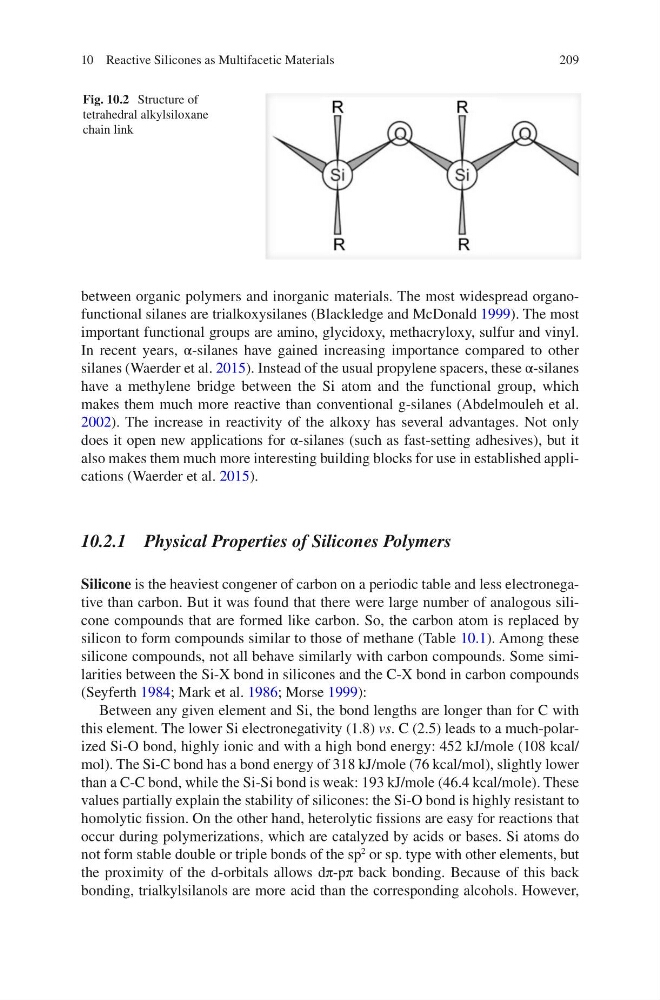
Fig. 10.2 Structure of
tetrahedral alkylsiloxane
chain link
between organic polymers and inorganic materials. The most widespread organofunctional silanes are trialkoxysilanes (Blackledge and McDonald 1999). The most
important functional groups are amino, glycidoxy, methacryloxy, sulfur and vinyl.
In recent years, α-silanes have gained increasing importance compared to other
silanes (Waerder et al. 2015). Instead of the usual propylene spacers, these α-silanes
have a methylene bridge between the Si atom and the functional group, which
makes them much more reactive than conventional g-silanes (Abdelmouleh et al.
2002). The increase in reactivity of the alkoxy has several advantages. Not only
does it open new applications for α-silanes (such as fast-setting adhesives), but it
also makes them much more interesting building blocks for use in established applications (Waerder et al. 2015).
10.2.1 Physical Properties of Silicones Polymers
Silicone is the heaviest congener of carbon on a periodic table and less electronegative than carbon. But it was found that there were large number of analogous silicone compounds that are formed like carbon. So, the carbon atom is replaced by
silicon to form compounds similar to those of methane (Table 10.1). Among these
silicone compounds, not all behave similarly with carbon compounds. Some similarities between the Si-X bond in silicones and the C-X bond in carbon compounds
(Seyferth 1984; Mark et al. 1986; Morse 1999):
Between any given element and Si, the bond lengths are longer than for C with
this element. The lower Si electronegativity (1.8) vs. C (2.5) leads to a much-polarized Si-O bond, highly ionic and with a high bond energy: 452 kJ/mole (108 kcal/
mol). The Si-C bond has a bond energy of 318 kJ/mole (76 kcal/mol), slightly lower
than a C-C bond, while the Si-Si bond is weak: 193 kJ/mole (46.4 kcal/mole). These
values partially explain the stability of silicones: the Si-O bond is highly resistant to
homolytic fission. On the other hand, heterolytic fissions are easy for reactions that
occur during polymerizations, which are catalyzed by acids or bases. Si atoms do
not form stable double or triple bonds of the sp
2
or sp. type with other elements, but
the proximity of the d-orbitals allows dπ-pπ back bonding. Because of this back
bonding, trialkylsilanols are more acid than the corresponding alcohols. However,
10 Reactive Silicones as Multifacetic Materials
Fig. 10.2 Structure of
tetrahedral alkylsiloxane
chain link
between organic polymers and inorganic materials. The most widespread organofunctional silanes are trialkoxysilanes (Blackledge and McDonald 1999). The most
important functional groups are amino, glycidoxy, methacryloxy, sulfur and vinyl.
In recent years, α-silanes have gained increasing importance compared to other
silanes (Waerder et al. 2015). Instead of the usual propylene spacers, these α-silanes
have a methylene bridge between the Si atom and the functional group, which
makes them much more reactive than conventional g-silanes (Abdelmouleh et al.
2002). The increase in reactivity of the alkoxy has several advantages. Not only
does it open new applications for α-silanes (such as fast-setting adhesives), but it
also makes them much more interesting building blocks for use in established applications (Waerder et al. 2015).
10.2.1 Physical Properties of Silicones Polymers
Silicone is the heaviest congener of carbon on a periodic table and less electronegative than carbon. But it was found that there were large number of analogous silicone compounds that are formed like carbon. So, the carbon atom is replaced by
silicon to form compounds similar to those of methane (Table 10.1). Among these
silicone compounds, not all behave similarly with carbon compounds. Some similarities between the Si-X bond in silicones and the C-X bond in carbon compounds
(Seyferth 1984; Mark et al. 1986; Morse 1999):
Between any given element and Si, the bond lengths are longer than for C with
this element. The lower Si electronegativity (1.8) vs. C (2.5) leads to a much-polarized Si-O bond, highly ionic and with a high bond energy: 452 kJ/mole (108 kcal/
mol). The Si-C bond has a bond energy of 318 kJ/mole (76 kcal/mol), slightly lower
than a C-C bond, while the Si-Si bond is weak: 193 kJ/mole (46.4 kcal/mole). These
values partially explain the stability of silicones: the Si-O bond is highly resistant to
homolytic fission. On the other hand, heterolytic fissions are easy for reactions that
occur during polymerizations, which are catalyzed by acids or bases. Si atoms do
not form stable double or triple bonds of the sp
2
or sp. type with other elements, but
the proximity of the d-orbitals allows dπ-pπ back bonding. Because of this back
bonding, trialkylsilanols are more acid than the corresponding alcohols. However,
10 Reactive Silicones as Multifacetic Materials