

208
Keywords Poly(diphenylsiloxane) · Polymerization · Polysiloxanes · Silicone
fluids · Silicone rubber · Thixotropy
10.1 Introduction
Today, the term silicone is used principally in conjunction with the technical applications of polysiloxanes (Hill 2005). Silicones have specific properties compared to
other similar types of polymers due to their bonding pattern with organic groups and
inorganic atoms. The Si-O-Si link is best represented by the term ‘siloxane’
(Mojsiewicz-Pieńkowska et al. 2016). Strictly speaking, all silicones should be correctly referred as ‘polysiloxanes’ (Hill 2005). Silicones are a diverse family of special high-performance materials that include reactive silanes, silicone fluids and
silicone polymers, which are widely used in many industries, including construction, electronics, food and paints (Longenberger et al. 2017). They are also used in
those materials that provide essential benefits in key segments of our economy,
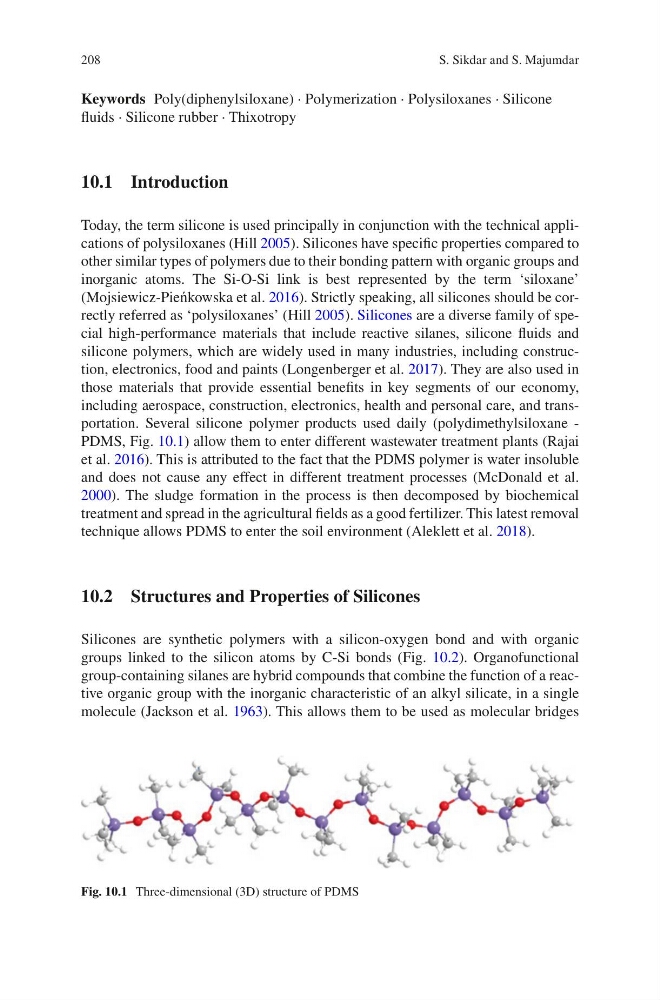
including aerospace, construction, electronics, health and personal care, and transportation. Several silicone polymer products used daily (polydimethylsiloxane -
PDMS, Fig. 10.1) allow them to enter different wastewater treatment plants (Rajai
et al. 2016). This is attributed to the fact that the PDMS polymer is water insoluble
and does not cause any effect in different treatment processes (McDonald et al.
2000). The sludge formation in the process is then decomposed by biochemical
treatment and spread in the agricultural fields as a good fertilizer. This latest removal
technique allows PDMS to enter the soil environment (Aleklett et al. 2018).
10.2 Structures and Properties of Silicones
Silicones are synthetic polymers with a silicon-oxygen bond and with organic
groups linked to the silicon atoms by C-Si bonds (Fig. 10.2). Organofunctional
group-containing silanes are hybrid compounds that combine the function of a reactive organic group with the inorganic characteristic of an alkyl silicate, in a single
molecule (Jackson et al. 1963). This allows them to be used as molecular bridges
Fig. 10.1 Three-dimensional (3D) structure of PDMS
S. Sikdar and S. Majumdar
Keywords Poly(diphenylsiloxane) · Polymerization · Polysiloxanes · Silicone
fluids · Silicone rubber · Thixotropy
10.1 Introduction
Today, the term silicone is used principally in conjunction with the technical applications of polysiloxanes (Hill 2005). Silicones have specific properties compared to
other similar types of polymers due to their bonding pattern with organic groups and
inorganic atoms. The Si-O-Si link is best represented by the term ‘siloxane’
(Mojsiewicz-Pieńkowska et al. 2016). Strictly speaking, all silicones should be correctly referred as ‘polysiloxanes’ (Hill 2005). Silicones are a diverse family of special high-performance materials that include reactive silanes, silicone fluids and
silicone polymers, which are widely used in many industries, including construction, electronics, food and paints (Longenberger et al. 2017). They are also used in
those materials that provide essential benefits in key segments of our economy,
including aerospace, construction, electronics, health and personal care, and transportation. Several silicone polymer products used daily (polydimethylsiloxane -
PDMS, Fig. 10.1) allow them to enter different wastewater treatment plants (Rajai
et al. 2016). This is attributed to the fact that the PDMS polymer is water insoluble
and does not cause any effect in different treatment processes (McDonald et al.
2000). The sludge formation in the process is then decomposed by biochemical
treatment and spread in the agricultural fields as a good fertilizer. This latest removal
technique allows PDMS to enter the soil environment (Aleklett et al. 2018).
10.2 Structures and Properties of Silicones
Silicones are synthetic polymers with a silicon-oxygen bond and with organic
groups linked to the silicon atoms by C-Si bonds (Fig. 10.2). Organofunctional
group-containing silanes are hybrid compounds that combine the function of a reactive organic group with the inorganic characteristic of an alkyl silicate, in a single
molecule (Jackson et al. 1963). This allows them to be used as molecular bridges
Fig. 10.1 Three-dimensional (3D) structure of PDMS
S. Sikdar and S. Majumdar