

212
(vi) The solubility parameter of the polymer containing trifluoropropyl groups has
changed from 7.5 to 9.5 cal/cm
3
. These polymers are also used to prepare elastomers with little swelling in aromatic solvents (Hamciuc et al. 2014;
Meador 2015).
10.3 Manufacture of Silicones
The development of silicone chemistry includes several main steps (Hamciuc et al.
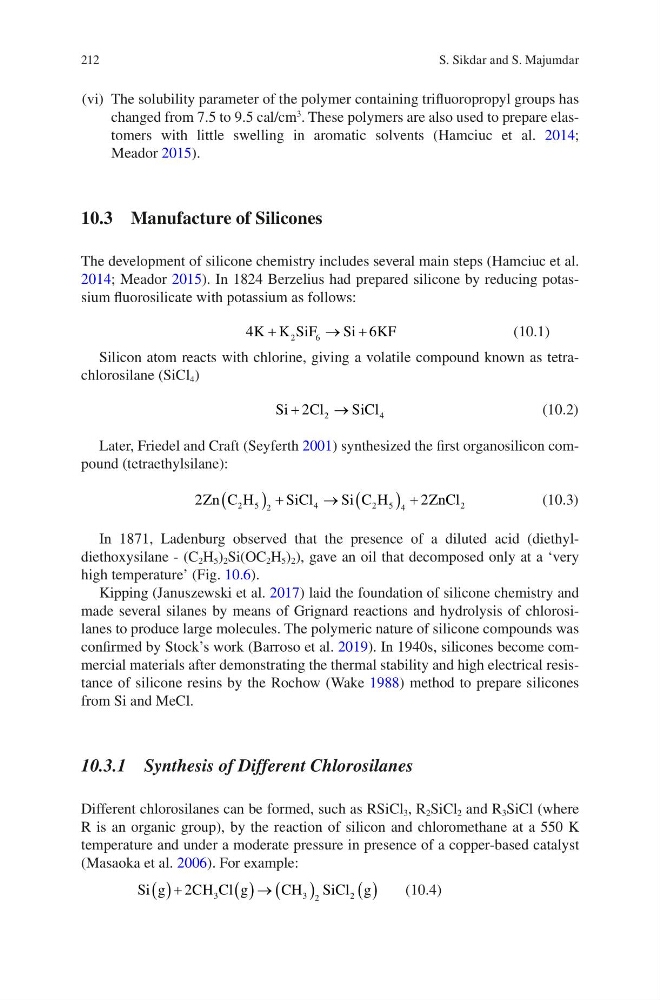
2014; Meador 2015). In 1824 Berzelius had prepared silicone by reducing potassium fluorosilicate with potassium as follows:
4
6
2
6
K K SiF
Si KF
+
→ +
(10.1)
Silicon atom reacts with chlorine, giving a volatile compound known as tetrachlorosilane (SiCl 4 )
Si Cl
SiCl
+
→
2 2
4
(10.2)
Later, Friedel and Craft (Seyferth 2001) synthesized the first organosilicon compound (tetraethylsilane):
2
2
2 5 2
4
2 5 4
2
Zn C H
SiCl
Si C H
ZnCl
(
) +
→ (
) +
(10.3)
In 1871, Ladenburg observed that the presence of a diluted acid (diethyldiethoxysilane - (C 2 H 5 ) 2 Si(OC 2 H 5 ) 2 ), gave an oil that decomposed only at a ‘very
high temperature’ (Fig. 10.6).
Kipping (Januszewski et al. 2017) laid the foundation of silicone chemistry and
made several silanes by means of Grignard reactions and hydrolysis of chlorosilanes to produce large molecules. The polymeric nature of silicone compounds was
confirmed by Stock’s work (Barroso et al. 2019). In 1940s, silicones become commercial materials after demonstrating the thermal stability and high electrical resistance of silicone resins by the Rochow (Wake 1988) method to prepare silicones
from Si and MeCl.
10.3.1 Synthesis of Different Chlorosilanes
Different chlorosilanes can be formed, such as RSiCl 3 , R 2 SiCl 2 and R 3 SiCl (where
R is an organic group), by the reaction of silicon and chloromethane at a 550 K
temperature and under a moderate pressure in presence of a copper-based catalyst
(Masaoka et al. 2006). For example:
Si g
CH Cl g
CH SiCl g
( )+
( ) → ( )
( )
2 3
3 2
2
(10.4)
S. Sikdar and S. Majumdar
(vi) The solubility parameter of the polymer containing trifluoropropyl groups has
changed from 7.5 to 9.5 cal/cm
3
. These polymers are also used to prepare elastomers with little swelling in aromatic solvents (Hamciuc et al. 2014;
Meador 2015).
10.3 Manufacture of Silicones
The development of silicone chemistry includes several main steps (Hamciuc et al.
2014; Meador 2015). In 1824 Berzelius had prepared silicone by reducing potassium fluorosilicate with potassium as follows:
4
6
2
6
K K SiF
Si KF
+
→ +
(10.1)
Silicon atom reacts with chlorine, giving a volatile compound known as tetrachlorosilane (SiCl 4 )
Si Cl
SiCl
+
→
2 2
4
(10.2)
Later, Friedel and Craft (Seyferth 2001) synthesized the first organosilicon compound (tetraethylsilane):
2
2
2 5 2
4
2 5 4
2
Zn C H
SiCl
Si C H
ZnCl
(
) +
→ (
) +
(10.3)
In 1871, Ladenburg observed that the presence of a diluted acid (diethyldiethoxysilane - (C 2 H 5 ) 2 Si(OC 2 H 5 ) 2 ), gave an oil that decomposed only at a ‘very
high temperature’ (Fig. 10.6).
Kipping (Januszewski et al. 2017) laid the foundation of silicone chemistry and
made several silanes by means of Grignard reactions and hydrolysis of chlorosilanes to produce large molecules. The polymeric nature of silicone compounds was
confirmed by Stock’s work (Barroso et al. 2019). In 1940s, silicones become commercial materials after demonstrating the thermal stability and high electrical resistance of silicone resins by the Rochow (Wake 1988) method to prepare silicones
from Si and MeCl.
10.3.1 Synthesis of Different Chlorosilanes
Different chlorosilanes can be formed, such as RSiCl 3 , R 2 SiCl 2 and R 3 SiCl (where
R is an organic group), by the reaction of silicon and chloromethane at a 550 K
temperature and under a moderate pressure in presence of a copper-based catalyst
(Masaoka et al. 2006). For example:
Si g
CH Cl g
CH SiCl g
( )+
( ) → ( )
( )
2 3
3 2
2
(10.4)
S. Sikdar and S. Majumdar