

179
It should be noted that diisocyanates (especially aromatic ones) are very
unhealthy and their inhalation or contact with them can cause serious problems in
the human body (Prueitt et al. 2017).
8.2.3 Chemistry of PUs
The high reactivity of the isocyanate group is attributed to the high electronegativity
of oxygen and nitrogen which are directly linked to carbon atom. Carbon atom
becomes positive and is prone to attack by atoms with a small negative charge.
Based on this, the isocyanates are very reactive and can react with almost every
compound having a partial negative charge (Szycher 2012). Isocyanates can react
with alcohols, amines, anhydrides, carboxylic acids, epoxides and water (LuceñoSánchez et al. 2018). These compounds can also react with themselves to form a
dimer or trimer (Szycher 2012).
Isocyanates can react with the alcohol at room temperatures without any catalyst
(Raspoet et al. 1998). This reaction is exothermic and leads to the formation of the
urethane group and is the basis of PU (Ionescu 2005). Primary alcohols react faster
than secondary alcohols and secondary alcohols react faster with isocyanates than
tertiary (Dyer et al. 1949). The reactivity of aliphatic alcohols is also greater than
aromatic alcohols such as phenol (Ionescu 2005). For example, a primary alcohol
without hindrance reacts 1000 times faster with isocyanates than phenol (Dyer
et al. 1949).
The isocyanates can also react with amines at low temperatures of up to 0 °C
without any catalyst (Szycher 2012). The reaction of isocyanates with amines is
exothermic and difficult to handle (Szycher 2012). As a result of this reaction, a urea
group is formed (Szycher 2012). The same as the reactivity of the alcohols of the
primary amines is faster than the secondary amines (Szycher 2012). For example,
the reactivity of a primary amine is almost 3 times greater than the secondary amine
(Frisch and Rumao 1970). In addition, aliphatic amines are more reactive to isocyanates than aromatic ones. A primary aliphatic amine reacts about 500 times faster
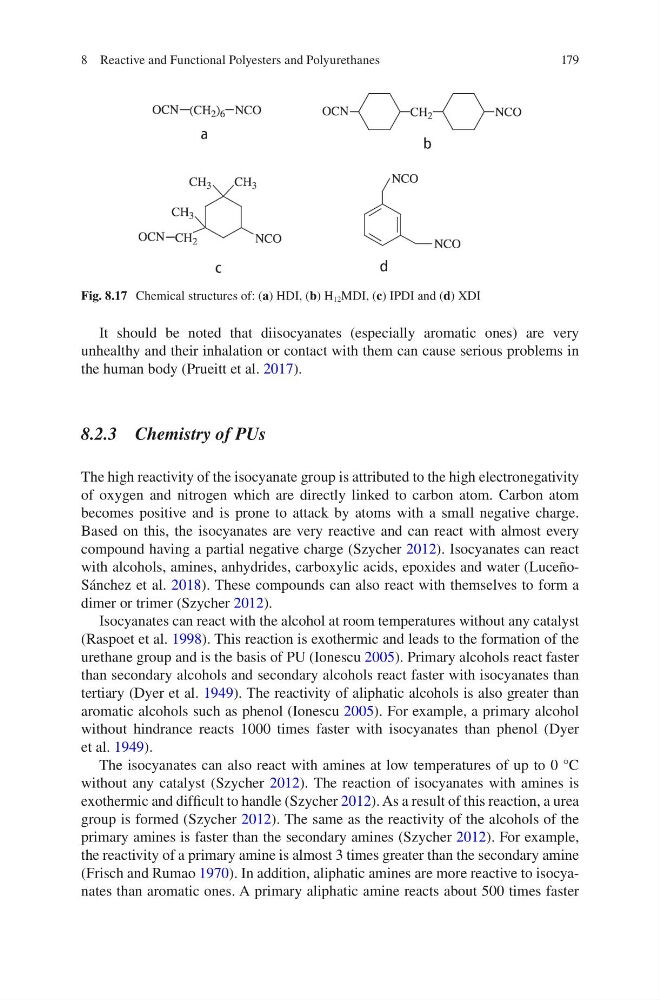
Fig. 8.17 Chemical structures of: (a) HDI, (b) H 12 MDI, (c) IPDI and (d) XDI
8 Reactive and Functional Polyesters and Polyurethanes
It should be noted that diisocyanates (especially aromatic ones) are very
unhealthy and their inhalation or contact with them can cause serious problems in
the human body (Prueitt et al. 2017).
8.2.3 Chemistry of PUs
The high reactivity of the isocyanate group is attributed to the high electronegativity
of oxygen and nitrogen which are directly linked to carbon atom. Carbon atom
becomes positive and is prone to attack by atoms with a small negative charge.
Based on this, the isocyanates are very reactive and can react with almost every
compound having a partial negative charge (Szycher 2012). Isocyanates can react
with alcohols, amines, anhydrides, carboxylic acids, epoxides and water (LuceñoSánchez et al. 2018). These compounds can also react with themselves to form a
dimer or trimer (Szycher 2012).
Isocyanates can react with the alcohol at room temperatures without any catalyst
(Raspoet et al. 1998). This reaction is exothermic and leads to the formation of the
urethane group and is the basis of PU (Ionescu 2005). Primary alcohols react faster
than secondary alcohols and secondary alcohols react faster with isocyanates than
tertiary (Dyer et al. 1949). The reactivity of aliphatic alcohols is also greater than
aromatic alcohols such as phenol (Ionescu 2005). For example, a primary alcohol
without hindrance reacts 1000 times faster with isocyanates than phenol (Dyer
et al. 1949).
The isocyanates can also react with amines at low temperatures of up to 0 °C
without any catalyst (Szycher 2012). The reaction of isocyanates with amines is
exothermic and difficult to handle (Szycher 2012). As a result of this reaction, a urea
group is formed (Szycher 2012). The same as the reactivity of the alcohols of the
primary amines is faster than the secondary amines (Szycher 2012). For example,
the reactivity of a primary amine is almost 3 times greater than the secondary amine
(Frisch and Rumao 1970). In addition, aliphatic amines are more reactive to isocyanates than aromatic ones. A primary aliphatic amine reacts about 500 times faster
Fig. 8.17 Chemical structures of: (a) HDI, (b) H 12 MDI, (c) IPDI and (d) XDI
8 Reactive and Functional Polyesters and Polyurethanes