

178
8.2.2.1.6 Aminic Polyols
Aminic polyols are produced in the same manner as polyether polyols with the
exception of initiator. Initiators such as diethylene triamine (DETA) and ethylenediamine (EDA) are used to produce polyols with amine end-capped (Ionescu 2005).
This type of polyol is very reactive with aromatic diisocyanates (the reaction takes
place in seconds). So, the pot-life and gel-time are very low. To overcome this problem, aliphatic diisocyanate which are less reactive than aromatics are used to
produce PU.
8.2.2.2 Diisocyanates
Two types of diisocyanates are used to produce PUs: aromatic and aliphatic diisocyanates. Aromatic diisocyanates are widely used as they are very cheaper than
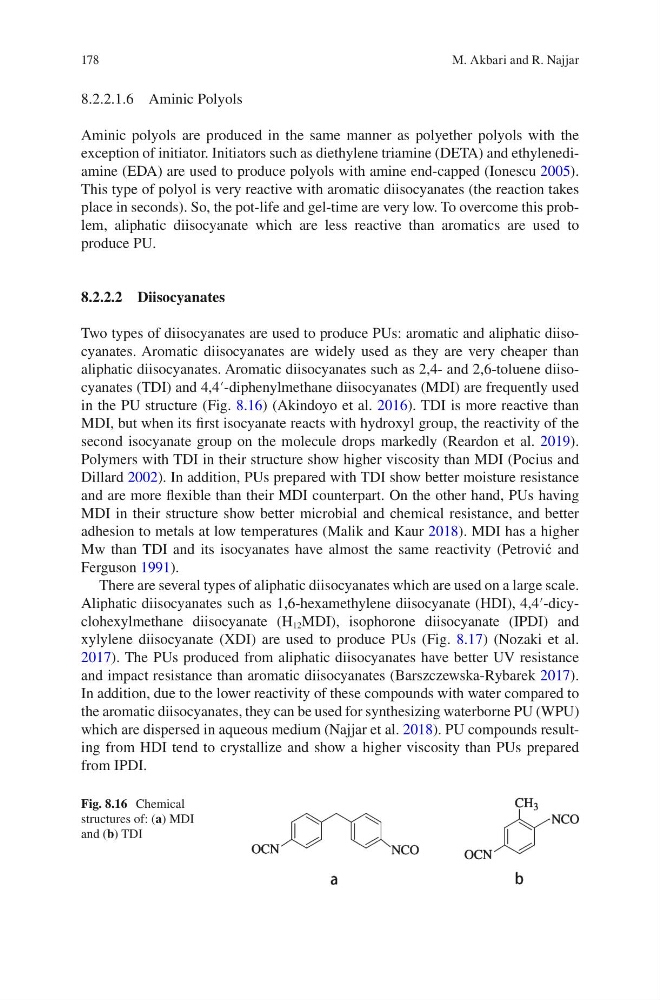
aliphatic diisocyanates. Aromatic diisocyanates such as 2,4- and 2,6-toluene diisocyanates (TDI) and 4,4′-diphenylmethane diisocyanates (MDI) are frequently used
in the PU structure (Fig. 8.16) (Akindoyo et al. 2016). TDI is more reactive than
MDI, but when its first isocyanate reacts with hydroxyl group, the reactivity of the
second isocyanate group on the molecule drops markedly (Reardon et al. 2019).
Polymers with TDI in their structure show higher viscosity than MDI (Pocius and
Dillard 2002). In addition, PUs prepared with TDI show better moisture resistance
and are more flexible than their MDI counterpart. On the other hand, PUs having
MDI in their structure show better microbial and chemical resistance, and better
adhesion to metals at low temperatures (Malik and Kaur 2018). MDI has a higher
Mw than TDI and its isocyanates have almost the same reactivity (Petrović and
Ferguson 1991).
There are several types of aliphatic diisocyanates which are used on a large scale.
Aliphatic diisocyanates such as 1,6-hexamethylene diisocyanate (HDI), 4,4′-dicyclohexylmethane diisocyanate (H 12 MDI), isophorone diisocyanate (IPDI) and
xylylene diisocyanate (XDI) are used to produce PUs (Fig. 8.17) (Nozaki et al.
2017). The PUs produced from aliphatic diisocyanates have better UV resistance
and impact resistance than aromatic diisocyanates (Barszczewska-Rybarek 2017).
In addition, due to the lower reactivity of these compounds with water compared to
the aromatic diisocyanates, they can be used for synthesizing waterborne PU (WPU)
which are dispersed in aqueous medium (Najjar et al. 2018). PU compounds resulting from HDI tend to crystallize and show a higher viscosity than PUs prepared
from IPDI.
Fig. 8.16 Chemical
structures of: (a) MDI
and (b) TDI
M. Akbari and R. Najjar
8.2.2.1.6 Aminic Polyols
Aminic polyols are produced in the same manner as polyether polyols with the
exception of initiator. Initiators such as diethylene triamine (DETA) and ethylenediamine (EDA) are used to produce polyols with amine end-capped (Ionescu 2005).
This type of polyol is very reactive with aromatic diisocyanates (the reaction takes
place in seconds). So, the pot-life and gel-time are very low. To overcome this problem, aliphatic diisocyanate which are less reactive than aromatics are used to
produce PU.
8.2.2.2 Diisocyanates
Two types of diisocyanates are used to produce PUs: aromatic and aliphatic diisocyanates. Aromatic diisocyanates are widely used as they are very cheaper than
aliphatic diisocyanates. Aromatic diisocyanates such as 2,4- and 2,6-toluene diisocyanates (TDI) and 4,4′-diphenylmethane diisocyanates (MDI) are frequently used
in the PU structure (Fig. 8.16) (Akindoyo et al. 2016). TDI is more reactive than
MDI, but when its first isocyanate reacts with hydroxyl group, the reactivity of the
second isocyanate group on the molecule drops markedly (Reardon et al. 2019).
Polymers with TDI in their structure show higher viscosity than MDI (Pocius and
Dillard 2002). In addition, PUs prepared with TDI show better moisture resistance
and are more flexible than their MDI counterpart. On the other hand, PUs having
MDI in their structure show better microbial and chemical resistance, and better
adhesion to metals at low temperatures (Malik and Kaur 2018). MDI has a higher
Mw than TDI and its isocyanates have almost the same reactivity (Petrović and
Ferguson 1991).
There are several types of aliphatic diisocyanates which are used on a large scale.
Aliphatic diisocyanates such as 1,6-hexamethylene diisocyanate (HDI), 4,4′-dicyclohexylmethane diisocyanate (H 12 MDI), isophorone diisocyanate (IPDI) and
xylylene diisocyanate (XDI) are used to produce PUs (Fig. 8.17) (Nozaki et al.
2017). The PUs produced from aliphatic diisocyanates have better UV resistance
and impact resistance than aromatic diisocyanates (Barszczewska-Rybarek 2017).
In addition, due to the lower reactivity of these compounds with water compared to
the aromatic diisocyanates, they can be used for synthesizing waterborne PU (WPU)
which are dispersed in aqueous medium (Najjar et al. 2018). PU compounds resulting from HDI tend to crystallize and show a higher viscosity than PUs prepared
from IPDI.
Fig. 8.16 Chemical
structures of: (a) MDI
and (b) TDI
M. Akbari and R. Najjar