

177
8.2.2.1.4 Polybutadiene Polyols
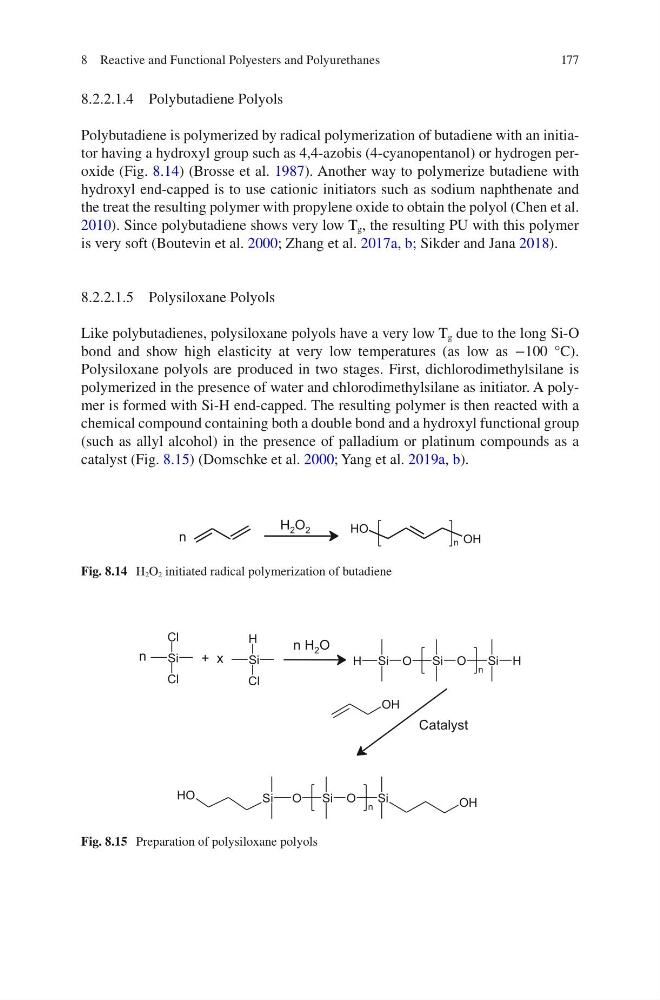
Polybutadiene is polymerized by radical polymerization of butadiene with an initiator having a hydroxyl group such as 4,4-azobis (4-cyanopentanol) or hydrogen peroxide (Fig. 8.14) (Brosse et al. 1987). Another way to polymerize butadiene with
hydroxyl end-capped is to use cationic initiators such as sodium naphthenate and
the treat the resulting polymer with propylene oxide to obtain the polyol (Chen et al.
2010). Since polybutadiene shows very low T g , the resulting PU with this polymer
is very soft (Boutevin et al. 2000; Zhang et al. 2017a, b; Sikder and Jana 2018).
8.2.2.1.5 Polysiloxane Polyols
Like polybutadienes, polysiloxane polyols have a very low T g due to the long Si-O
bond and show high elasticity at very low temperatures (as low as −100 °C).
Polysiloxane polyols are produced in two stages. First, dichlorodimethylsilane is
polymerized in the presence of water and chlorodimethylsilane as initiator. A polymer is formed with Si-H end-capped. The resulting polymer is then reacted with a
chemical compound containing both a double bond and a hydroxyl functional group
(such as allyl alcohol) in the presence of palladium or platinum compounds as a
catalyst (Fig. 8.15) (Domschke et al. 2000; Yang et al. 2019a, b).
O
H
OH
n
n
H 2 O 2
Fig. 8.14 H 2 O 2 initiated radical polymerization of butadiene
Cl
Si
Cl
H
Si
Cl
Si H
O
Si
O
Si
H
n
OH
Si
O
Si
O
Si
n
O
H
OH
n
+ x
n H 2 O
Catalyst
Fig. 8.15 Preparation of polysiloxane polyols
8 Reactive and Functional Polyesters and Polyurethanes
8.2.2.1.4 Polybutadiene Polyols
Polybutadiene is polymerized by radical polymerization of butadiene with an initiator having a hydroxyl group such as 4,4-azobis (4-cyanopentanol) or hydrogen peroxide (Fig. 8.14) (Brosse et al. 1987). Another way to polymerize butadiene with
hydroxyl end-capped is to use cationic initiators such as sodium naphthenate and
the treat the resulting polymer with propylene oxide to obtain the polyol (Chen et al.
2010). Since polybutadiene shows very low T g , the resulting PU with this polymer
is very soft (Boutevin et al. 2000; Zhang et al. 2017a, b; Sikder and Jana 2018).
8.2.2.1.5 Polysiloxane Polyols
Like polybutadienes, polysiloxane polyols have a very low T g due to the long Si-O
bond and show high elasticity at very low temperatures (as low as −100 °C).
Polysiloxane polyols are produced in two stages. First, dichlorodimethylsilane is
polymerized in the presence of water and chlorodimethylsilane as initiator. A polymer is formed with Si-H end-capped. The resulting polymer is then reacted with a
chemical compound containing both a double bond and a hydroxyl functional group
(such as allyl alcohol) in the presence of palladium or platinum compounds as a
catalyst (Fig. 8.15) (Domschke et al. 2000; Yang et al. 2019a, b).
O
H
OH
n
n
H 2 O 2
Fig. 8.14 H 2 O 2 initiated radical polymerization of butadiene
Cl
Si
Cl
H
Si
Cl
Si H
O
Si
O
Si
H
n
OH
Si
O
Si
O
Si
n
O
H
OH
n
+ x
n H 2 O
Catalyst
Fig. 8.15 Preparation of polysiloxane polyols
8 Reactive and Functional Polyesters and Polyurethanes