

176
vacuum pump is an easy method for removing water (Ullmann et al. 1985). Another
method is to use a compound which forms azeotrope with water such as toluene and
xylene (Ullmann et al. 1985). Since the polyester is used for producing PU, mainly
free solvent polyesters are used, therefore the second method is not as favorable as
the first (Ullmann et al. 1985).
Polycaprolactone (PCL) is another type of polyester which is used as the polyol
for producing PUs (Babaie et al. 2019). Although this compound is more expensive
than common polyester, it imparts excellent mechanical and hydrolysis resistance to
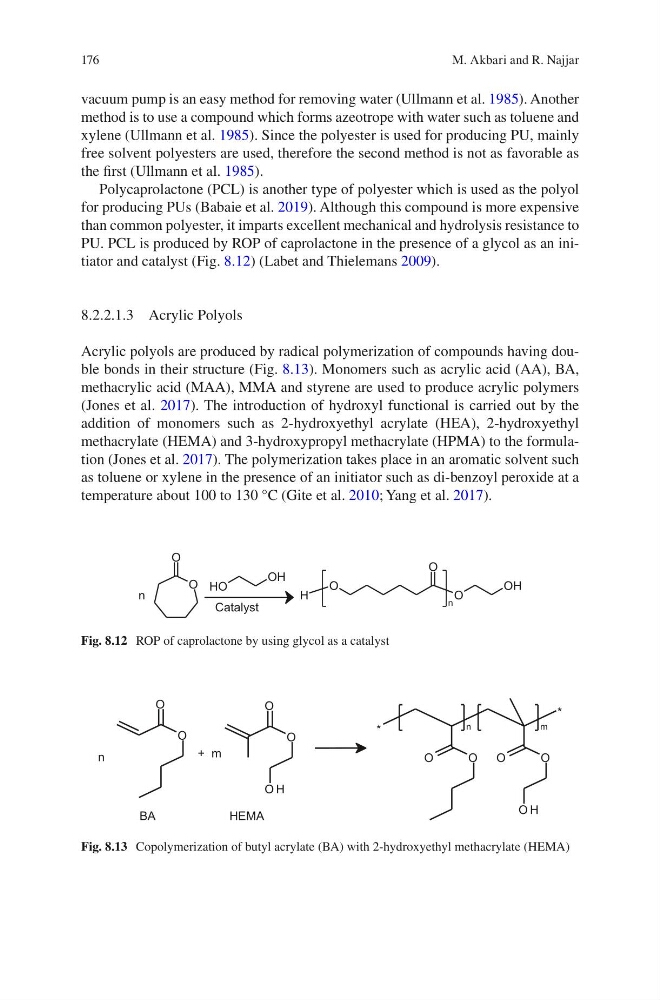
PU. PCL is produced by ROP of caprolactone in the presence of a glycol as an initiator and catalyst (Fig. 8.12) (Labet and Thielemans 2009).
8.2.2.1.3 Acrylic Polyols
Acrylic polyols are produced by radical polymerization of compounds having double bonds in their structure (Fig. 8.13). Monomers such as acrylic acid (AA), BA,
methacrylic acid (MAA), MMA and styrene are used to produce acrylic polymers
(Jones et al. 2017). The introduction of hydroxyl functional is carried out by the
addition of monomers such as 2-hydroxyethyl acrylate (HEA), 2-hydroxyethyl
methacrylate (HEMA) and 3-hydroxypropyl methacrylate (HPMA) to the formulation (Jones et al. 2017). The polymerization takes place in an aromatic solvent such
as toluene or xylene in the presence of an initiator such as di-benzoyl peroxide at a
temperature about 100 to 130 °C (Gite et al. 2010; Yang et al. 2017).
O
O
O
H
OH
H
O
O
OH
O
n
Catalyst
n
Fig. 8.12 ROP of caprolactone by using glycol as a catalyst
*
*
O
O
O
O
O H
n
m
O
O
O
O
O H
n
+ m
BA
HEMA
Fig. 8.13 Copolymerization of butyl acrylate (BA) with 2-hydroxyethyl methacrylate (HEMA)
M. Akbari and R. Najjar
vacuum pump is an easy method for removing water (Ullmann et al. 1985). Another
method is to use a compound which forms azeotrope with water such as toluene and
xylene (Ullmann et al. 1985). Since the polyester is used for producing PU, mainly
free solvent polyesters are used, therefore the second method is not as favorable as
the first (Ullmann et al. 1985).
Polycaprolactone (PCL) is another type of polyester which is used as the polyol
for producing PUs (Babaie et al. 2019). Although this compound is more expensive
than common polyester, it imparts excellent mechanical and hydrolysis resistance to
PU. PCL is produced by ROP of caprolactone in the presence of a glycol as an initiator and catalyst (Fig. 8.12) (Labet and Thielemans 2009).
8.2.2.1.3 Acrylic Polyols
Acrylic polyols are produced by radical polymerization of compounds having double bonds in their structure (Fig. 8.13). Monomers such as acrylic acid (AA), BA,
methacrylic acid (MAA), MMA and styrene are used to produce acrylic polymers
(Jones et al. 2017). The introduction of hydroxyl functional is carried out by the
addition of monomers such as 2-hydroxyethyl acrylate (HEA), 2-hydroxyethyl
methacrylate (HEMA) and 3-hydroxypropyl methacrylate (HPMA) to the formulation (Jones et al. 2017). The polymerization takes place in an aromatic solvent such
as toluene or xylene in the presence of an initiator such as di-benzoyl peroxide at a
temperature about 100 to 130 °C (Gite et al. 2010; Yang et al. 2017).
O
O
O
H
OH
H
O
O
OH
O
n
Catalyst
n
Fig. 8.12 ROP of caprolactone by using glycol as a catalyst
*
*
O
O
O
O
O H
n
m
O
O
O
O
O H
n
+ m
BA
HEMA
Fig. 8.13 Copolymerization of butyl acrylate (BA) with 2-hydroxyethyl methacrylate (HEMA)
M. Akbari and R. Najjar