

175
Thielemans 2009). In the polycondensation reaction, water is produced and must be
removed from the reaction medium to obtain high yield polyester since the reaction
is in equilibrium. For ROP of lactones, no by-product is produced (Labet and
Thielemans 2009). Polyesters are tough, oil resistant with good adhesion properties
compared to polyethers. However, they show lower hydrolysis resistance and higher
viscosity than polyethers (Petrović et al. 2008).
There is a wide range of commercially available monomers to produce polyester
polyols. Based on the final application of the mature PU, different types of dicarboxylic acids (or anhydrides) and glycols can be used. Dicarboxylic acids such as
adipic acid, isophthalic acid, terephthalic acid and phthalic anhydride are well
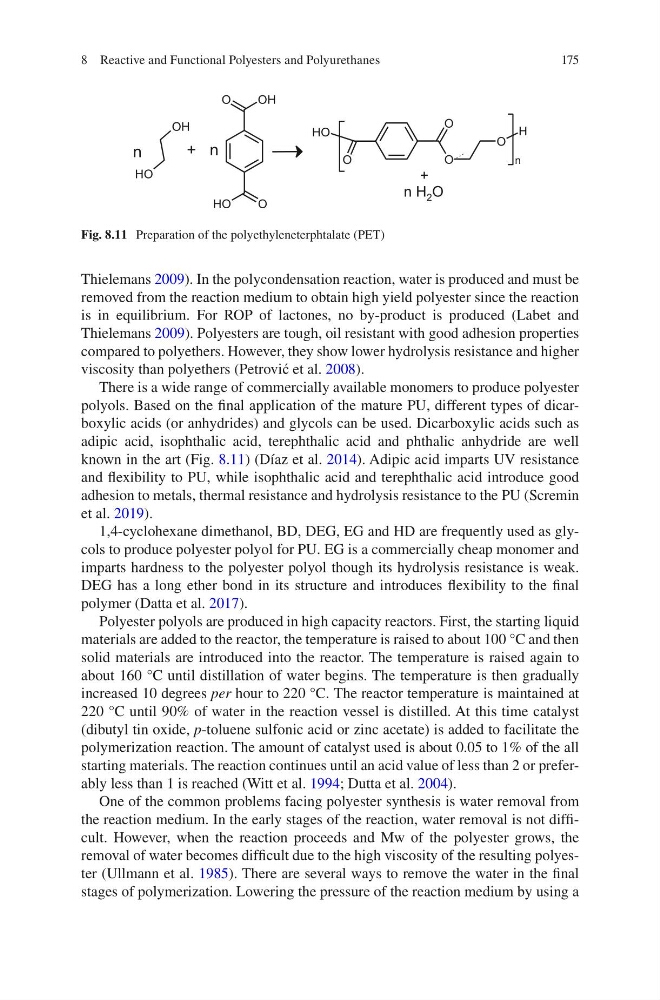
known in the art (Fig. 8.11) (Díaz et al. 2014). Adipic acid imparts UV resistance
and flexibility to PU, while isophthalic acid and terephthalic acid introduce good
adhesion to metals, thermal resistance and hydrolysis resistance to the PU (Scremin
et al. 2019).
1,4-cyclohexane dimethanol, BD, DEG, EG and HD are frequently used as glycols to produce polyester polyol for PU. EG is a commercially cheap monomer and
imparts hardness to the polyester polyol though its hydrolysis resistance is weak.
DEG has a long ether bond in its structure and introduces flexibility to the final
polymer (Datta et al. 2017).
Polyester polyols are produced in high capacity reactors. First, the starting liquid
materials are added to the reactor, the temperature is raised to about 100 °C and then
solid materials are introduced into the reactor. The temperature is raised again to
about 160 °C until distillation of water begins. The temperature is then gradually
increased 10 degrees per hour to 220 °C. The reactor temperature is maintained at
220 °C until 90% of water in the reaction vessel is distilled. At this time catalyst
(dibutyl tin oxide, p-toluene sulfonic acid or zinc acetate) is added to facilitate the
polymerization reaction. The amount of catalyst used is about 0.05 to 1% of the all
starting materials. The reaction continues until an acid value of less than 2 or preferably less than 1 is reached (Witt et al. 1994; Dutta et al. 2004).
One of the common problems facing polyester synthesis is water removal from
the reaction medium. In the early stages of the reaction, water removal is not difficult. However, when the reaction proceeds and Mw of the polyester grows, the
removal of water becomes difficult due to the high viscosity of the resulting polyester (Ullmann et al. 1985). There are several ways to remove the water in the final
stages of polymerization. Lowering the pressure of the reaction medium by using a
O
H
OH
OH
O
O
H
O
O
H
O
O
O
O
H
n
+ n
n
+
n H 2 O
Fig. 8.11 Preparation of the polyethyleneterphtalate (PET)
8 Reactive and Functional Polyesters and Polyurethanes
Thielemans 2009). In the polycondensation reaction, water is produced and must be
removed from the reaction medium to obtain high yield polyester since the reaction
is in equilibrium. For ROP of lactones, no by-product is produced (Labet and
Thielemans 2009). Polyesters are tough, oil resistant with good adhesion properties
compared to polyethers. However, they show lower hydrolysis resistance and higher
viscosity than polyethers (Petrović et al. 2008).
There is a wide range of commercially available monomers to produce polyester
polyols. Based on the final application of the mature PU, different types of dicarboxylic acids (or anhydrides) and glycols can be used. Dicarboxylic acids such as
adipic acid, isophthalic acid, terephthalic acid and phthalic anhydride are well
known in the art (Fig. 8.11) (Díaz et al. 2014). Adipic acid imparts UV resistance
and flexibility to PU, while isophthalic acid and terephthalic acid introduce good
adhesion to metals, thermal resistance and hydrolysis resistance to the PU (Scremin
et al. 2019).
1,4-cyclohexane dimethanol, BD, DEG, EG and HD are frequently used as glycols to produce polyester polyol for PU. EG is a commercially cheap monomer and
imparts hardness to the polyester polyol though its hydrolysis resistance is weak.
DEG has a long ether bond in its structure and introduces flexibility to the final
polymer (Datta et al. 2017).
Polyester polyols are produced in high capacity reactors. First, the starting liquid
materials are added to the reactor, the temperature is raised to about 100 °C and then
solid materials are introduced into the reactor. The temperature is raised again to
about 160 °C until distillation of water begins. The temperature is then gradually
increased 10 degrees per hour to 220 °C. The reactor temperature is maintained at
220 °C until 90% of water in the reaction vessel is distilled. At this time catalyst
(dibutyl tin oxide, p-toluene sulfonic acid or zinc acetate) is added to facilitate the
polymerization reaction. The amount of catalyst used is about 0.05 to 1% of the all
starting materials. The reaction continues until an acid value of less than 2 or preferably less than 1 is reached (Witt et al. 1994; Dutta et al. 2004).
One of the common problems facing polyester synthesis is water removal from
the reaction medium. In the early stages of the reaction, water removal is not difficult. However, when the reaction proceeds and Mw of the polyester grows, the
removal of water becomes difficult due to the high viscosity of the resulting polyester (Ullmann et al. 1985). There are several ways to remove the water in the final
stages of polymerization. Lowering the pressure of the reaction medium by using a
O
H
OH
OH
O
O
H
O
O
H
O
O
O
O
H
n
+ n
n
+
n H 2 O
Fig. 8.11 Preparation of the polyethyleneterphtalate (PET)
8 Reactive and Functional Polyesters and Polyurethanes