

174
8.2.2.1.1 Polyethers
Polyether polyols are produced by exothermic ring opening polymerization (ROP)
of alkylene oxides (or oxiranes) such as butylene oxide, ethylene oxide and propylene oxide in the presence of KOH or sodium hydroxide (NaOH) as catalysts and
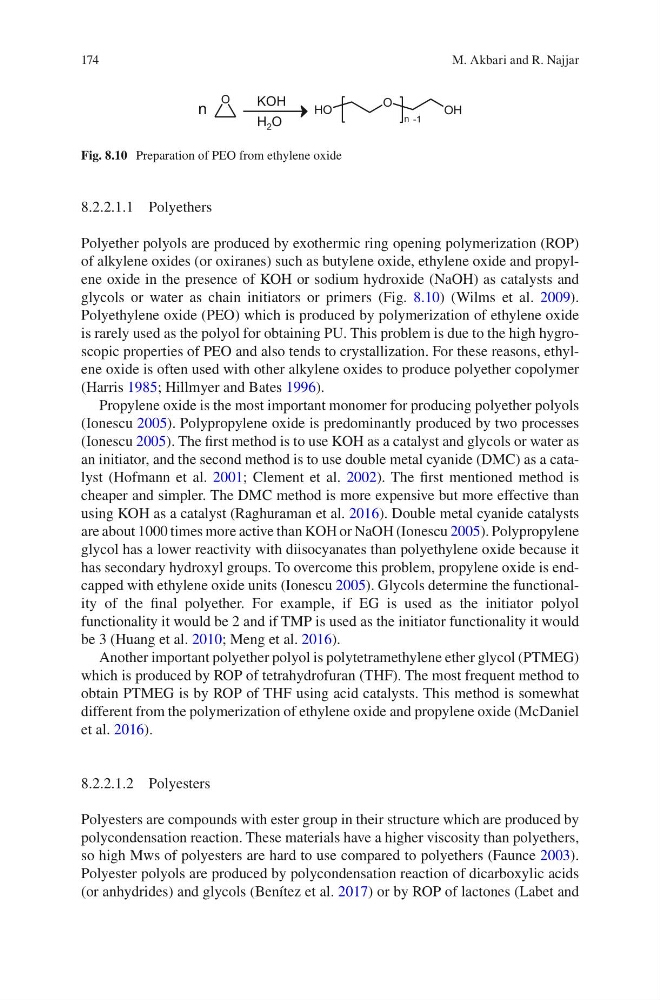
glycols or water as chain initiators or primers (Fig. 8.10) (Wilms et al. 2009).
Polyethylene oxide (PEO) which is produced by polymerization of ethylene oxide
is rarely used as the polyol for obtaining PU. This problem is due to the high hygroscopic properties of PEO and also tends to crystallization. For these reasons, ethylene oxide is often used with other alkylene oxides to produce polyether copolymer
(Harris 1985; Hillmyer and Bates 1996).
Propylene oxide is the most important monomer for producing polyether polyols
(Ionescu 2005). Polypropylene oxide is predominantly produced by two processes
(Ionescu 2005). The first method is to use KOH as a catalyst and glycols or water as
an initiator, and the second method is to use double metal cyanide (DMC) as a catalyst (Hofmann et al. 2001; Clement et al. 2002). The first mentioned method is
cheaper and simpler. The DMC method is more expensive but more effective than
using KOH as a catalyst (Raghuraman et al. 2016). Double metal cyanide catalysts
are about 1000 times more active than KOH or NaOH (Ionescu 2005). Polypropylene
glycol has a lower reactivity with diisocyanates than polyethylene oxide because it
has secondary hydroxyl groups. To overcome this problem, propylene oxide is endcapped with ethylene oxide units (Ionescu 2005). Glycols determine the functionality of the final polyether. For example, if EG is used as the initiator polyol
functionality it would be 2 and if TMP is used as the initiator functionality it would
be 3 (Huang et al. 2010; Meng et al. 2016).
Another important polyether polyol is polytetramethylene ether glycol (PTMEG)
which is produced by ROP of tetrahydrofuran (THF). The most frequent method to
obtain PTMEG is by ROP of THF using acid catalysts. This method is somewhat
different from the polymerization of ethylene oxide and propylene oxide (McDaniel
et al. 2016).
8.2.2.1.2 Polyesters
Polyesters are compounds with ester group in their structure which are produced by
polycondensation reaction. These materials have a higher viscosity than polyethers,
so high Mws of polyesters are hard to use compared to polyethers (Faunce 2003).
Polyester polyols are produced by polycondensation reaction of dicarboxylic acids
(or anhydrides) and glycols (Benítez et al. 2017) or by ROP of lactones (Labet and
O
O
H
O
OH
n -1
n
KOH
H 2 O
Fig. 8.10 Preparation of PEO from ethylene oxide
M. Akbari and R. Najjar
8.2.2.1.1 Polyethers
Polyether polyols are produced by exothermic ring opening polymerization (ROP)
of alkylene oxides (or oxiranes) such as butylene oxide, ethylene oxide and propylene oxide in the presence of KOH or sodium hydroxide (NaOH) as catalysts and
glycols or water as chain initiators or primers (Fig. 8.10) (Wilms et al. 2009).
Polyethylene oxide (PEO) which is produced by polymerization of ethylene oxide
is rarely used as the polyol for obtaining PU. This problem is due to the high hygroscopic properties of PEO and also tends to crystallization. For these reasons, ethylene oxide is often used with other alkylene oxides to produce polyether copolymer
(Harris 1985; Hillmyer and Bates 1996).
Propylene oxide is the most important monomer for producing polyether polyols
(Ionescu 2005). Polypropylene oxide is predominantly produced by two processes
(Ionescu 2005). The first method is to use KOH as a catalyst and glycols or water as
an initiator, and the second method is to use double metal cyanide (DMC) as a catalyst (Hofmann et al. 2001; Clement et al. 2002). The first mentioned method is
cheaper and simpler. The DMC method is more expensive but more effective than
using KOH as a catalyst (Raghuraman et al. 2016). Double metal cyanide catalysts
are about 1000 times more active than KOH or NaOH (Ionescu 2005). Polypropylene
glycol has a lower reactivity with diisocyanates than polyethylene oxide because it
has secondary hydroxyl groups. To overcome this problem, propylene oxide is endcapped with ethylene oxide units (Ionescu 2005). Glycols determine the functionality of the final polyether. For example, if EG is used as the initiator polyol
functionality it would be 2 and if TMP is used as the initiator functionality it would
be 3 (Huang et al. 2010; Meng et al. 2016).
Another important polyether polyol is polytetramethylene ether glycol (PTMEG)
which is produced by ROP of tetrahydrofuran (THF). The most frequent method to
obtain PTMEG is by ROP of THF using acid catalysts. This method is somewhat
different from the polymerization of ethylene oxide and propylene oxide (McDaniel
et al. 2016).
8.2.2.1.2 Polyesters
Polyesters are compounds with ester group in their structure which are produced by
polycondensation reaction. These materials have a higher viscosity than polyethers,
so high Mws of polyesters are hard to use compared to polyethers (Faunce 2003).
Polyester polyols are produced by polycondensation reaction of dicarboxylic acids
(or anhydrides) and glycols (Benítez et al. 2017) or by ROP of lactones (Labet and
O
O
H
O
OH
n -1
n
KOH
H 2 O
Fig. 8.10 Preparation of PEO from ethylene oxide
M. Akbari and R. Najjar