

173
and diisocyanates contain hard (HS) and soft segments (SS). SS include polyol
chain and HS consist of urethane groups. HS show a higher T g value than SS, and
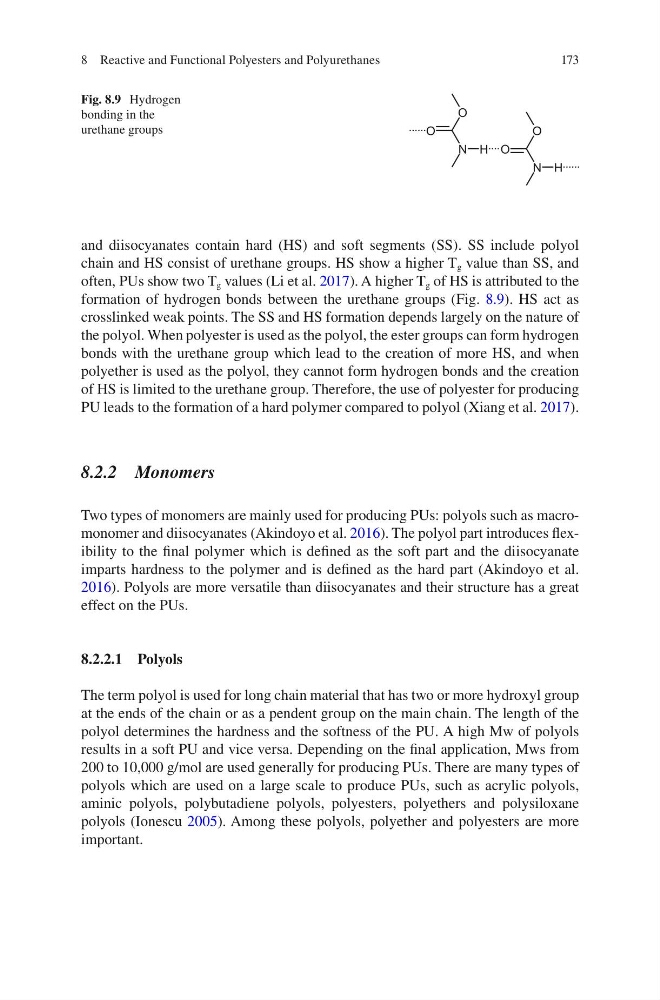
often, PUs show two T g values (Li et al. 2017). A higher T g of HS is attributed to the
formation of hydrogen bonds between the urethane groups (Fig. 8.9). HS act as
crosslinked weak points. The SS and HS formation depends largely on the nature of
the polyol. When polyester is used as the polyol, the ester groups can form hydrogen
bonds with the urethane group which lead to the creation of more HS, and when
polyether is used as the polyol, they cannot form hydrogen bonds and the creation
of HS is limited to the urethane group. Therefore, the use of polyester for producing
PU leads to the formation of a hard polymer compared to polyol (Xiang et al. 2017).
8.2.2 Monomers
Two types of monomers are mainly used for producing PUs: polyols such as macromonomer and diisocyanates (Akindoyo et al. 2016). The polyol part introduces flexibility to the final polymer which is defined as the soft part and the diisocyanate
imparts hardness to the polymer and is defined as the hard part (Akindoyo et al.
2016). Polyols are more versatile than diisocyanates and their structure has a great
effect on the PUs.
8.2.2.1 Polyols
The term polyol is used for long chain material that has two or more hydroxyl group
at the ends of the chain or as a pendent group on the main chain. The length of the
polyol determines the hardness and the softness of the PU. A high Mw of polyols
results in a soft PU and vice versa. Depending on the final application, Mws from
200 to 10,000 g/mol are used generally for producing PUs. There are many types of
polyols which are used on a large scale to produce PUs, such as acrylic polyols,
aminic polyols, polybutadiene polyols, polyesters, polyethers and polysiloxane
polyols (Ionescu 2005). Among these polyols, polyether and polyesters are more
important.
O
N
O
H O
N
O
H
Fig. 8.9 Hydrogen
bonding in the
urethane groups
8 Reactive and Functional Polyesters and Polyurethanes
and diisocyanates contain hard (HS) and soft segments (SS). SS include polyol
chain and HS consist of urethane groups. HS show a higher T g value than SS, and
often, PUs show two T g values (Li et al. 2017). A higher T g of HS is attributed to the
formation of hydrogen bonds between the urethane groups (Fig. 8.9). HS act as
crosslinked weak points. The SS and HS formation depends largely on the nature of
the polyol. When polyester is used as the polyol, the ester groups can form hydrogen
bonds with the urethane group which lead to the creation of more HS, and when
polyether is used as the polyol, they cannot form hydrogen bonds and the creation
of HS is limited to the urethane group. Therefore, the use of polyester for producing
PU leads to the formation of a hard polymer compared to polyol (Xiang et al. 2017).
8.2.2 Monomers
Two types of monomers are mainly used for producing PUs: polyols such as macromonomer and diisocyanates (Akindoyo et al. 2016). The polyol part introduces flexibility to the final polymer which is defined as the soft part and the diisocyanate
imparts hardness to the polymer and is defined as the hard part (Akindoyo et al.
2016). Polyols are more versatile than diisocyanates and their structure has a great
effect on the PUs.
8.2.2.1 Polyols
The term polyol is used for long chain material that has two or more hydroxyl group
at the ends of the chain or as a pendent group on the main chain. The length of the
polyol determines the hardness and the softness of the PU. A high Mw of polyols
results in a soft PU and vice versa. Depending on the final application, Mws from
200 to 10,000 g/mol are used generally for producing PUs. There are many types of
polyols which are used on a large scale to produce PUs, such as acrylic polyols,
aminic polyols, polybutadiene polyols, polyesters, polyethers and polysiloxane
polyols (Ionescu 2005). Among these polyols, polyether and polyesters are more
important.
O
N
O
H O
N
O
H
Fig. 8.9 Hydrogen
bonding in the
urethane groups
8 Reactive and Functional Polyesters and Polyurethanes