

180
than aromatic amines (Vilar 2006). The reactivity of amines with isocyanates is also
much faster than alcohols (Vilar 2006). For example, a primary amine compound
reacts almost 1000 times faster than a compound containing a primary hydroxyl
group (Vilar 2006).
The reaction of the isocyanates with water takes place in two stages: first carbon
dioxide (gaseous compound) and an amine compound are formed, and in the second
stage due to the greater reactivity of the amines towards the isocyanates, it reacts
spontaneously with isocyanate to form a urea group. Therefore, one molecule of
water reacts with two molecules of isocyanate, this must be taken into account for
the formulation dealing with water (Kent 2007). It should be noted that an unstable
compound called carbamic acid is formed before the formation of amine and carbon
dioxide (Ni et al. 2002).
Another important reaction of the isocyanate is trimerization (Frisch and Rumao
1970). As a result of this reaction, a heterocyclic compound named isocyanurate is
formed which is an intermediate in PU synthesis (Frisch and Rumao 1970). The
isocyanates also react with the urethane group at high temperatures (above 100 °C)
to form an allophanate group (Lapprand et al. 2005). Similarly, they react with urea
above 100 °C to form biuret group (Dušek et al. 1991). The reaction of isocyanates
with carboxylic acids leads to the formation of an amide compound and carbon
dioxide (Sasaki and Crich 2011). The isocyanates can also react with epoxides and
anhydrides (Paul et al. 2015). The reaction product of isocyanates with epoxides is
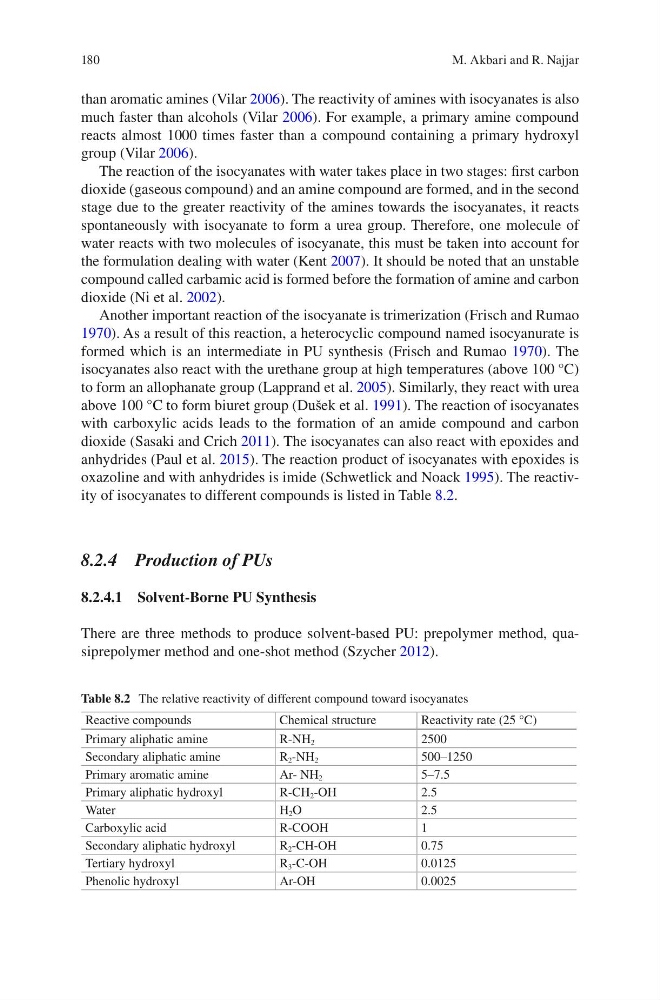
oxazoline and with anhydrides is imide (Schwetlick and Noack 1995). The reactivity of isocyanates to different compounds is listed in Table 8.2.
8.2.4 Production of PUs
8.2.4.1 Solvent-Borne PU Synthesis
There are three methods to produce solvent-based PU: prepolymer method, quasiprepolymer method and one-shot method (Szycher 2012).
Table 8.2 The relative reactivity of different compound toward isocyanates
Reactive compounds
Chemical structure
Reactivity rate (25 °C)
Primary aliphatic amine
R-NH 2
2500
Secondary aliphatic amine
R 2 -NH 2
500–1250
Primary aromatic amine
Ar- NH 2
5–7.5
Primary aliphatic hydroxyl
R-CH 2 -OH
2.5
Water
H 2 O
2.5
Carboxylic acid
R-COOH
1
Secondary aliphatic hydroxyl
R 2 -CH-OH
0.75
Tertiary hydroxyl
R 3 -C-OH
0.0125
Phenolic hydroxyl
Ar-OH
0.0025
M. Akbari and R. Najjar
than aromatic amines (Vilar 2006). The reactivity of amines with isocyanates is also
much faster than alcohols (Vilar 2006). For example, a primary amine compound
reacts almost 1000 times faster than a compound containing a primary hydroxyl
group (Vilar 2006).
The reaction of the isocyanates with water takes place in two stages: first carbon
dioxide (gaseous compound) and an amine compound are formed, and in the second
stage due to the greater reactivity of the amines towards the isocyanates, it reacts
spontaneously with isocyanate to form a urea group. Therefore, one molecule of
water reacts with two molecules of isocyanate, this must be taken into account for
the formulation dealing with water (Kent 2007). It should be noted that an unstable
compound called carbamic acid is formed before the formation of amine and carbon
dioxide (Ni et al. 2002).
Another important reaction of the isocyanate is trimerization (Frisch and Rumao
1970). As a result of this reaction, a heterocyclic compound named isocyanurate is
formed which is an intermediate in PU synthesis (Frisch and Rumao 1970). The
isocyanates also react with the urethane group at high temperatures (above 100 °C)
to form an allophanate group (Lapprand et al. 2005). Similarly, they react with urea
above 100 °C to form biuret group (Dušek et al. 1991). The reaction of isocyanates
with carboxylic acids leads to the formation of an amide compound and carbon
dioxide (Sasaki and Crich 2011). The isocyanates can also react with epoxides and
anhydrides (Paul et al. 2015). The reaction product of isocyanates with epoxides is
oxazoline and with anhydrides is imide (Schwetlick and Noack 1995). The reactivity of isocyanates to different compounds is listed in Table 8.2.
8.2.4 Production of PUs
8.2.4.1 Solvent-Borne PU Synthesis
There are three methods to produce solvent-based PU: prepolymer method, quasiprepolymer method and one-shot method (Szycher 2012).
Table 8.2 The relative reactivity of different compound toward isocyanates
Reactive compounds
Chemical structure
Reactivity rate (25 °C)
Primary aliphatic amine
R-NH 2
2500
Secondary aliphatic amine
R 2 -NH 2
500–1250
Primary aromatic amine
Ar- NH 2
5–7.5
Primary aliphatic hydroxyl
R-CH 2 -OH
2.5
Water
H 2 O
2.5
Carboxylic acid
R-COOH
1
Secondary aliphatic hydroxyl
R 2 -CH-OH
0.75
Tertiary hydroxyl
R 3 -C-OH
0.0125
Phenolic hydroxyl
Ar-OH
0.0025
M. Akbari and R. Najjar