

170
The reaction rate of polyester with modified melamine depends on several factors, such as the catalyst concentration, the temperature, the volatility of formed
alcohol and type of hydroxyl. Hydroxyl groups with less hindrance react faster with
metholylate and alkoxy methyl melamine. Primary hydroxyls react much faster than
secondary or tertiary hydroxyls. The catalyst concentration has a direct effect on the
reaction rate, but high concentrations can lead to side reactions. The volatility of the
alcohol formed is important to precede the reaction quickly. The reaction rate based
on the type of alcohol is as follows: methanol > ethanol > n-propanol > n-butanol
(Wilson and Pfohl 2000; Merline et al. 2013).
The hydroxyl functionality of the polyesters can also react with polyisocyanate
and form PU. Depending on the type of polyisocyanate, this reaction can take place
at room temperature for aromatic polyisocyanates or at about 60 °C for aliphatic
polyisocyanates. The reactivity of hydroxyl groups towards isocyanates depends on
the type of hydroxyl and isocyanate, as well as the temperature. Primary hydroxyls
react with isocyanates faster than secondary and tertiary hydroxyl groups: approx. 5
times faster than secondary hydroxyls and 200 times faster than tertiary hydroxyls.
The aromatic isocyanates react with the hydroxyl group at about 60–90 °C without
using any catalyst (Persoons et al. 2016). By adding catalyst, the reaction can be
preceded at the ambient temperature. Catalysts such as tertiary amine compounds
(e.g. 1,4-diazabicyclo[2.2.2]octane - DABCO) and tin compounds (e.g. dibutyl tin
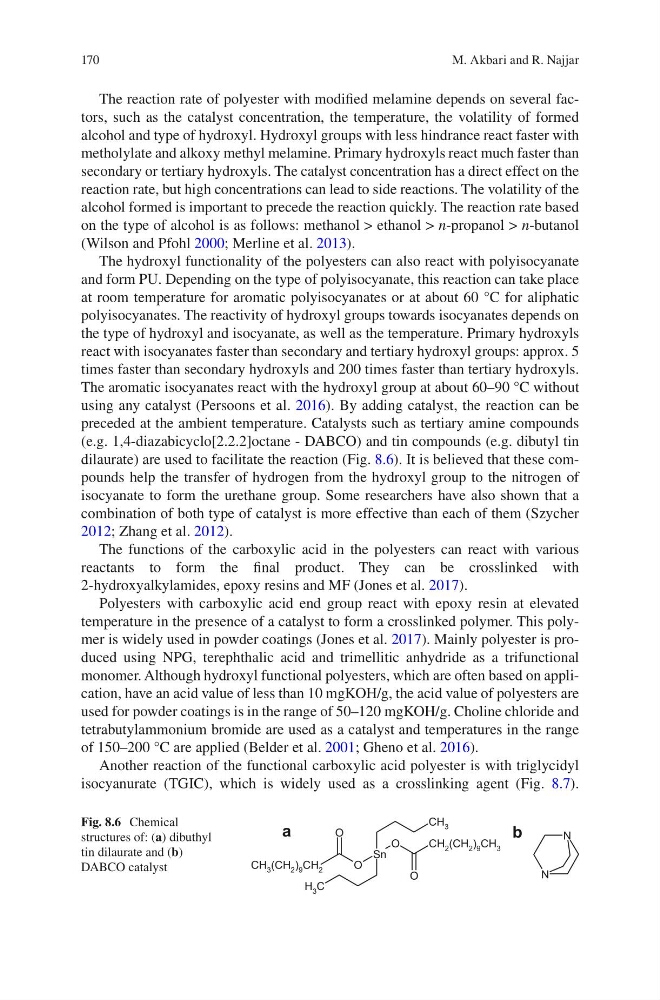
dilaurate) are used to facilitate the reaction (Fig. 8.6). It is believed that these compounds help the transfer of hydrogen from the hydroxyl group to the nitrogen of
isocyanate to form the urethane group. Some researchers have also shown that a
combination of both type of catalyst is more effective than each of them (Szycher
2012; Zhang et al. 2012).
The functions of the carboxylic acid in the polyesters can react with various
reactants to form the final product. They can be crosslinked with
2- hydroxyalkylamides, epoxy resins and MF (Jones et al. 2017).
Polyesters with carboxylic acid end group react with epoxy resin at elevated
temperature in the presence of a catalyst to form a crosslinked polymer. This polymer is widely used in powder coatings (Jones et al. 2017). Mainly polyester is produced using NPG, terephthalic acid and trimellitic anhydride as a trifunctional
monomer. Although hydroxyl functional polyesters, which are often based on application, have an acid value of less than 10 mgKOH/g, the acid value of polyesters are
used for powder coatings is in the range of 50–120 mgKOH/g. Choline chloride and
tetrabutylammonium bromide are used as a catalyst and temperatures in the range
of 150–200 °C are applied (Belder et al. 2001; Gheno et al. 2016).
Another reaction of the functional carboxylic acid polyester is with triglycidyl
isocyanurate (TGIC), which is widely used as a crosslinking agent (Fig. 8.7).
Sn
CH 2 (CH 2 ) 9 CH 3
O
O
CH 3 (CH 2 ) 9 CH 2
O
O
CH 3
C
H 3
N
N
a
b
Fig. 8.6 Chemical
structures of: (a) dibuthyl
tin dilaurate and (b)
DABCO catalyst
M. Akbari and R. Najjar
The reaction rate of polyester with modified melamine depends on several factors, such as the catalyst concentration, the temperature, the volatility of formed
alcohol and type of hydroxyl. Hydroxyl groups with less hindrance react faster with
metholylate and alkoxy methyl melamine. Primary hydroxyls react much faster than
secondary or tertiary hydroxyls. The catalyst concentration has a direct effect on the
reaction rate, but high concentrations can lead to side reactions. The volatility of the
alcohol formed is important to precede the reaction quickly. The reaction rate based
on the type of alcohol is as follows: methanol > ethanol > n-propanol > n-butanol
(Wilson and Pfohl 2000; Merline et al. 2013).
The hydroxyl functionality of the polyesters can also react with polyisocyanate
and form PU. Depending on the type of polyisocyanate, this reaction can take place
at room temperature for aromatic polyisocyanates or at about 60 °C for aliphatic
polyisocyanates. The reactivity of hydroxyl groups towards isocyanates depends on
the type of hydroxyl and isocyanate, as well as the temperature. Primary hydroxyls
react with isocyanates faster than secondary and tertiary hydroxyl groups: approx. 5
times faster than secondary hydroxyls and 200 times faster than tertiary hydroxyls.
The aromatic isocyanates react with the hydroxyl group at about 60–90 °C without
using any catalyst (Persoons et al. 2016). By adding catalyst, the reaction can be
preceded at the ambient temperature. Catalysts such as tertiary amine compounds
(e.g. 1,4-diazabicyclo[2.2.2]octane - DABCO) and tin compounds (e.g. dibutyl tin
dilaurate) are used to facilitate the reaction (Fig. 8.6). It is believed that these compounds help the transfer of hydrogen from the hydroxyl group to the nitrogen of
isocyanate to form the urethane group. Some researchers have also shown that a
combination of both type of catalyst is more effective than each of them (Szycher
2012; Zhang et al. 2012).
The functions of the carboxylic acid in the polyesters can react with various
reactants to form the final product. They can be crosslinked with
2- hydroxyalkylamides, epoxy resins and MF (Jones et al. 2017).
Polyesters with carboxylic acid end group react with epoxy resin at elevated
temperature in the presence of a catalyst to form a crosslinked polymer. This polymer is widely used in powder coatings (Jones et al. 2017). Mainly polyester is produced using NPG, terephthalic acid and trimellitic anhydride as a trifunctional
monomer. Although hydroxyl functional polyesters, which are often based on application, have an acid value of less than 10 mgKOH/g, the acid value of polyesters are
used for powder coatings is in the range of 50–120 mgKOH/g. Choline chloride and
tetrabutylammonium bromide are used as a catalyst and temperatures in the range
of 150–200 °C are applied (Belder et al. 2001; Gheno et al. 2016).
Another reaction of the functional carboxylic acid polyester is with triglycidyl
isocyanurate (TGIC), which is widely used as a crosslinking agent (Fig. 8.7).
Sn
CH 2 (CH 2 ) 9 CH 3
O
O
CH 3 (CH 2 ) 9 CH 2
O
O
CH 3
C
H 3
N
N
a
b
Fig. 8.6 Chemical
structures of: (a) dibuthyl
tin dilaurate and (b)
DABCO catalyst
M. Akbari and R. Najjar