

169
At the gel point X p it becomes infinite because the whole system is considered as
a molecule, so
P
F
gel =
2
When P gel > 1, then the formulation is safe to proceed. For the aforementioned
formulation F = 2/1.89 = 1.06. Therefore, the starting materials are safe to
polymerize.
Another method to predict the gel point of the reaction is based on the Patton’s
constant, which is defined as Eq. 8.9.
K
m
e
i
COOH
=
(8.9)
where K is Patton’s constant. When K > 1, the formulation is safe to polymerize.
For the previous formulation K = 19/18 = 1.05, which means that the formulation is
safe (Percec et al. 1989).
Polyesters containing reactive carboxylic acid are prepared in the same way as
reactive hydroxyl groups, with the exception when the dicarboxylic acid groups/
hydroxyl groups ratio is >1. In addition, instead of TMP for branching, a trimellitic
anhydride is often used.
8.1.2.4 Final Reactions on Saturated Reactive Polyester
Depending on the end-group of polyesters, they can react with various curing agents
to produce the final product. When the end-group is hydroxyl, it reacts primarily
with polyisocyanates to form PU and with MF.
Polyesters with hydroxyl functional groups are crosslinked with MF in the presence of an acidic catalyst at temperatures about 110–130 °C. The first formaldehyde
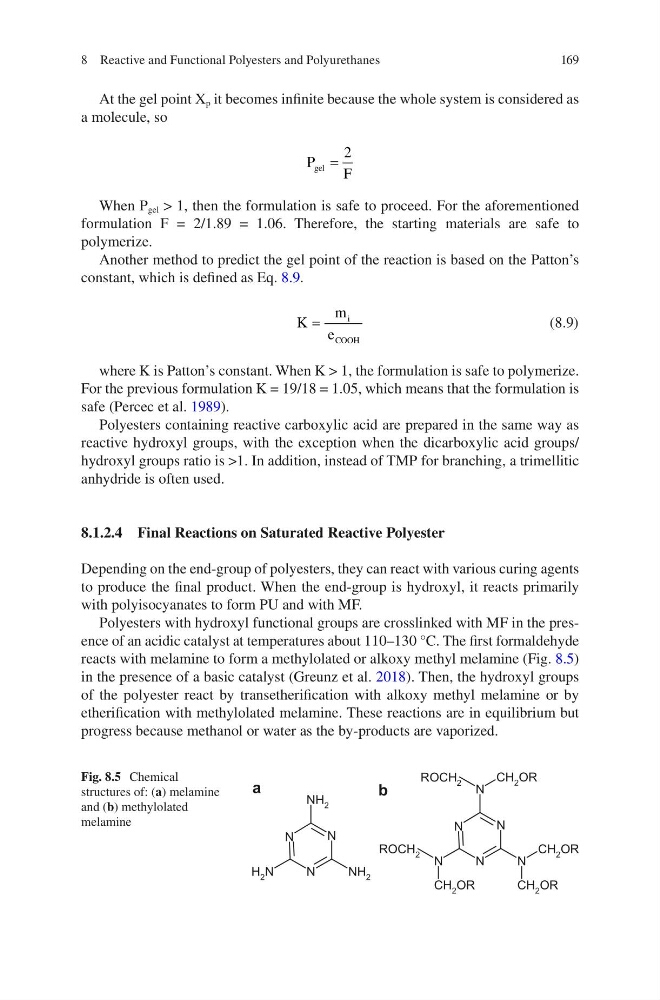
reacts with melamine to form a methylolated or alkoxy methyl melamine (Fig. 8.5)
in the presence of a basic catalyst (Greunz et al. 2018). Then, the hydroxyl groups
of the polyester react by transetherification with alkoxy methyl melamine or by
etherification with methylolated melamine. These reactions are in equilibrium but
progress because methanol or water as the by-products are vaporized.
N
N
N
NH 2
NH 2
N
H 2
N
N
N
N
N
N
CH 2 OR
ROCH 2
CH 2 OR
CH 2 OR
ROCH 2
CH 2 OR
a
b
Fig. 8.5 Chemical
structures of: (a) melamine
and (b) methylolated
melamine
8 Reactive and Functional Polyesters and Polyurethanes
At the gel point X p it becomes infinite because the whole system is considered as
a molecule, so
P
F
gel =
2
When P gel > 1, then the formulation is safe to proceed. For the aforementioned
formulation F = 2/1.89 = 1.06. Therefore, the starting materials are safe to
polymerize.
Another method to predict the gel point of the reaction is based on the Patton’s
constant, which is defined as Eq. 8.9.
K
m
e
i
COOH
=
(8.9)
where K is Patton’s constant. When K > 1, the formulation is safe to polymerize.
For the previous formulation K = 19/18 = 1.05, which means that the formulation is
safe (Percec et al. 1989).
Polyesters containing reactive carboxylic acid are prepared in the same way as
reactive hydroxyl groups, with the exception when the dicarboxylic acid groups/
hydroxyl groups ratio is >1. In addition, instead of TMP for branching, a trimellitic
anhydride is often used.
8.1.2.4 Final Reactions on Saturated Reactive Polyester
Depending on the end-group of polyesters, they can react with various curing agents
to produce the final product. When the end-group is hydroxyl, it reacts primarily
with polyisocyanates to form PU and with MF.
Polyesters with hydroxyl functional groups are crosslinked with MF in the presence of an acidic catalyst at temperatures about 110–130 °C. The first formaldehyde
reacts with melamine to form a methylolated or alkoxy methyl melamine (Fig. 8.5)
in the presence of a basic catalyst (Greunz et al. 2018). Then, the hydroxyl groups
of the polyester react by transetherification with alkoxy methyl melamine or by
etherification with methylolated melamine. These reactions are in equilibrium but
progress because methanol or water as the by-products are vaporized.
N
N
N
NH 2
NH 2
N
H 2
N
N
N
N
N
N
CH 2 OR
ROCH 2
CH 2 OR
CH 2 OR
ROCH 2
CH 2 OR
a
b
Fig. 8.5 Chemical
structures of: (a) melamine
and (b) methylolated
melamine
8 Reactive and Functional Polyesters and Polyurethanes