

171
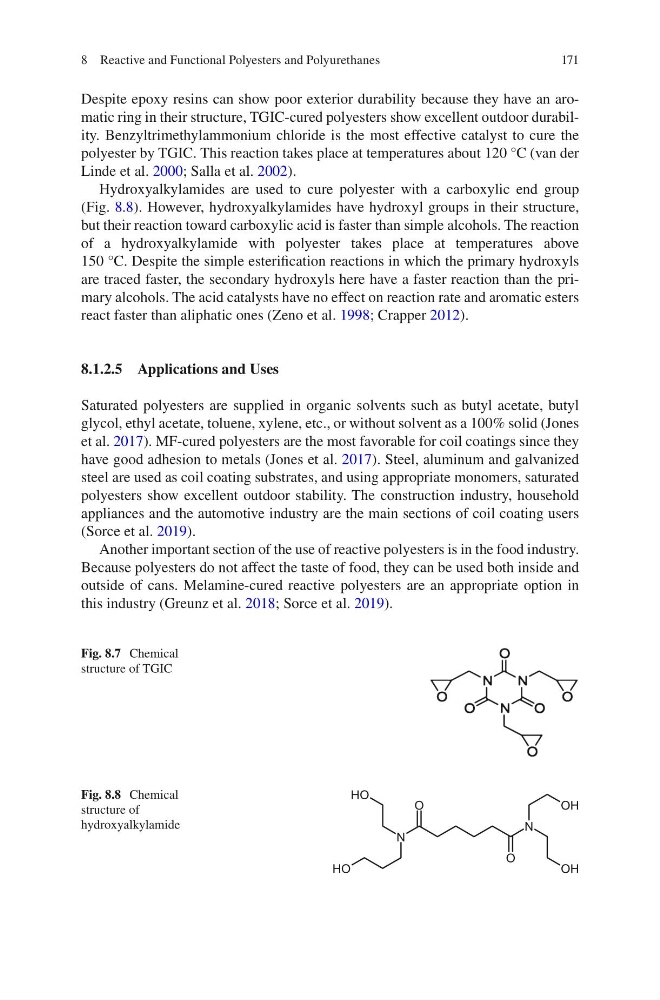
Despite epoxy resins can show poor exterior durability because they have an aromatic ring in their structure, TGIC-cured polyesters show excellent outdoor durability. Benzyltrimethylammonium chloride is the most effective catalyst to cure the
polyester by TGIC. This reaction takes place at temperatures about 120 °C (van der
Linde et al. 2000; Salla et al. 2002).
Hydroxyalkylamides are used to cure polyester with a carboxylic end group
(Fig. 8.8). However, hydroxyalkylamides have hydroxyl groups in their structure,
but their reaction toward carboxylic acid is faster than simple alcohols. The reaction
of a hydroxyalkylamide with polyester takes place at temperatures above
150 °C. Despite the simple esterification reactions in which the primary hydroxyls
are traced faster, the secondary hydroxyls here have a faster reaction than the primary alcohols. The acid catalysts have no effect on reaction rate and aromatic esters
react faster than aliphatic ones (Zeno et al. 1998; Crapper 2012).
8.1.2.5 Applications and Uses
Saturated polyesters are supplied in organic solvents such as butyl acetate, butyl
glycol, ethyl acetate, toluene, xylene, etc., or without solvent as a 100% solid (Jones
et al. 2017). MF-cured polyesters are the most favorable for coil coatings since they
have good adhesion to metals (Jones et al. 2017). Steel, aluminum and galvanized
steel are used as coil coating substrates, and using appropriate monomers, saturated
polyesters show excellent outdoor stability. The construction industry, household
appliances and the automotive industry are the main sections of coil coating users
(Sorce et al. 2019).
Another important section of the use of reactive polyesters is in the food industry.
Because polyesters do not affect the taste of food, they can be used both inside and
outside of cans. Melamine-cured reactive polyesters are an appropriate option in
this industry (Greunz et al. 2018; Sorce et al. 2019).
Fig. 8.7 Chemical
structure of TGIC
O
N
N
O
OH
OH
O
H
O
H
Fig. 8.8 Chemical
structure of
hydroxyalkylamide
8 Reactive and Functional Polyesters and Polyurethanes
Despite epoxy resins can show poor exterior durability because they have an aromatic ring in their structure, TGIC-cured polyesters show excellent outdoor durability. Benzyltrimethylammonium chloride is the most effective catalyst to cure the
polyester by TGIC. This reaction takes place at temperatures about 120 °C (van der
Linde et al. 2000; Salla et al. 2002).
Hydroxyalkylamides are used to cure polyester with a carboxylic end group
(Fig. 8.8). However, hydroxyalkylamides have hydroxyl groups in their structure,
but their reaction toward carboxylic acid is faster than simple alcohols. The reaction
of a hydroxyalkylamide with polyester takes place at temperatures above
150 °C. Despite the simple esterification reactions in which the primary hydroxyls
are traced faster, the secondary hydroxyls here have a faster reaction than the primary alcohols. The acid catalysts have no effect on reaction rate and aromatic esters
react faster than aliphatic ones (Zeno et al. 1998; Crapper 2012).
8.1.2.5 Applications and Uses
Saturated polyesters are supplied in organic solvents such as butyl acetate, butyl
glycol, ethyl acetate, toluene, xylene, etc., or without solvent as a 100% solid (Jones
et al. 2017). MF-cured polyesters are the most favorable for coil coatings since they
have good adhesion to metals (Jones et al. 2017). Steel, aluminum and galvanized
steel are used as coil coating substrates, and using appropriate monomers, saturated
polyesters show excellent outdoor stability. The construction industry, household
appliances and the automotive industry are the main sections of coil coating users
(Sorce et al. 2019).
Another important section of the use of reactive polyesters is in the food industry.
Because polyesters do not affect the taste of food, they can be used both inside and
outside of cans. Melamine-cured reactive polyesters are an appropriate option in
this industry (Greunz et al. 2018; Sorce et al. 2019).
Fig. 8.7 Chemical
structure of TGIC
O
N
N
O
OH
OH
O
H
O
H
Fig. 8.8 Chemical
structure of
hydroxyalkylamide
8 Reactive and Functional Polyesters and Polyurethanes