

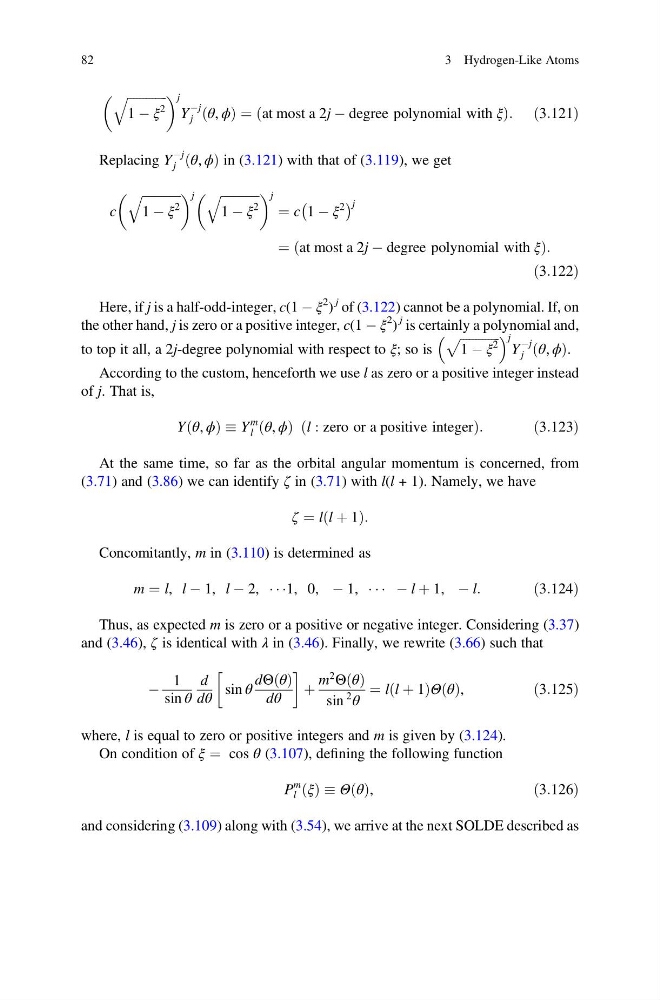
ffiffiffiffiffiffiffiffiffiffiffiffi ffi
1 À ξ
2
q
j
Y
Àj
j θ, ϕ
ð
Þ ¼ at most a 2j À degree polynomial with ξ
ð
Þ : ð3:121Þ
Replacing Y
Àj
j θ, ϕ
ð
Þ in (3.121) with that of (3.119), we get
c
ffiffiffiffiffiffiffiffiffiffiffiffi ffi
1 À ξ
2
q
j
ffiffiffiffiffiffiffiffiffiffiffiffi ffi
1 À ξ
2
q
j
¼ c 1 À ξ
2
À
Á j
¼ at most a 2j À degree polynomial with ξ
ð
Þ :
ð3:122Þ
Here, if j is a half-odd-integer, c(1 À ξ
2 )
j of (3.122) cannot be a polynomial. If, on
the other hand, j is zero or a positive integer, c(1 À ξ
2 )
j is certainly a polynomial and,
to top it all, a 2j-degree polynomial with respect to ξ; so is
ffiffiffiffiffiffiffiffiffiffiffiffi ffi
1 À ξ
2
p
j
Y
Àj
j θ, ϕ
ð
Þ.
According to the custom, henceforth we use l as zero or a positive integer instead
of j. That is,
Y θ, ϕ
ð
Þ Y
m
l θ, ϕ
ð
Þ l : zero or a positive integer
ð
Þ :
ð3:123Þ
At the same time, so far as the orbital angular momentum is concerned, from
(3.71) and (3.86) we can identify ζ in (3.71) with l(l + 1). Namely, we have
ζ ¼ l l þ 1
ð
Þ:
Concomitantly, m in (3.110) is determined as
m ¼ l, l À 1, l À 2, Á Á Á1, 0, À 1, Á Á Á À l þ 1, À l:
ð3:124Þ
Thus, as expected m is zero or a positive or negative integer. Considering (3.37)
and (3.46), ζ is identical with λ in (3.46). Finally, we rewrite (3.66) such that
À
1
sin θ
d
dθ
sin θ
dΘ θ
ð Þ
dθ
!
þ
m
2
Θ θ
ð Þ
sin
2
θ
¼ l l þ 1
ð
ÞΘ θ
ð Þ,
ð3:125Þ
where, l is equal to zero or positive integers and m is given by (3.124).
On condition of ξ ¼ cos θ (3.107), defining the following function
P
m
l ξ
ð Þ Θ θ
ð Þ,
ð3:126Þ
and considering (3.109) along with (3.54), we arrive at the next SOLDE described as
82
3 Hydrogen-Like Atoms
1 À ξ
2
q
j
Y
Àj
j θ, ϕ
ð
Þ ¼ at most a 2j À degree polynomial with ξ
ð
Þ : ð3:121Þ
Replacing Y
Àj
j θ, ϕ
ð
Þ in (3.121) with that of (3.119), we get
c
ffiffiffiffiffiffiffiffiffiffiffiffi ffi
1 À ξ
2
q
j
ffiffiffiffiffiffiffiffiffiffiffiffi ffi
1 À ξ
2
q
j
¼ c 1 À ξ
2
À
Á j
¼ at most a 2j À degree polynomial with ξ
ð
Þ :
ð3:122Þ
Here, if j is a half-odd-integer, c(1 À ξ
2 )
j of (3.122) cannot be a polynomial. If, on
the other hand, j is zero or a positive integer, c(1 À ξ
2 )
j is certainly a polynomial and,
to top it all, a 2j-degree polynomial with respect to ξ; so is
ffiffiffiffiffiffiffiffiffiffiffiffi ffi
1 À ξ
2
p
j
Y
Àj
j θ, ϕ
ð
Þ.
According to the custom, henceforth we use l as zero or a positive integer instead
of j. That is,
Y θ, ϕ
ð
Þ Y
m
l θ, ϕ
ð
Þ l : zero or a positive integer
ð
Þ :
ð3:123Þ
At the same time, so far as the orbital angular momentum is concerned, from
(3.71) and (3.86) we can identify ζ in (3.71) with l(l + 1). Namely, we have
ζ ¼ l l þ 1
ð
Þ:
Concomitantly, m in (3.110) is determined as
m ¼ l, l À 1, l À 2, Á Á Á1, 0, À 1, Á Á Á À l þ 1, À l:
ð3:124Þ
Thus, as expected m is zero or a positive or negative integer. Considering (3.37)
and (3.46), ζ is identical with λ in (3.46). Finally, we rewrite (3.66) such that
À
1
sin θ
d
dθ
sin θ
dΘ θ
ð Þ
dθ
!
þ
m
2
Θ θ
ð Þ
sin
2
θ
¼ l l þ 1
ð
ÞΘ θ
ð Þ,
ð3:125Þ
where, l is equal to zero or positive integers and m is given by (3.124).
On condition of ξ ¼ cos θ (3.107), defining the following function
P
m
l ξ
ð Þ Θ θ
ð Þ,
ð3:126Þ
and considering (3.109) along with (3.54), we arrive at the next SOLDE described as
82
3 Hydrogen-Like Atoms