

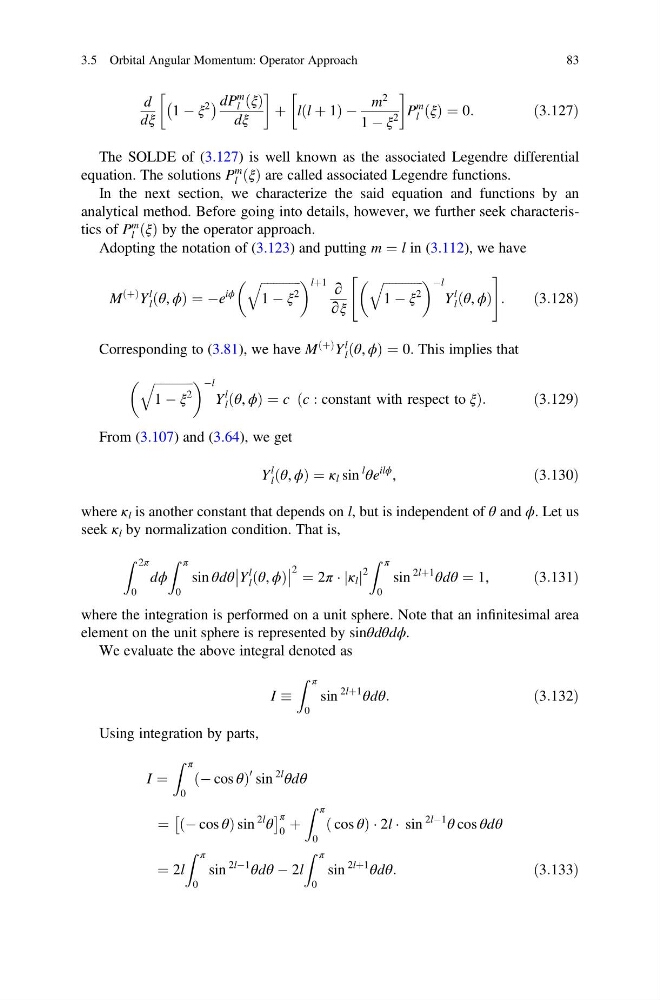
d
dξ
1 À ξ
2
À
Á dP
m
l ξ
ð Þ
dξ
!
þ l l þ 1
ð
ÞÀ
m
2
1 À ξ
2
!
P
m
l ξ
ð Þ ¼ 0:
ð3:127Þ
The SOLDE of (3.127) is well known as the associated Legendre differential
equation. The solutions P
m
l ξ
ð Þ are called associated Legendre functions.
In the next section, we characterize the said equation and functions by an
analytical method. Before going into details, however, we further seek characteristics of P
m
l ξ
ð Þ by the operator approach.
Adopting the notation of (3.123) and putting m ¼ l in (3.112), we have
M
þ
ð Þ Y
l
l θ, ϕ
ð
Þ ¼ Àe
iϕ
ffiffiffiffiffiffiffiffiffiffiffiffi ffi
1 À ξ
2
q
lþ1 ∂
∂ξ
ffiffiffiffiffiffiffiffiffiffiffiffi ffi
1 À ξ
2
q
Àl
Y
l
l θ, ϕ
ð
Þ
"
#
:
ð3:128Þ
Corresponding to (3.81), we have M
þ
ð Þ Y
l
l θ, ϕ
ð
Þ ¼ 0. This implies that
ffiffiffiffiffiffiffiffiffiffiffiffi ffi
1 À ξ
2
q
Àl
Y
l
l θ, ϕ
ð
Þ ¼ c c : constant with respect to ξ
ð
Þ :
ð3:129Þ
From (3.107) and (3.64), we get
Y
l
l θ, ϕ
ð
Þ ¼ κ l sin
l
θe
ilϕ ,
ð3:130Þ
where κ l is another constant that depends on l, but is independent of θ and ϕ. Let us
seek κ l by normalization condition. That is,
Z 2π
0
dϕ
Z π
0
sin θdθ Y
l
l θ, ϕ
ð
Þ
2 ¼ 2π Á κ l
j j
2
Z π
0
sin
2lþ1
θdθ ¼ 1,
ð3:131Þ
where the integration is performed on a unit sphere. Note that an infinitesimal area
element on the unit sphere is represented by sinθdθdϕ.
We evaluate the above integral denoted as
I
Z π
0
sin
2lþ1
θdθ:
ð3:132Þ
Using integration by parts,
I ¼
Z π
0
À cos θ
ð
Þ
0 sin
2l
θdθ
¼ Àcos θ
ð
Þsin
2l
θ
Â
à π
0
þ
Z π
0
cos θ
ð
ÞÁ2l Á sin
2lÀ1
θ cos θdθ
¼ 2l
Z π
0
sin
2lÀ1
θdθ À 2l
Z π
0
sin
2lþ1
θdθ:
ð3:133Þ
3.5 Orbital Angular Momentum: Operator Approach
83
dξ
1 À ξ
2
À
Á dP
m
l ξ
ð Þ
dξ
!
þ l l þ 1
ð
ÞÀ
m
2
1 À ξ
2
!
P
m
l ξ
ð Þ ¼ 0:
ð3:127Þ
The SOLDE of (3.127) is well known as the associated Legendre differential
equation. The solutions P
m
l ξ
ð Þ are called associated Legendre functions.
In the next section, we characterize the said equation and functions by an
analytical method. Before going into details, however, we further seek characteristics of P
m
l ξ
ð Þ by the operator approach.
Adopting the notation of (3.123) and putting m ¼ l in (3.112), we have
M
þ
ð Þ Y
l
l θ, ϕ
ð
Þ ¼ Àe
iϕ
ffiffiffiffiffiffiffiffiffiffiffiffi ffi
1 À ξ
2
q
lþ1 ∂
∂ξ
ffiffiffiffiffiffiffiffiffiffiffiffi ffi
1 À ξ
2
q
Àl
Y
l
l θ, ϕ
ð
Þ
"
#
:
ð3:128Þ
Corresponding to (3.81), we have M
þ
ð Þ Y
l
l θ, ϕ
ð
Þ ¼ 0. This implies that
ffiffiffiffiffiffiffiffiffiffiffiffi ffi
1 À ξ
2
q
Àl
Y
l
l θ, ϕ
ð
Þ ¼ c c : constant with respect to ξ
ð
Þ :
ð3:129Þ
From (3.107) and (3.64), we get
Y
l
l θ, ϕ
ð
Þ ¼ κ l sin
l
θe
ilϕ ,
ð3:130Þ
where κ l is another constant that depends on l, but is independent of θ and ϕ. Let us
seek κ l by normalization condition. That is,
Z 2π
0
dϕ
Z π
0
sin θdθ Y
l
l θ, ϕ
ð
Þ
2 ¼ 2π Á κ l
j j
2
Z π
0
sin
2lþ1
θdθ ¼ 1,
ð3:131Þ
where the integration is performed on a unit sphere. Note that an infinitesimal area
element on the unit sphere is represented by sinθdθdϕ.
We evaluate the above integral denoted as
I
Z π
0
sin
2lþ1
θdθ:
ð3:132Þ
Using integration by parts,
I ¼
Z π
0
À cos θ
ð
Þ
0 sin
2l
θdθ
¼ Àcos θ
ð
Þsin
2l
θ
Â
à π
0
þ
Z π
0
cos θ
ð
ÞÁ2l Á sin
2lÀ1
θ cos θdθ
¼ 2l
Z π
0
sin
2lÀ1
θdθ À 2l
Z π
0
sin
2lþ1
θdθ:
ð3:133Þ
3.5 Orbital Angular Momentum: Operator Approach
83