

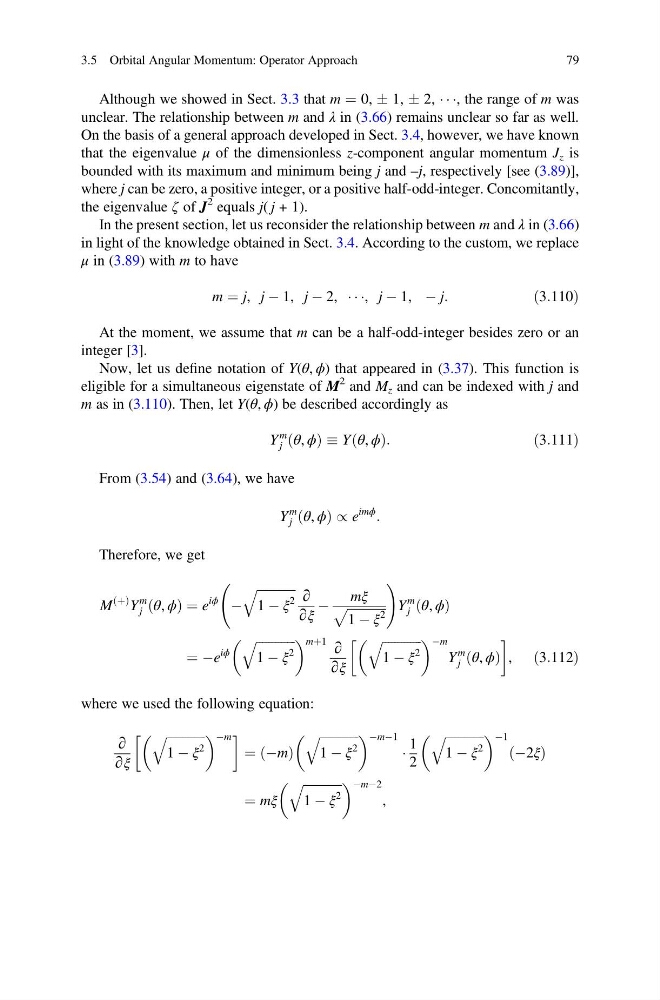
Although we showed in Sect. 3.3 that m ¼ 0, Æ 1, Æ 2, Á Á Á, the range of m was
unclear. The relationship between m and λ in (3.66) remains unclear so far as well.
On the basis of a general approach developed in Sect. 3.4, however, we have known
that the eigenvalue μ of the dimensionless z-component angular momentum J z is
bounded with its maximum and minimum being j and –j, respectively [see (3.89)],
where j can be zero, a positive integer, or a positive half-odd-integer. Concomitantly,
the eigenvalue ζ of J
2 equals j( j + 1).
In the present section, let us reconsider the relationship between m and λ in (3.66)
in light of the knowledge obtained in Sect. 3.4. According to the custom, we replace
μ in (3.89) with m to have
m ¼ j, j À 1, j À 2, Á Á Á, j À 1, À j:
ð3:110Þ
At the moment, we assume that m can be a half-odd-integer besides zero or an
integer [3].
Now, let us define notation of Y(θ, ϕ) that appeared in (3.37). This function is
eligible for a simultaneous eigenstate of M
2 and M z and can be indexed with j and
m as in (3.110). Then, let Y(θ, ϕ) be described accordingly as
Y
m
j θ, ϕ
ð
Þ Y θ, ϕ
ð
Þ:
ð3:111Þ
From (3.54) and (3.64), we have
Y
m
j θ, ϕ
ð
Þ / e
imϕ
:
Therefore, we get
M
þ
ð Þ Y
m
j θ, ϕ
ð
Þ ¼ e
iϕ
À
ffiffiffiffiffiffiffiffiffiffiffiffi ffi
1 À ξ
2
q
∂
∂ξ
À
mξ
ffiffiffiffiffiffiffiffiffiffiffiffi ffi
1 À ξ
2
p
!
Y
m
j θ, ϕ
ð
Þ
¼ Àe
iϕ
ffiffiffiffiffiffiffiffiffiffiffiffi ffi
1 À ξ
2
q
mþ1 ∂
∂ξ
ffiffiffiffiffiffiffiffiffiffiffiffi ffi
1 À ξ
2
q
Àm
Y
m
j θ, ϕ
ð
Þ
!
, ð3:112Þ
where we used the following equation:
∂
∂ξ
ffiffiffiffiffiffiffiffiffiffiffiffi ffi
1 À ξ
2
q
Àm !
¼ Àm
ð Þ
ffiffiffiffiffiffiffiffiffiffiffiffi ffi
1 À ξ
2
q
ÀmÀ1
Á
1
2
ffiffiffiffiffiffiffiffiffiffiffiffi ffi
1 À ξ
2
q
À1
À2ξ
ð
Þ
¼ mξ
ffiffiffiffiffiffiffiffiffiffiffiffi ffi
1 À ξ
2
q
ÀmÀ2
,
3.5 Orbital Angular Momentum: Operator Approach
79
unclear. The relationship between m and λ in (3.66) remains unclear so far as well.
On the basis of a general approach developed in Sect. 3.4, however, we have known
that the eigenvalue μ of the dimensionless z-component angular momentum J z is
bounded with its maximum and minimum being j and –j, respectively [see (3.89)],
where j can be zero, a positive integer, or a positive half-odd-integer. Concomitantly,
the eigenvalue ζ of J
2 equals j( j + 1).
In the present section, let us reconsider the relationship between m and λ in (3.66)
in light of the knowledge obtained in Sect. 3.4. According to the custom, we replace
μ in (3.89) with m to have
m ¼ j, j À 1, j À 2, Á Á Á, j À 1, À j:
ð3:110Þ
At the moment, we assume that m can be a half-odd-integer besides zero or an
integer [3].
Now, let us define notation of Y(θ, ϕ) that appeared in (3.37). This function is
eligible for a simultaneous eigenstate of M
2 and M z and can be indexed with j and
m as in (3.110). Then, let Y(θ, ϕ) be described accordingly as
Y
m
j θ, ϕ
ð
Þ Y θ, ϕ
ð
Þ:
ð3:111Þ
From (3.54) and (3.64), we have
Y
m
j θ, ϕ
ð
Þ / e
imϕ
:
Therefore, we get
M
þ
ð Þ Y
m
j θ, ϕ
ð
Þ ¼ e
iϕ
À
ffiffiffiffiffiffiffiffiffiffiffiffi ffi
1 À ξ
2
q
∂
∂ξ
À
mξ
ffiffiffiffiffiffiffiffiffiffiffiffi ffi
1 À ξ
2
p
!
Y
m
j θ, ϕ
ð
Þ
¼ Àe
iϕ
ffiffiffiffiffiffiffiffiffiffiffiffi ffi
1 À ξ
2
q
mþ1 ∂
∂ξ
ffiffiffiffiffiffiffiffiffiffiffiffi ffi
1 À ξ
2
q
Àm
Y
m
j θ, ϕ
ð
Þ
!
, ð3:112Þ
where we used the following equation:
∂
∂ξ
ffiffiffiffiffiffiffiffiffiffiffiffi ffi
1 À ξ
2
q
Àm !
¼ Àm
ð Þ
ffiffiffiffiffiffiffiffiffiffiffiffi ffi
1 À ξ
2
q
ÀmÀ1
Á
1
2
ffiffiffiffiffiffiffiffiffiffiffiffi ffi
1 À ξ
2
q
À1
À2ξ
ð
Þ
¼ mξ
ffiffiffiffiffiffiffiffiffiffiffiffi ffi
1 À ξ
2
q
ÀmÀ2
,
3.5 Orbital Angular Momentum: Operator Approach
79