

J
2 J
þ
ð Þ
jζ, μi ¼ J
þ
ð Þ J
2
jμi ¼ ζJ
þ
ð Þ
jζ, μi,
J
2 J
À
ð Þ
jζ, μi ¼ J
À
ð Þ J
2
jζ, μi ¼ ζJ
À
ð Þ
jζ, μi:
ð3:75Þ
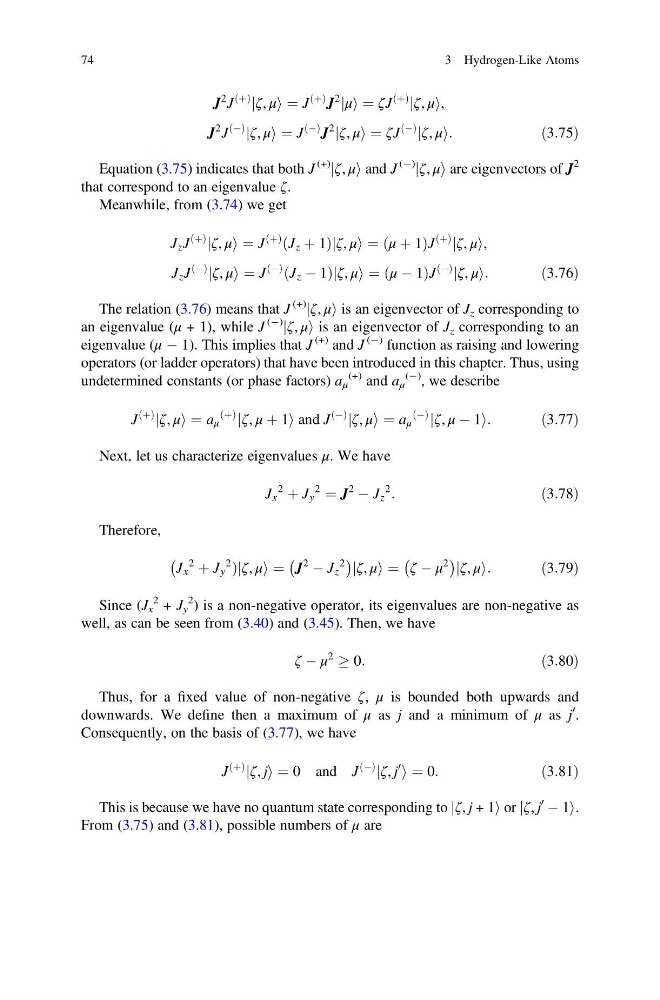
Equation (3.75) indicates that both J
(+)
jζ, μi and J
(À)
jζ, μi are eigenvectors of J
2
that correspond to an eigenvalue ζ.
Meanwhile, from (3.74) we get
J z J
þ
ð Þ
jζ, μi ¼ J
þ
ð Þ J z þ 1
ð
Þjζ, μi ¼ μ þ 1
ð
ÞJ
þ
ð Þ
jζ, μi,
J z J
À
ð Þ
jζ, μi ¼ J
À
ð Þ J z À 1
ð
Þjζ, μi ¼ μ À 1
ð
ÞJ
À
ð Þ
jζ, μi:
ð3:76Þ
The relation (3.76) means that J
(+)
jζ, μi is an eigenvector of J z corresponding to
an eigenvalue (μ + 1), while J
(À)
jζ, μi is an eigenvector of J z corresponding to an
eigenvalue (μ À 1). This implies that J
(+) and J
(À) function as raising and lowering
operators (or ladder operators) that have been introduced in this chapter. Thus, using
undetermined constants (or phase factors) a μ
(+) and a μ
(À) , we describe
J
þ
ð Þ
jζ, μi ¼ a μ
þ
ð Þ
jζ, μ þ 1i and J
À
ð Þ
jζ, μi ¼ a μ
À
ð Þ
jζ, μ À 1i:
ð3:77Þ
Next, let us characterize eigenvalues μ. We have
J x
2
þ J y
2
¼ J
2
À J z
2
:
ð3:78Þ
Therefore,
J x
2
þ J y
2
Þjζ, μi ¼ J
2
À J z
2
À
Á jζ, μi ¼ ζ À μ
2
À
Á jζ, μi:
À
ð3:79Þ
Since (J x
2 + J y
2 ) is a non-negative operator, its eigenvalues are non-negative as
well, as can be seen from (3.40) and (3.45). Then, we have
ζ À μ
2
! 0:
ð3:80Þ
Thus, for a fixed value of non-negative ζ, μ is bounded both upwards and
downwards. We define then a maximum of μ as j and a minimum of μ as j
0 .
Consequently, on the basis of (3.77), we have
J
þ
ð Þ
jζ, ji ¼ 0 and J
À
ð Þ
jζ, j
0
i ¼ 0:
ð3:81Þ
This is because we have no quantum state corresponding to jζ, j + 1i or jζ, j
0
À 1i.
From (3.75) and (3.81), possible numbers of μ are
74
3 Hydrogen-Like Atoms
2 J
þ
ð Þ
jζ, μi ¼ J
þ
ð Þ J
2
jμi ¼ ζJ
þ
ð Þ
jζ, μi,
J
2 J
À
ð Þ
jζ, μi ¼ J
À
ð Þ J
2
jζ, μi ¼ ζJ
À
ð Þ
jζ, μi:
ð3:75Þ
Equation (3.75) indicates that both J
(+)
jζ, μi and J
(À)
jζ, μi are eigenvectors of J
2
that correspond to an eigenvalue ζ.
Meanwhile, from (3.74) we get
J z J
þ
ð Þ
jζ, μi ¼ J
þ
ð Þ J z þ 1
ð
Þjζ, μi ¼ μ þ 1
ð
ÞJ
þ
ð Þ
jζ, μi,
J z J
À
ð Þ
jζ, μi ¼ J
À
ð Þ J z À 1
ð
Þjζ, μi ¼ μ À 1
ð
ÞJ
À
ð Þ
jζ, μi:
ð3:76Þ
The relation (3.76) means that J
(+)
jζ, μi is an eigenvector of J z corresponding to
an eigenvalue (μ + 1), while J
(À)
jζ, μi is an eigenvector of J z corresponding to an
eigenvalue (μ À 1). This implies that J
(+) and J
(À) function as raising and lowering
operators (or ladder operators) that have been introduced in this chapter. Thus, using
undetermined constants (or phase factors) a μ
(+) and a μ
(À) , we describe
J
þ
ð Þ
jζ, μi ¼ a μ
þ
ð Þ
jζ, μ þ 1i and J
À
ð Þ
jζ, μi ¼ a μ
À
ð Þ
jζ, μ À 1i:
ð3:77Þ
Next, let us characterize eigenvalues μ. We have
J x
2
þ J y
2
¼ J
2
À J z
2
:
ð3:78Þ
Therefore,
J x
2
þ J y
2
Þjζ, μi ¼ J
2
À J z
2
À
Á jζ, μi ¼ ζ À μ
2
À
Á jζ, μi:
À
ð3:79Þ
Since (J x
2 + J y
2 ) is a non-negative operator, its eigenvalues are non-negative as
well, as can be seen from (3.40) and (3.45). Then, we have
ζ À μ
2
! 0:
ð3:80Þ
Thus, for a fixed value of non-negative ζ, μ is bounded both upwards and
downwards. We define then a maximum of μ as j and a minimum of μ as j
0 .
Consequently, on the basis of (3.77), we have
J
þ
ð Þ
jζ, ji ¼ 0 and J
À
ð Þ
jζ, j
0
i ¼ 0:
ð3:81Þ
This is because we have no quantum state corresponding to jζ, j + 1i or jζ, j
0
À 1i.
From (3.75) and (3.81), possible numbers of μ are
74
3 Hydrogen-Like Atoms