

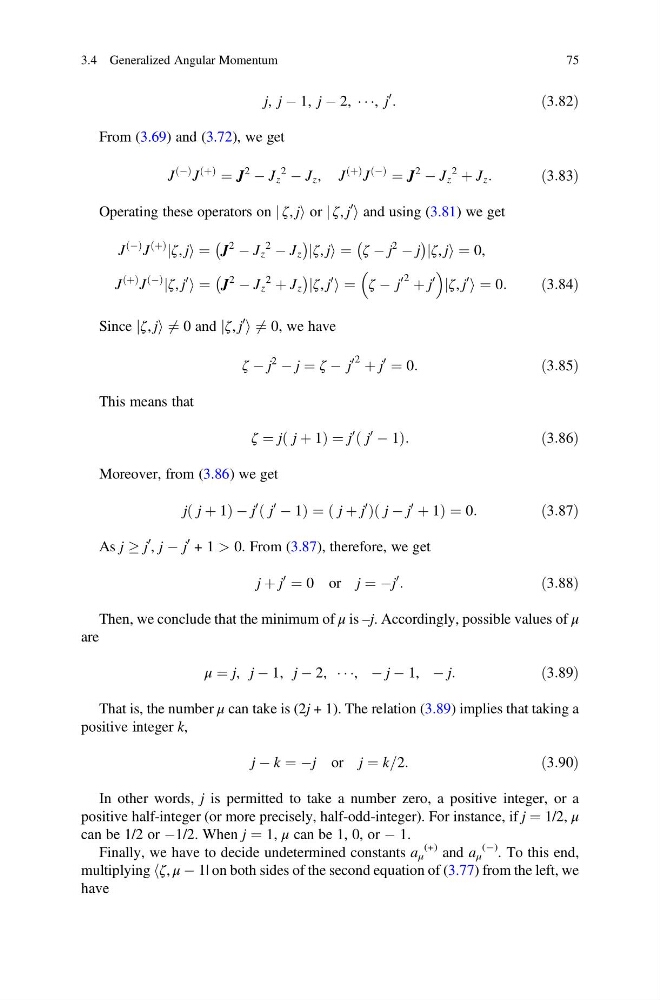
j, j À 1, j À 2, Á Á Á, j
0
:
ð3:82Þ
From (3.69) and (3.72), we get
J
À
ð Þ J
þ
ð Þ
¼ J
2
À J z
2
À J z , J
þ
ð Þ J
À
ð Þ
¼ J
2
À J z
2
þ J z :
ð3:83Þ
Operating these operators on j ζ, ji or j ζ, j
0
i and using (3.81) we get
J
À
ð Þ J
þ
ð Þ
jζ, ji ¼ J
2
À J z
2
À J z
À
Á jζ, ji ¼ ζ À j
2
À j
À
Á jζ, ji ¼ 0,
J
þ
ð Þ J
À
ð Þ
jζ, j
0
i ¼ J
2
À J z
2
þ J z
À
Á jζ, j
0
i ¼ ζ À j
0 2 þ j
0
jζ, j
0
i ¼ 0:
ð3:84Þ
Since jζ, ji 6 ¼ 0 and jζ, j
0
i 6 ¼ 0, we have
ζ À j
2
À j ¼ ζ À j
0 2 þ j
0
¼ 0:
ð3:85Þ
This means that
ζ ¼ j j þ 1
ð
Þ¼j
0 j
0
À 1
ð
Þ:
ð3:86Þ
Moreover, from (3.86) we get
j j þ 1
ð
ÞÀj
0 j
0
À 1
ð
Þ¼ j þ j
0
ð
Þ j À j
0
þ 1
ð
Þ¼0:
ð3:87Þ
As j ! j
0 , j À j
0 + 1 > 0. From (3.87), therefore, we get
j þ j
0
¼ 0 or j ¼ Àj
0
:
ð3:88Þ
Then, we conclude that the minimum of μ is –j. Accordingly, possible values of μ
are
μ ¼ j, j À 1, j À 2, Á Á Á, À j À 1, À j:
ð3:89Þ
That is, the number μ can take is (2j + 1). The relation (3.89) implies that taking a
positive integer k,
j À k ¼ Àj or j ¼ k=2:
ð3:90Þ
In other words, j is permitted to take a number zero, a positive integer, or a
positive half-integer (or more precisely, half-odd-integer). For instance, if j ¼ 1/2, μ
can be 1/2 or À1/2. When j ¼ 1, μ can be 1, 0, or À 1.
Finally, we have to decide undetermined constants a μ
(+) and a μ
(À) . To this end,
multiplying hζ, μ À 1| on both sides of the second equation of (3.77) from the left, we
have
3.4 Generalized Angular Momentum
75
0
:
ð3:82Þ
From (3.69) and (3.72), we get
J
À
ð Þ J
þ
ð Þ
¼ J
2
À J z
2
À J z , J
þ
ð Þ J
À
ð Þ
¼ J
2
À J z
2
þ J z :
ð3:83Þ
Operating these operators on j ζ, ji or j ζ, j
0
i and using (3.81) we get
J
À
ð Þ J
þ
ð Þ
jζ, ji ¼ J
2
À J z
2
À J z
À
Á jζ, ji ¼ ζ À j
2
À j
À
Á jζ, ji ¼ 0,
J
þ
ð Þ J
À
ð Þ
jζ, j
0
i ¼ J
2
À J z
2
þ J z
À
Á jζ, j
0
i ¼ ζ À j
0 2 þ j
0
jζ, j
0
i ¼ 0:
ð3:84Þ
Since jζ, ji 6 ¼ 0 and jζ, j
0
i 6 ¼ 0, we have
ζ À j
2
À j ¼ ζ À j
0 2 þ j
0
¼ 0:
ð3:85Þ
This means that
ζ ¼ j j þ 1
ð
Þ¼j
0 j
0
À 1
ð
Þ:
ð3:86Þ
Moreover, from (3.86) we get
j j þ 1
ð
ÞÀj
0 j
0
À 1
ð
Þ¼ j þ j
0
ð
Þ j À j
0
þ 1
ð
Þ¼0:
ð3:87Þ
As j ! j
0 , j À j
0 + 1 > 0. From (3.87), therefore, we get
j þ j
0
¼ 0 or j ¼ Àj
0
:
ð3:88Þ
Then, we conclude that the minimum of μ is –j. Accordingly, possible values of μ
are
μ ¼ j, j À 1, j À 2, Á Á Á, À j À 1, À j:
ð3:89Þ
That is, the number μ can take is (2j + 1). The relation (3.89) implies that taking a
positive integer k,
j À k ¼ Àj or j ¼ k=2:
ð3:90Þ
In other words, j is permitted to take a number zero, a positive integer, or a
positive half-integer (or more precisely, half-odd-integer). For instance, if j ¼ 1/2, μ
can be 1/2 or À1/2. When j ¼ 1, μ can be 1, 0, or À 1.
Finally, we have to decide undetermined constants a μ
(+) and a μ
(À) . To this end,
multiplying hζ, μ À 1| on both sides of the second equation of (3.77) from the left, we
have
3.4 Generalized Angular Momentum
75