

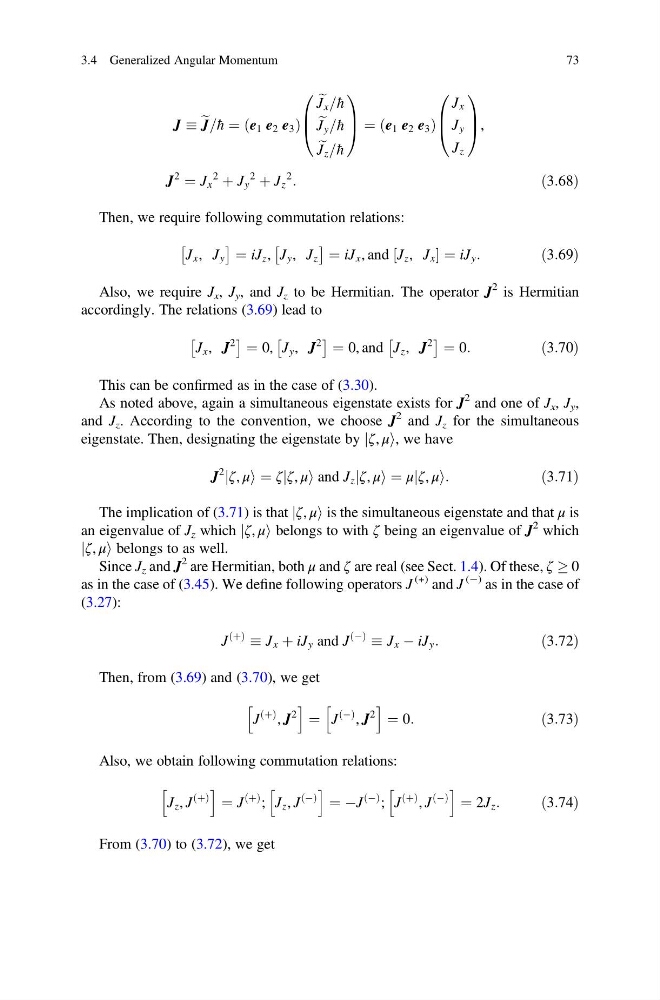
J e J=ħ ¼ e 1 e 2 e 3
ð
Þ
e
J x =ħ
e
J y =ħ
e
J z =ħ
0
B
@
1
C
A ¼ e 1 e 2 e 3
ð
Þ
J x
J y
J z
0
B
@
1
C
A,
J
2
¼ J x
2
þ J y
2
þ J z
2
:
ð3:68Þ
Then, we require following commutation relations:
J x , J y
Â
à ¼ iJ z , J y , J z
Â
à ¼ iJ x , and J z , J x
½
¼iJ y :
ð3:69Þ
Also, we require J x , J y , and J z to be Hermitian. The operator J
2 is Hermitian
accordingly. The relations (3.69) lead to
J x , J
2
Â
à ¼ 0, J y , J
2
Â
à ¼ 0, and J z , J
2
Â
à ¼ 0:
ð3:70Þ
This can be confirmed as in the case of (3.30).
As noted above, again a simultaneous eigenstate exists for J
2 and one of J x , J y ,
and J z . According to the convention, we choose J
2 and J z for the simultaneous
eigenstate. Then, designating the eigenstate by jζ, μi, we have
J
2
jζ, μi ¼ ζjζ, μi and J z jζ, μi ¼ μjζ, μi:
ð3:71Þ
The implication of (3.71) is that jζ, μi is the simultaneous eigenstate and that μ is
an eigenvalue of J z which jζ, μi belongs to with ζ being an eigenvalue of J
2 which
jζ, μi belongs to as well.
Since J z and J
2 are Hermitian, both μ and ζ are real (see Sect. 1.4). Of these, ζ ! 0
as in the case of (3.45). We define following operators J
(+) and J
(À) as in the case of
(3.27):
J
þ
ð Þ
J x þ iJ y and J
À
ð Þ
J x À iJ y :
ð3:72Þ
Then, from (3.69) and (3.70), we get
J
þ
ð Þ , J
2
h
i
¼ J
À
ð Þ , J
2
h
i
¼ 0:
ð3:73Þ
Also, we obtain following commutation relations:
J z , J
þ
ð Þ
h
i
¼ J
þ
ð Þ ; J z , J
À
ð Þ
h
i
¼ ÀJ
À
ð Þ ; J
þ
ð Þ , J
À
ð Þ
h
i
¼ 2J z :
ð3:74Þ
From (3.70) to (3.72), we get
3.4 Generalized Angular Momentum
73
ð
Þ
e
J x =ħ
e
J y =ħ
e
J z =ħ
0
B
@
1
C
A ¼ e 1 e 2 e 3
ð
Þ
J x
J y
J z
0
B
@
1
C
A,
J
2
¼ J x
2
þ J y
2
þ J z
2
:
ð3:68Þ
Then, we require following commutation relations:
J x , J y
Â
à ¼ iJ z , J y , J z
Â
à ¼ iJ x , and J z , J x
½
¼iJ y :
ð3:69Þ
Also, we require J x , J y , and J z to be Hermitian. The operator J
2 is Hermitian
accordingly. The relations (3.69) lead to
J x , J
2
Â
à ¼ 0, J y , J
2
Â
à ¼ 0, and J z , J
2
Â
à ¼ 0:
ð3:70Þ
This can be confirmed as in the case of (3.30).
As noted above, again a simultaneous eigenstate exists for J
2 and one of J x , J y ,
and J z . According to the convention, we choose J
2 and J z for the simultaneous
eigenstate. Then, designating the eigenstate by jζ, μi, we have
J
2
jζ, μi ¼ ζjζ, μi and J z jζ, μi ¼ μjζ, μi:
ð3:71Þ
The implication of (3.71) is that jζ, μi is the simultaneous eigenstate and that μ is
an eigenvalue of J z which jζ, μi belongs to with ζ being an eigenvalue of J
2 which
jζ, μi belongs to as well.
Since J z and J
2 are Hermitian, both μ and ζ are real (see Sect. 1.4). Of these, ζ ! 0
as in the case of (3.45). We define following operators J
(+) and J
(À) as in the case of
(3.27):
J
þ
ð Þ
J x þ iJ y and J
À
ð Þ
J x À iJ y :
ð3:72Þ
Then, from (3.69) and (3.70), we get
J
þ
ð Þ , J
2
h
i
¼ J
À
ð Þ , J
2
h
i
¼ 0:
ð3:73Þ
Also, we obtain following commutation relations:
J z , J
þ
ð Þ
h
i
¼ J
þ
ð Þ ; J z , J
À
ð Þ
h
i
¼ ÀJ
À
ð Þ ; J
þ
ð Þ , J
À
ð Þ
h
i
¼ 2J z :
ð3:74Þ
From (3.70) to (3.72), we get
3.4 Generalized Angular Momentum
73