

1
2μ
À
ħ
2
r 2
∂
∂r
r
2 ∂R r
ð Þ
∂r
þ
ħ
2
λ
r 2
!
R r
ð Þ À
Ze
2
4πε 0 r
R r
ð Þ ¼ ER r
ð Þ:
ð3:51Þ
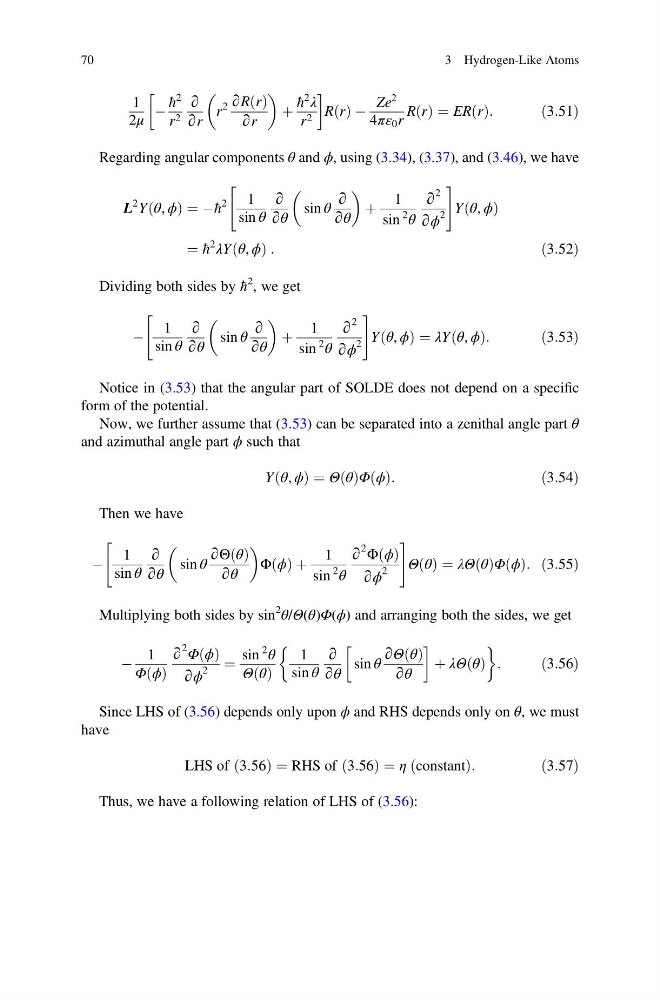
Regarding angular components θ and ϕ, using (3.34), (3.37), and (3.46), we have
L
2 Y θ, ϕ
ð
Þ ¼ Àħ
2
1
sin θ
∂
∂θ
sin θ
∂
∂θ
þ
1
sin
2
θ
∂
2
∂ϕ
2
"
#
Y θ, ϕ
ð
Þ
¼ ħ
2
λY θ, ϕ
ð
Þ:
ð3:52Þ
Dividing both sides by ħ
2 , we get
À
1
sin θ
∂
∂θ
sin θ
∂
∂θ
þ
1
sin
2
θ
∂
2
∂ϕ
2
"
#
Y θ, ϕ
ð
Þ ¼ λY θ, ϕ
ð
Þ:
ð3:53Þ
Notice in (3.53) that the angular part of SOLDE does not depend on a specific
form of the potential.
Now, we further assume that (3.53) can be separated into a zenithal angle part θ
and azimuthal angle part ϕ such that
Y θ, ϕ
ð
Þ ¼ Θ θ
ð ÞΦ ϕ
ð Þ:
ð3:54Þ
Then we have
À
1
sin θ
∂
∂θ
sin θ
∂Θ θ
ð Þ
∂θ
Φ ϕ
ð Þ þ
1
sin
2
θ
∂
2 Φ ϕ
ð Þ
∂ϕ
2
"
#
Θ θ
ð Þ ¼ λΘ θ
ð ÞΦ ϕ
ð Þ: ð3:55Þ
Multiplying both sides by sin
2
θ/Θ(θ)Φ(ϕ) and arranging both the sides, we get
À
1
Φ ϕ
ð Þ
∂
2 Φ ϕ
ð Þ
∂ϕ
2
¼
sin
2
θ
Θ θ
ð Þ
1
sin θ
∂
∂θ
sin θ
∂Θ θ
ð Þ
∂θ
!
þ λΘ θ
ð Þ
&
'
:
ð3:56Þ
Since LHS of (3.56) depends only upon ϕ and RHS depends only on θ, we must
have
LHS of 3:56
ð
Þ¼ RHS of 3:56
ð
Þ ¼η constant
ð
Þ :
ð3:57Þ
Thus, we have a following relation of LHS of (3.56):
70
3 Hydrogen-Like Atoms
2μ
À
ħ
2
r 2
∂
∂r
r
2 ∂R r
ð Þ
∂r
þ
ħ
2
λ
r 2
!
R r
ð Þ À
Ze
2
4πε 0 r
R r
ð Þ ¼ ER r
ð Þ:
ð3:51Þ
Regarding angular components θ and ϕ, using (3.34), (3.37), and (3.46), we have
L
2 Y θ, ϕ
ð
Þ ¼ Àħ
2
1
sin θ
∂
∂θ
sin θ
∂
∂θ
þ
1
sin
2
θ
∂
2
∂ϕ
2
"
#
Y θ, ϕ
ð
Þ
¼ ħ
2
λY θ, ϕ
ð
Þ:
ð3:52Þ
Dividing both sides by ħ
2 , we get
À
1
sin θ
∂
∂θ
sin θ
∂
∂θ
þ
1
sin
2
θ
∂
2
∂ϕ
2
"
#
Y θ, ϕ
ð
Þ ¼ λY θ, ϕ
ð
Þ:
ð3:53Þ
Notice in (3.53) that the angular part of SOLDE does not depend on a specific
form of the potential.
Now, we further assume that (3.53) can be separated into a zenithal angle part θ
and azimuthal angle part ϕ such that
Y θ, ϕ
ð
Þ ¼ Θ θ
ð ÞΦ ϕ
ð Þ:
ð3:54Þ
Then we have
À
1
sin θ
∂
∂θ
sin θ
∂Θ θ
ð Þ
∂θ
Φ ϕ
ð Þ þ
1
sin
2
θ
∂
2 Φ ϕ
ð Þ
∂ϕ
2
"
#
Θ θ
ð Þ ¼ λΘ θ
ð ÞΦ ϕ
ð Þ: ð3:55Þ
Multiplying both sides by sin
2
θ/Θ(θ)Φ(ϕ) and arranging both the sides, we get
À
1
Φ ϕ
ð Þ
∂
2 Φ ϕ
ð Þ
∂ϕ
2
¼
sin
2
θ
Θ θ
ð Þ
1
sin θ
∂
∂θ
sin θ
∂Θ θ
ð Þ
∂θ
!
þ λΘ θ
ð Þ
&
'
:
ð3:56Þ
Since LHS of (3.56) depends only upon ϕ and RHS depends only on θ, we must
have
LHS of 3:56
ð
Þ¼ RHS of 3:56
ð
Þ ¼η constant
ð
Þ :
ð3:57Þ
Thus, we have a following relation of LHS of (3.56):
70
3 Hydrogen-Like Atoms