

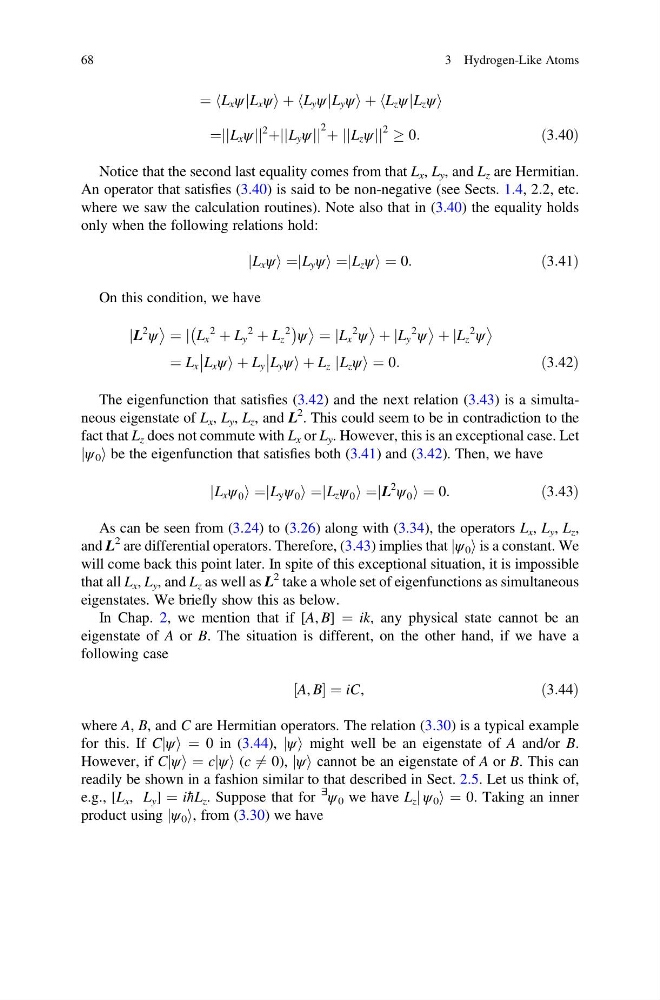
¼ hL x ψ jL x ψi þ hL y ψ jL y ψi þ hL z ψ jL z ψi
¼jjL x ψ jj
2
þjjL y ψ jj
2 þ jjL z ψ jj
2 ! 0:
ð3:40Þ
Notice that the second last equality comes from that L x , L y , and L z are Hermitian.
An operator that satisfies (3.40) is said to be non-negative (see Sects. 1.4, 2.2, etc.
where we saw the calculation routines). Note also that in (3.40) the equality holds
only when the following relations hold:
jL x ψi ¼jL y ψi ¼jL z ψi ¼ 0:
ð3:41Þ
On this condition, we have
jL
2
ψ
¼ j L x
2
þ L y
2
þ L z
2
À
Á ψ
¼ jL x
2
ψ
þ jL y
2
ψ
þ jL z
2
ψ
¼ L x L x ψi þ L y
L y ψi þ L z jL z ψi ¼ 0:
ð3:42Þ
The eigenfunction that satisfies (3.42) and the next relation (3.43) is a simultaneous eigenstate of L x , L y , L z , and L
2 . This could seem to be in contradiction to the
fact that L z does not commute with L x or L y . However, this is an exceptional case. Let
jψ 0 i be the eigenfunction that satisfies both (3.41) and (3.42). Then, we have
jL x ψ 0 i ¼jL y ψ 0 i ¼jL z ψ 0 i ¼jL
2
ψ 0 i ¼ 0:
ð3:43Þ
As can be seen from (3.24) to (3.26) along with (3.34), the operators L x , L y , L z ,
and L
2 are differential operators. Therefore, (3.43) implies that jψ 0 i is a constant. We
will come back this point later. In spite of this exceptional situation, it is impossible
that all L x , L y , and L z as well as L
2 take a whole set of eigenfunctions as simultaneous
eigenstates. We briefly show this as below.
In Chap. 2, we mention that if [A, B] ¼ ik, any physical state cannot be an
eigenstate of A or B. The situation is different, on the other hand, if we have a
following case
A, B
½
¼ iC,
ð3:44Þ
where A, B, and C are Hermitian operators. The relation (3.30) is a typical example
for this. If Cjψi ¼ 0 in (3.44), jψi might well be an eigenstate of A and/or B.
However, if Cjψi ¼ cjψi (c 6 ¼ 0), jψi cannot be an eigenstate of A or B. This can
readily be shown in a fashion similar to that described in Sect. 2.5. Let us think of,
e.g., [L x , L y ] ¼ iħL z . Suppose that for
∃
ψ 0 we have L z j ψ 0 i ¼ 0. Taking an inner
product using jψ 0 i, from (3.30) we have
68
3 Hydrogen-Like Atoms
¼jjL x ψ jj
2
þjjL y ψ jj
2 þ jjL z ψ jj
2 ! 0:
ð3:40Þ
Notice that the second last equality comes from that L x , L y , and L z are Hermitian.
An operator that satisfies (3.40) is said to be non-negative (see Sects. 1.4, 2.2, etc.
where we saw the calculation routines). Note also that in (3.40) the equality holds
only when the following relations hold:
jL x ψi ¼jL y ψi ¼jL z ψi ¼ 0:
ð3:41Þ
On this condition, we have
jL
2
ψ
¼ j L x
2
þ L y
2
þ L z
2
À
Á ψ
¼ jL x
2
ψ
þ jL y
2
ψ
þ jL z
2
ψ
¼ L x L x ψi þ L y
L y ψi þ L z jL z ψi ¼ 0:
ð3:42Þ
The eigenfunction that satisfies (3.42) and the next relation (3.43) is a simultaneous eigenstate of L x , L y , L z , and L
2 . This could seem to be in contradiction to the
fact that L z does not commute with L x or L y . However, this is an exceptional case. Let
jψ 0 i be the eigenfunction that satisfies both (3.41) and (3.42). Then, we have
jL x ψ 0 i ¼jL y ψ 0 i ¼jL z ψ 0 i ¼jL
2
ψ 0 i ¼ 0:
ð3:43Þ
As can be seen from (3.24) to (3.26) along with (3.34), the operators L x , L y , L z ,
and L
2 are differential operators. Therefore, (3.43) implies that jψ 0 i is a constant. We
will come back this point later. In spite of this exceptional situation, it is impossible
that all L x , L y , and L z as well as L
2 take a whole set of eigenfunctions as simultaneous
eigenstates. We briefly show this as below.
In Chap. 2, we mention that if [A, B] ¼ ik, any physical state cannot be an
eigenstate of A or B. The situation is different, on the other hand, if we have a
following case
A, B
½
¼ iC,
ð3:44Þ
where A, B, and C are Hermitian operators. The relation (3.30) is a typical example
for this. If Cjψi ¼ 0 in (3.44), jψi might well be an eigenstate of A and/or B.
However, if Cjψi ¼ cjψi (c 6 ¼ 0), jψi cannot be an eigenstate of A or B. This can
readily be shown in a fashion similar to that described in Sect. 2.5. Let us think of,
e.g., [L x , L y ] ¼ iħL z . Suppose that for
∃
ψ 0 we have L z j ψ 0 i ¼ 0. Taking an inner
product using jψ 0 i, from (3.30) we have
68
3 Hydrogen-Like Atoms