

A, B þ C
½
¼ A, B
½
þ A, C
½
:
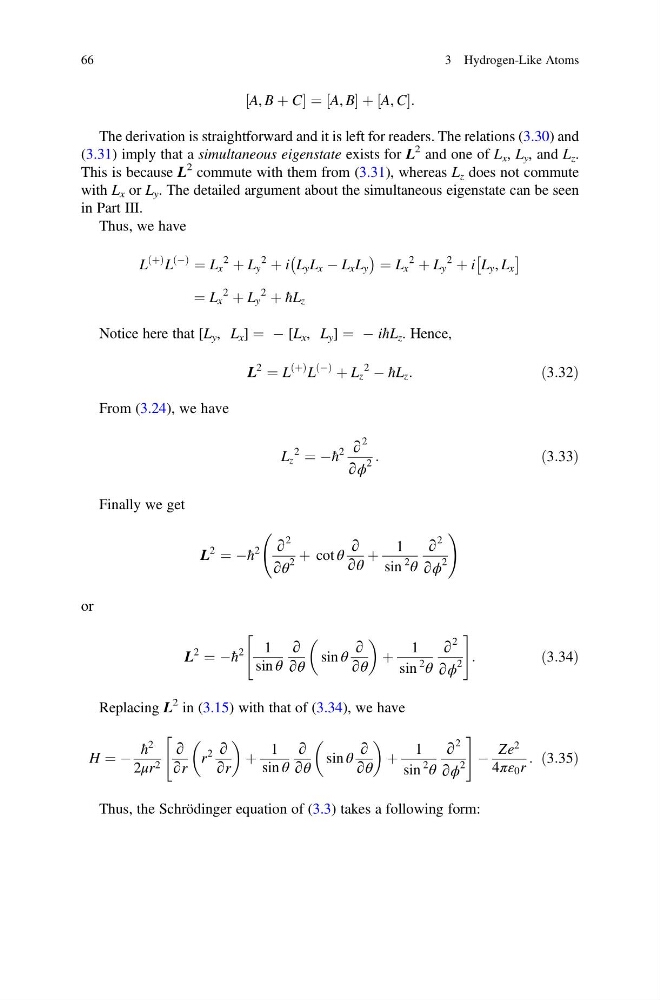
The derivation is straightforward and it is left for readers. The relations (3.30) and
(3.31) imply that a simultaneous eigenstate exists for L
2 and one of L x , L y , and L z .
This is because L
2 commute with them from (3.31), whereas L z does not commute
with L x or L y . The detailed argument about the simultaneous eigenstate can be seen
in Part III.
Thus, we have
L
þ
ð Þ L
À
ð Þ
¼ L x
2
þ L y
2
þ i L y L x À L x L y
À
Á ¼ L x
2
þ L y
2
þ i L y , L x
Â
Ã
¼ L x
2
þ L y
2
þ ħL z
Notice here that [L y , L x ] ¼ À [L x , L y ] ¼ À iħL z . Hence,
L
2
¼ L
þ
ð Þ L
À
ð Þ
þ L z
2
À ħL z :
ð3:32Þ
From (3.24), we have
L z
2
¼ Àħ
2 ∂
2
∂ϕ
2
:
ð3:33Þ
Finally we get
L
2
¼ Àħ
2
∂
2
∂θ
2
þ cot θ
∂
∂θ
þ
1
sin
2
θ
∂
2
∂ϕ
2
!
or
L
2
¼ Àħ
2
1
sin θ
∂
∂θ
sin θ
∂
∂θ
þ
1
sin
2
θ
∂
2
∂ϕ
2
"
#
:
ð3:34Þ
Replacing L
2 in (3.15) with that of (3.34), we have
H ¼ À
ħ
2
2μr 2
∂
∂r
r
2 ∂
∂r
þ
1
sin θ
∂
∂θ
sin θ
∂
∂θ
þ
1
sin
2
θ
∂
2
∂ϕ
2
"
#
À
Ze
2
4πε 0 r
: ð3:35Þ
Thus, the Schrödinger equation of (3.3) takes a following form:
66
3 Hydrogen-Like Atoms
½
¼ A, B
½
þ A, C
½
:
The derivation is straightforward and it is left for readers. The relations (3.30) and
(3.31) imply that a simultaneous eigenstate exists for L
2 and one of L x , L y , and L z .
This is because L
2 commute with them from (3.31), whereas L z does not commute
with L x or L y . The detailed argument about the simultaneous eigenstate can be seen
in Part III.
Thus, we have
L
þ
ð Þ L
À
ð Þ
¼ L x
2
þ L y
2
þ i L y L x À L x L y
À
Á ¼ L x
2
þ L y
2
þ i L y , L x
Â
Ã
¼ L x
2
þ L y
2
þ ħL z
Notice here that [L y , L x ] ¼ À [L x , L y ] ¼ À iħL z . Hence,
L
2
¼ L
þ
ð Þ L
À
ð Þ
þ L z
2
À ħL z :
ð3:32Þ
From (3.24), we have
L z
2
¼ Àħ
2 ∂
2
∂ϕ
2
:
ð3:33Þ
Finally we get
L
2
¼ Àħ
2
∂
2
∂θ
2
þ cot θ
∂
∂θ
þ
1
sin
2
θ
∂
2
∂ϕ
2
!
or
L
2
¼ Àħ
2
1
sin θ
∂
∂θ
sin θ
∂
∂θ
þ
1
sin
2
θ
∂
2
∂ϕ
2
"
#
:
ð3:34Þ
Replacing L
2 in (3.15) with that of (3.34), we have
H ¼ À
ħ
2
2μr 2
∂
∂r
r
2 ∂
∂r
þ
1
sin θ
∂
∂θ
sin θ
∂
∂θ
þ
1
sin
2
θ
∂
2
∂ϕ
2
"
#
À
Ze
2
4πε 0 r
: ð3:35Þ
Thus, the Schrödinger equation of (3.3) takes a following form:
66
3 Hydrogen-Like Atoms