

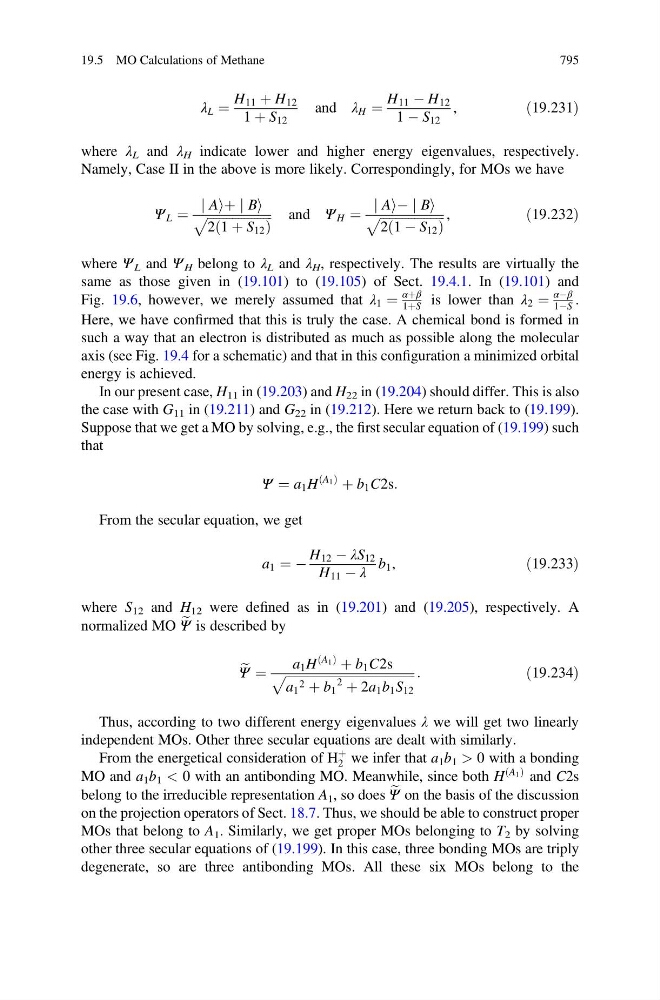
λ L ¼
H 11 þ H 12
1 þ S 12
and λ H ¼
H 11 À H 12
1 À S 12
,
ð19:231Þ
where λ L and λ H indicate lower and higher energy eigenvalues, respectively.
Namely, Case II in the above is more likely. Correspondingly, for MOs we have
Ψ L ¼
j Aiþ j Bi
ffiffiffiffiffiffiffiffiffiffiffiffiffiffiffiffiffiffiffiffi ffi
2 1 þ S 12
ð
Þ
p
and Ψ H ¼
j AiÀ j Bi
ffiffiffiffiffiffiffiffiffiffiffiffiffiffiffiffiffiffiffiffi ffi
2 1 À S 12
ð
Þ
p
,
ð19:232Þ
where Ψ L and Ψ H belong to λ L and λ H , respectively. The results are virtually the
same as those given in (19.101) to (19.105) of Sect. 19.4.1. In (19.101) and
Fig. 19.6, however, we merely assumed that λ 1 ¼
αþβ
1þS is lower than λ 2 ¼
αÀβ
1ÀS .
Here, we have confirmed that this is truly the case. A chemical bond is formed in
such a way that an electron is distributed as much as possible along the molecular
axis (see Fig. 19.4 for a schematic) and that in this configuration a minimized orbital
energy is achieved.
In our present case, H 11 in (19.203) and H 22 in (19.204) should differ. This is also
the case with G 11 in (19.211) and G 22 in (19.212). Here we return back to (19.199).
Suppose that we get a MO by solving, e.g., the first secular equation of (19.199) such
that
Ψ ¼ a 1 H
A 1
ð Þ
þ b 1 C2s:
From the secular equation, we get
a 1 ¼ À
H 12 À λS 12
H 11 À λ
b 1 ,
ð19:233Þ
where S 12 and H 12 were defined as in (19.201) and (19.205), respectively. A
normalized MO e
Ψ is described by
e
Ψ ¼
a 1 H
A 1
ð Þ
þ b 1 C2s
ffiffiffiffiffiffiffiffiffiffiffiffiffiffiffiffiffiffiffiffiffiffiffiffiffiffiffiffiffiffiffiffiffiffiffiffiffiffiffiffiffi ffi
a 1
2 þ b 1
2
þ 2a 1 b 1 S 12
p
:
ð19:234Þ
Thus, according to two different energy eigenvalues λ we will get two linearly
independent MOs. Other three secular equations are dealt with similarly.
From the energetical consideration of H
þ
2 we infer that a 1 b 1 > 0 with a bonding
MO and a 1 b 1 < 0 with an antibonding MO. Meanwhile, since both H
A 1
ð Þ and C2s
belong to the irreducible representation A 1 , so does e
Ψ on the basis of the discussion
on the projection operators of Sect. 18.7. Thus, we should be able to construct proper
MOs that belong to A 1 . Similarly, we get proper MOs belonging to T 2 by solving
other three secular equations of (19.199). In this case, three bonding MOs are triply
degenerate, so are three antibonding MOs. All these six MOs belong to the
19.5 MO Calculations of Methane
795