

irreducible representation T 2 . Thus, we can get a complete set of MOs for methane.
These eight MOs span the representation space V
8 .
To precisely determine the energy levels, we need to take more elaborate
approaches to approximate and calculate various parameters that appear in
(19.199). At the same time, we need to perform detailed experiments including
spectroscopic measurements and interpret those results carefully [4]. Taking account
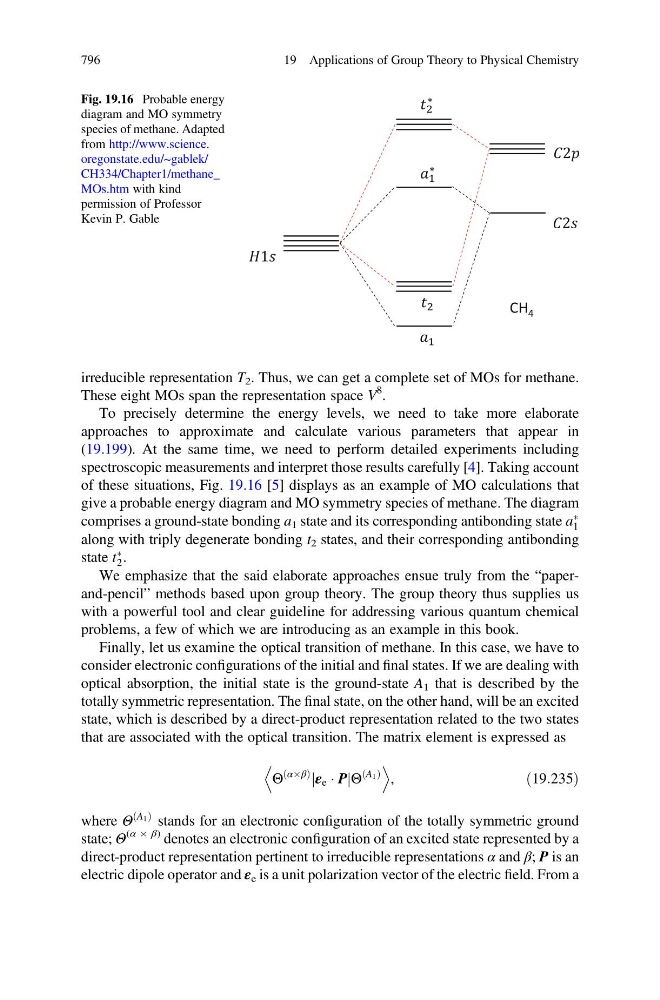
of these situations, Fig. 19.16 [5] displays as an example of MO calculations that
give a probable energy diagram and MO symmetry species of methane. The diagram
comprises a ground-state bonding a 1 state and its corresponding antibonding state a
Ã
1
along with triply degenerate bonding t 2 states, and their corresponding antibonding
state t
Ã
2 .
We emphasize that the said elaborate approaches ensue truly from the “paperand-pencil” methods based upon group theory. The group theory thus supplies us
with a powerful tool and clear guideline for addressing various quantum chemical
problems, a few of which we are introducing as an example in this book.
Finally, let us examine the optical transition of methane. In this case, we have to
consider electronic configurations of the initial and final states. If we are dealing with
optical absorption, the initial state is the ground-state A 1 that is described by the
totally symmetric representation. The final state, on the other hand, will be an excited
state, which is described by a direct-product representation related to the two states
that are associated with the optical transition. The matrix element is expressed as
Θ
αÂβ
ð
Þ
ε e Á P
j
jΘ
A 1
ð Þ
D
E
,
ð19:235Þ
where Θ
A 1
ð Þ stands for an electronic configuration of the totally symmetric ground
state; Θ
(α Â β) denotes an electronic configuration of an excited state represented by a
direct-product representation pertinent to irreducible representations α and β; P is an
electric dipole operator and ε e is a unit polarization vector of the electric field. From a
CH 4
∗
∗
Fig. 19.16 Probable energy
diagram and MO symmetry
species of methane. Adapted
from http://www.science.
oregonstate.edu/~gablek/
CH334/Chapter1/methane_
MOs.htm with kind
permission of Professor
Kevin P. Gable
796
19 Applications of Group Theory to Physical Chemistry