

A
1
r A
B
(
)
¼
1
a
1 þ
R
a
e
ÀR=a
:
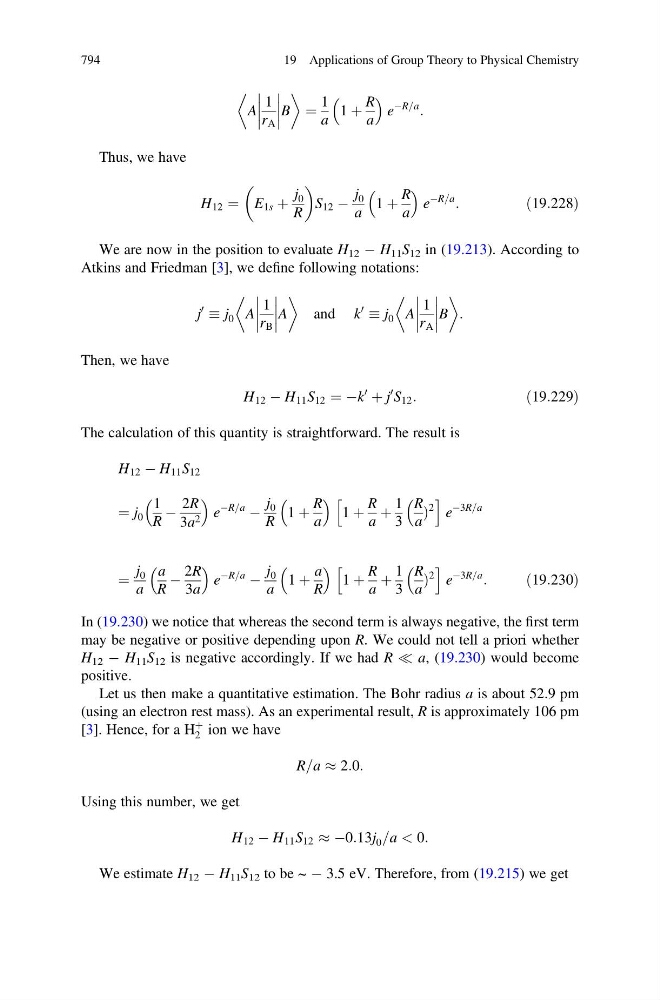
Thus, we have
H 12 ¼ E 1s þ
j 0
R
S 12 À
j 0
a
1 þ
R
a
e
ÀR=a
:
ð19:228Þ
We are now in the position to evaluate H 12 À H 11 S 12 in (19.213). According to
Atkins and Friedman [3], we define following notations:
j
0
j 0 A
1
r B
A
(
)
and k
0
j 0 A
1
r A
B
(
)
:
Then, we have
H 12 À H 11 S 12 ¼ Àk
0
þ j
0 S 12 :
ð19:229Þ
The calculation of this quantity is straightforward. The result is
H 12 À H 11 S 12
¼ j 0
1
R
À
2R
3a 2
e
ÀR=a
À
j 0
R
1 þ
R
a
1 þ
R
a
þ
1
3
R
a
Þ
2
i
e
À3R=a
h
¼
j 0
a
a
R
À
2R
3a
e
ÀR=a
À
j 0
a
1 þ
a
R
1 þ
R
a
þ
1
3
R
a
Þ
2
i
e
À3R=a
:
h
ð19:230Þ
In (19.230) we notice that whereas the second term is always negative, the first term
may be negative or positive depending upon R. We could not tell a priori whether
H 12 À H 11 S 12 is negative accordingly. If we had R ( a, (19.230) would become
positive.
Let us then make a quantitative estimation. The Bohr radius a is about 52.9 pm
(using an electron rest mass). As an experimental result, R is approximately 106 pm
[3]. Hence, for a H
þ
2 ion we have
R=a % 2:0:
Using this number, we get
H 12 À H 11 S 12 % À0:13j 0 =a < 0:
We estimate H 12 À H 11 S 12 to be ~ À 3.5 eV. Therefore, from (19.215) we get
794
19 Applications of Group Theory to Physical Chemistry
1
r A
B
(
)
¼
1
a
1 þ
R
a
e
ÀR=a
:
Thus, we have
H 12 ¼ E 1s þ
j 0
R
S 12 À
j 0
a
1 þ
R
a
e
ÀR=a
:
ð19:228Þ
We are now in the position to evaluate H 12 À H 11 S 12 in (19.213). According to
Atkins and Friedman [3], we define following notations:
j
0
j 0 A
1
r B
A
(
)
and k
0
j 0 A
1
r A
B
(
)
:
Then, we have
H 12 À H 11 S 12 ¼ Àk
0
þ j
0 S 12 :
ð19:229Þ
The calculation of this quantity is straightforward. The result is
H 12 À H 11 S 12
¼ j 0
1
R
À
2R
3a 2
e
ÀR=a
À
j 0
R
1 þ
R
a
1 þ
R
a
þ
1
3
R
a
Þ
2
i
e
À3R=a
h
¼
j 0
a
a
R
À
2R
3a
e
ÀR=a
À
j 0
a
1 þ
a
R
1 þ
R
a
þ
1
3
R
a
Þ
2
i
e
À3R=a
:
h
ð19:230Þ
In (19.230) we notice that whereas the second term is always negative, the first term
may be negative or positive depending upon R. We could not tell a priori whether
H 12 À H 11 S 12 is negative accordingly. If we had R ( a, (19.230) would become
positive.
Let us then make a quantitative estimation. The Bohr radius a is about 52.9 pm
(using an electron rest mass). As an experimental result, R is approximately 106 pm
[3]. Hence, for a H
þ
2 ion we have
R=a % 2:0:
Using this number, we get
H 12 À H 11 S 12 % À0:13j 0 =a < 0:
We estimate H 12 À H 11 S 12 to be ~ À 3.5 eV. Therefore, from (19.215) we get
794
19 Applications of Group Theory to Physical Chemistry