

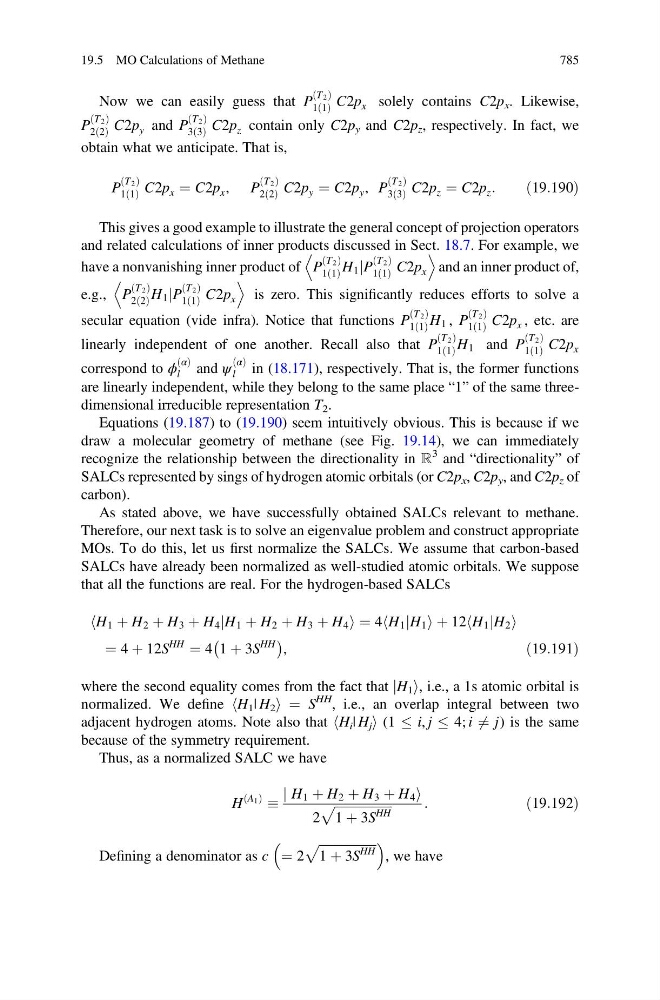
Now we can easily guess that P
T 2
ð Þ
1 1
ð Þ C2p x solely contains C2p x . Likewise,
P
T 2
ð Þ
2 2
ð Þ C2p y and P
T 2
ð Þ
3 3
ð Þ C2p z contain only C2p y and C2p z , respectively. In fact, we
obtain what we anticipate. That is,
P
T 2
ð Þ
1 1
ð Þ C2p x ¼ C2p x , P
T 2
ð Þ
2 2
ð Þ C2p y ¼ C2p y , P
T 2
ð Þ
3 3
ð Þ C2p z ¼ C2p z :
ð19:190Þ
This gives a good example to illustrate the general concept of projection operators
and related calculations of inner products discussed in Sect. 18.7. For example, we
have a nonvanishing inner product of P
T 2
ð Þ
1 1
ð Þ H 1 jP
T 2
ð Þ
1 1
ð Þ C2p x
D
E
and an inner product of,
e.g., P
T 2
ð Þ
2 2
ð Þ H 1 jP
T 2
ð Þ
1 1
ð Þ C2p x
D
E
is zero. This significantly reduces efforts to solve a
secular equation (vide infra). Notice that functions P
T 2
ð Þ
1 1
ð Þ H 1 , P
T 2
ð Þ
1 1
ð Þ C2p x , etc. are
linearly independent of one another. Recall also that P
T 2
ð Þ
1 1
ð Þ H 1 and P
T 2
ð Þ
1 1
ð Þ C2p x
correspond to ϕ
α
ð Þ
l
and ψ
α
ð Þ
l
in (18.171), respectively. That is, the former functions
are linearly independent, while they belong to the same place “1” of the same threedimensional irreducible representation T 2 .
Equations (19.187) to (19.190) seem intuitively obvious. This is because if we
draw a molecular geometry of methane (see Fig. 19.14), we can immediately
recognize the relationship between the directionality in ℝ
3 and “directionality” of
SALCs represented by sings of hydrogen atomic orbitals (or C2p x , C2p y , and C2p z of
carbon).
As stated above, we have successfully obtained SALCs relevant to methane.
Therefore, our next task is to solve an eigenvalue problem and construct appropriate
MOs. To do this, let us first normalize the SALCs. We assume that carbon-based
SALCs have already been normalized as well-studied atomic orbitals. We suppose
that all the functions are real. For the hydrogen-based SALCs
H 1 þ H 2 þ H 3 þ H 4 jH 1 þ H 2 þ H 3 þ H 4
h
i ¼ 4 H 1 jH 1
h
iþ12 H 1 jH 2
h
i
¼ 4 þ 12S
HH
¼ 4 1 þ 3S
HH
À
Á
,
ð19:191Þ
where the second equality comes from the fact that jH 1 i, i.e., a 1s atomic orbital is
normalized. We define hH 1 | H 2 i ¼ S
HH , i.e., an overlap integral between two
adjacent hydrogen atoms. Note also that hH i | H j i (1 i, j 4; i 6 ¼ j) is the same
because of the symmetry requirement.
Thus, as a normalized SALC we have
H
A 1
ð Þ
j H 1 þ H 2 þ H 3 þ H 4 i
2
ffiffiffiffiffiffiffiffiffiffiffiffiffiffiffiffiffiffi ffi
1 þ 3S
HH
p
:
ð19:192Þ
Defining a denominator as c ¼ 2
ffiffiffiffiffiffiffiffiffiffiffiffiffiffiffiffiffiffi ffi
1 þ 3S
HH
p
, we have
19.5 MO Calculations of Methane
785
T 2
ð Þ
1 1
ð Þ C2p x solely contains C2p x . Likewise,
P
T 2
ð Þ
2 2
ð Þ C2p y and P
T 2
ð Þ
3 3
ð Þ C2p z contain only C2p y and C2p z , respectively. In fact, we
obtain what we anticipate. That is,
P
T 2
ð Þ
1 1
ð Þ C2p x ¼ C2p x , P
T 2
ð Þ
2 2
ð Þ C2p y ¼ C2p y , P
T 2
ð Þ
3 3
ð Þ C2p z ¼ C2p z :
ð19:190Þ
This gives a good example to illustrate the general concept of projection operators
and related calculations of inner products discussed in Sect. 18.7. For example, we
have a nonvanishing inner product of P
T 2
ð Þ
1 1
ð Þ H 1 jP
T 2
ð Þ
1 1
ð Þ C2p x
D
E
and an inner product of,
e.g., P
T 2
ð Þ
2 2
ð Þ H 1 jP
T 2
ð Þ
1 1
ð Þ C2p x
D
E
is zero. This significantly reduces efforts to solve a
secular equation (vide infra). Notice that functions P
T 2
ð Þ
1 1
ð Þ H 1 , P
T 2
ð Þ
1 1
ð Þ C2p x , etc. are
linearly independent of one another. Recall also that P
T 2
ð Þ
1 1
ð Þ H 1 and P
T 2
ð Þ
1 1
ð Þ C2p x
correspond to ϕ
α
ð Þ
l
and ψ
α
ð Þ
l
in (18.171), respectively. That is, the former functions
are linearly independent, while they belong to the same place “1” of the same threedimensional irreducible representation T 2 .
Equations (19.187) to (19.190) seem intuitively obvious. This is because if we
draw a molecular geometry of methane (see Fig. 19.14), we can immediately
recognize the relationship between the directionality in ℝ
3 and “directionality” of
SALCs represented by sings of hydrogen atomic orbitals (or C2p x , C2p y , and C2p z of
carbon).
As stated above, we have successfully obtained SALCs relevant to methane.
Therefore, our next task is to solve an eigenvalue problem and construct appropriate
MOs. To do this, let us first normalize the SALCs. We assume that carbon-based
SALCs have already been normalized as well-studied atomic orbitals. We suppose
that all the functions are real. For the hydrogen-based SALCs
H 1 þ H 2 þ H 3 þ H 4 jH 1 þ H 2 þ H 3 þ H 4
h
i ¼ 4 H 1 jH 1
h
iþ12 H 1 jH 2
h
i
¼ 4 þ 12S
HH
¼ 4 1 þ 3S
HH
À
Á
,
ð19:191Þ
where the second equality comes from the fact that jH 1 i, i.e., a 1s atomic orbital is
normalized. We define hH 1 | H 2 i ¼ S
HH , i.e., an overlap integral between two
adjacent hydrogen atoms. Note also that hH i | H j i (1 i, j 4; i 6 ¼ j) is the same
because of the symmetry requirement.
Thus, as a normalized SALC we have
H
A 1
ð Þ
j H 1 þ H 2 þ H 3 þ H 4 i
2
ffiffiffiffiffiffiffiffiffiffiffiffiffiffiffiffiffiffi ffi
1 þ 3S
HH
p
:
ð19:192Þ
Defining a denominator as c ¼ 2
ffiffiffiffiffiffiffiffiffiffiffiffiffiffiffiffiffiffi ffi
1 þ 3S
HH
p
, we have
19.5 MO Calculations of Methane
785