

þ 1 Á C2p y þ 1 Á C2p x þ 1 Á C2p z þ 1 Á ÀC2p y
À
Á þ 1 Á C2p x þ 1 Á ÀC2p z
À
Á
À
É
¼ 0:
The calculation is somewhat tedious, but it is natural that since C2s is spherically
symmetric, it belongs to the totally symmetric representation. Conversely, it is
natural to think that C2p x is totally unlikely to contain a totally symmetric representation. This is also the case with C2p y and C2p z .
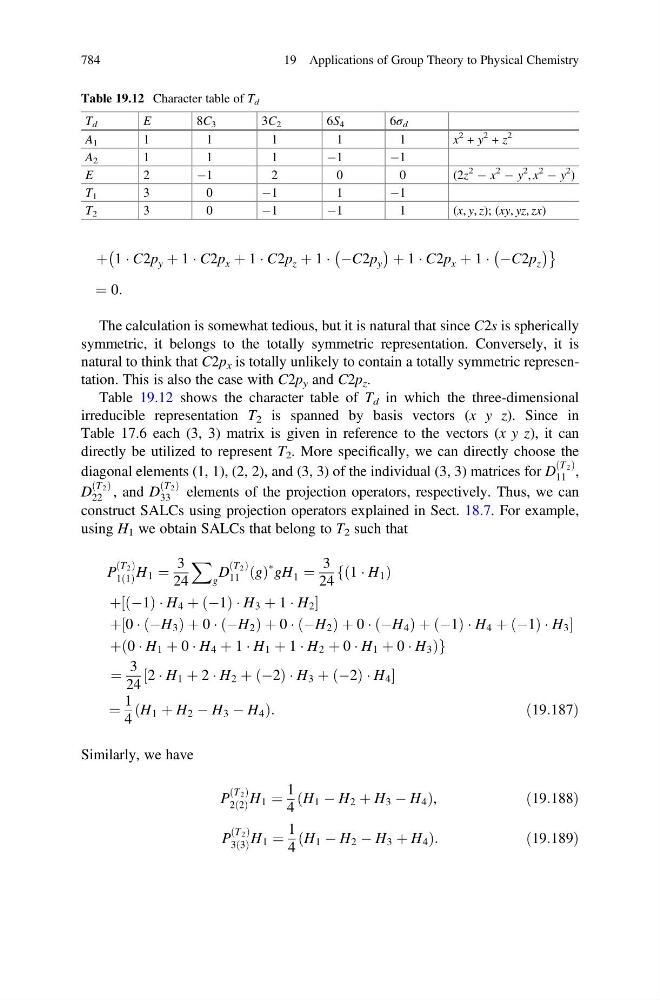
Table 19.12 shows the character table of T d in which the three-dimensional
irreducible representation T 2 is spanned by basis vectors (x y z). Since in
Table 17.6 each (3, 3) matrix is given in reference to the vectors (x y z), it can
directly be utilized to represent T 2 . More specifically, we can directly choose the
diagonal elements (1, 1), (2, 2), and (3, 3) of the individual (3, 3) matrices for D
T 2
ð Þ
11 ,
D
T 2
ð Þ
22 , and D
T 2
ð Þ
33
elements of the projection operators, respectively. Thus, we can
construct SALCs using projection operators explained in Sect. 18.7. For example,
using H 1 we obtain SALCs that belong to T 2 such that
P
T 2
ð Þ
1 1
ð Þ H 1 ¼
3
24
X
g
D
T 2
ð Þ
11 g
ð Þ
à gH 1 ¼
3
24
f 1 Á H 1
ð
Þ
þ À1
ð ÞÁH 4 þ À1
ð ÞÁH 3 þ 1 Á H 2
½
þ 0 Á ÀH 3
ð
Þþ0 Á ÀH 2
ð
Þþ0 Á ÀH 2
ð
Þþ0 Á ÀH 4
ð
Þþ À1
ð ÞÁH 4 þ À1
ð ÞÁH 3
½
þ 0 Á H 1 þ 0 Á H 4 þ 1 Á H 1 þ 1 Á H 2 þ 0 Á H 1 þ 0 Á H 3
ð
Þ g
¼
3
24
2 Á H 1 þ 2 Á H 2 þ À2
ð ÞÁH 3 þ À2
ð ÞÁH 4
½
¼
1
4
H 1 þ H 2 À H 3 À H 4
ð
Þ :
ð19:187Þ
Similarly, we have
P
T 2
ð Þ
2 2
ð Þ H 1 ¼
1
4
H 1 À H 2 þ H 3 À H 4
ð
Þ ,
ð19:188Þ
P
T 2
ð Þ
3 3
ð Þ H 1 ¼
1
4
H 1 À H 2 À H 3 þ H 4
ð
Þ :
ð19:189Þ
Table 19.12 Character table of T d
T d
E
8C 3
3C 2
6S 4
6σ d
A 1
1
1
1
1
1
x
2 + y
2 + z
2
A 2
1
1
1
À1
À1
E
2
À1
2
0
0
( 2 z
2 À x
2 À y
2
, x
2 À y
2
)
T 1
3
0
À1
1
À1
T 2
3
0
À1
À1
1
( x, y, z); (xy, yz, zx)
784
19 Applications of Group Theory to Physical Chemistry
À
Á þ 1 Á C2p x þ 1 Á ÀC2p z
À
Á
À
É
¼ 0:
The calculation is somewhat tedious, but it is natural that since C2s is spherically
symmetric, it belongs to the totally symmetric representation. Conversely, it is
natural to think that C2p x is totally unlikely to contain a totally symmetric representation. This is also the case with C2p y and C2p z .
Table 19.12 shows the character table of T d in which the three-dimensional
irreducible representation T 2 is spanned by basis vectors (x y z). Since in
Table 17.6 each (3, 3) matrix is given in reference to the vectors (x y z), it can
directly be utilized to represent T 2 . More specifically, we can directly choose the
diagonal elements (1, 1), (2, 2), and (3, 3) of the individual (3, 3) matrices for D
T 2
ð Þ
11 ,
D
T 2
ð Þ
22 , and D
T 2
ð Þ
33
elements of the projection operators, respectively. Thus, we can
construct SALCs using projection operators explained in Sect. 18.7. For example,
using H 1 we obtain SALCs that belong to T 2 such that
P
T 2
ð Þ
1 1
ð Þ H 1 ¼
3
24
X
g
D
T 2
ð Þ
11 g
ð Þ
à gH 1 ¼
3
24
f 1 Á H 1
ð
Þ
þ À1
ð ÞÁH 4 þ À1
ð ÞÁH 3 þ 1 Á H 2
½
þ 0 Á ÀH 3
ð
Þþ0 Á ÀH 2
ð
Þþ0 Á ÀH 2
ð
Þþ0 Á ÀH 4
ð
Þþ À1
ð ÞÁH 4 þ À1
ð ÞÁH 3
½
þ 0 Á H 1 þ 0 Á H 4 þ 1 Á H 1 þ 1 Á H 2 þ 0 Á H 1 þ 0 Á H 3
ð
Þ g
¼
3
24
2 Á H 1 þ 2 Á H 2 þ À2
ð ÞÁH 3 þ À2
ð ÞÁH 4
½
¼
1
4
H 1 þ H 2 À H 3 À H 4
ð
Þ :
ð19:187Þ
Similarly, we have
P
T 2
ð Þ
2 2
ð Þ H 1 ¼
1
4
H 1 À H 2 þ H 3 À H 4
ð
Þ ,
ð19:188Þ
P
T 2
ð Þ
3 3
ð Þ H 1 ¼
1
4
H 1 À H 2 À H 3 þ H 4
ð
Þ :
ð19:189Þ
Table 19.12 Character table of T d
T d
E
8C 3
3C 2
6S 4
6σ d
A 1
1
1
1
1
1
x
2 + y
2 + z
2
A 2
1
1
1
À1
À1
E
2
À1
2
0
0
( 2 z
2 À x
2 À y
2
, x
2 À y
2
)
T 1
3
0
À1
1
À1
T 2
3
0
À1
À1
1
( x, y, z); (xy, yz, zx)
784
19 Applications of Group Theory to Physical Chemistry