

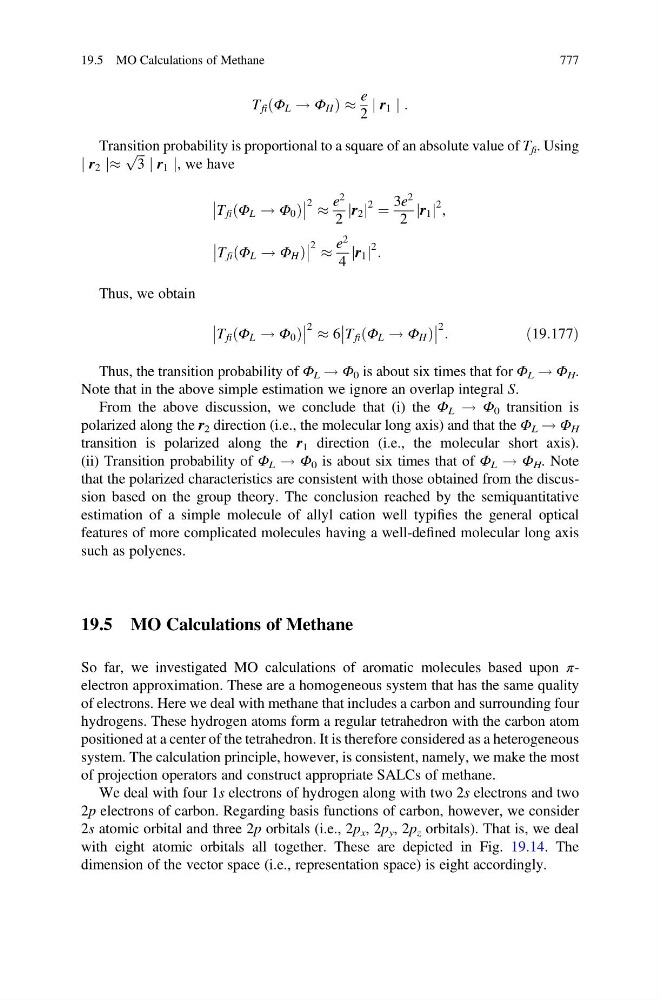
T fi Φ L ! Φ H
ð
Þ%
e
2
j r 1 j :
Transition probability is proportional to a square of an absolute value of T fi . Using
j r 2 j%
ffiffi ffi
3
p j r 1 j, we have
T fi Φ L ! Φ 0
ð
Þ
2 %
e
2
2
r 2
j j
2 ¼
3e
2
2
r 1
j j
2 ,
T fi Φ L ! Φ H
ð
Þ
2 %
e
2
4
r 1
j j
2 :
Thus, we obtain
T fi Φ L ! Φ 0
ð
Þ
2 % 6 T fi Φ L ! Φ H
ð
Þ
2 :
ð19:177Þ
Thus, the transition probability of Φ L ! Φ 0 is about six times that for Φ L ! Φ H .
Note that in the above simple estimation we ignore an overlap integral S.
From the above discussion, we conclude that (i) the Φ L ! Φ 0 transition is
polarized along the r 2 direction (i.e., the molecular long axis) and that the Φ L ! Φ H
transition is polarized along the r 1 direction (i.e., the molecular short axis).
(ii) Transition probability of Φ L ! Φ 0 is about six times that of Φ L ! Φ H . Note
that the polarized characteristics are consistent with those obtained from the discussion based on the group theory. The conclusion reached by the semiquantitative
estimation of a simple molecule of allyl cation well typifies the general optical
features of more complicated molecules having a well-defined molecular long axis
such as polyenes.
19.5 MO Calculations of Methane
So far, we investigated MO calculations of aromatic molecules based upon πelectron approximation. These are a homogeneous system that has the same quality
of electrons. Here we deal with methane that includes a carbon and surrounding four
hydrogens. These hydrogen atoms form a regular tetrahedron with the carbon atom
positioned at a center of the tetrahedron. It is therefore considered as a heterogeneous
system. The calculation principle, however, is consistent, namely, we make the most
of projection operators and construct appropriate SALCs of methane.
We deal with four 1s electrons of hydrogen along with two 2s electrons and two
2p electrons of carbon. Regarding basis functions of carbon, however, we consider
2s atomic orbital and three 2p orbitals (i.e., 2p x , 2p y , 2p z orbitals). That is, we deal
with eight atomic orbitals all together. These are depicted in Fig. 19.14. The
dimension of the vector space (i.e., representation space) is eight accordingly.
19.5 MO Calculations of Methane
777
ð
Þ%
e
2
j r 1 j :
Transition probability is proportional to a square of an absolute value of T fi . Using
j r 2 j%
ffiffi ffi
3
p j r 1 j, we have
T fi Φ L ! Φ 0
ð
Þ
2 %
e
2
2
r 2
j j
2 ¼
3e
2
2
r 1
j j
2 ,
T fi Φ L ! Φ H
ð
Þ
2 %
e
2
4
r 1
j j
2 :
Thus, we obtain
T fi Φ L ! Φ 0
ð
Þ
2 % 6 T fi Φ L ! Φ H
ð
Þ
2 :
ð19:177Þ
Thus, the transition probability of Φ L ! Φ 0 is about six times that for Φ L ! Φ H .
Note that in the above simple estimation we ignore an overlap integral S.
From the above discussion, we conclude that (i) the Φ L ! Φ 0 transition is
polarized along the r 2 direction (i.e., the molecular long axis) and that the Φ L ! Φ H
transition is polarized along the r 1 direction (i.e., the molecular short axis).
(ii) Transition probability of Φ L ! Φ 0 is about six times that of Φ L ! Φ H . Note
that the polarized characteristics are consistent with those obtained from the discussion based on the group theory. The conclusion reached by the semiquantitative
estimation of a simple molecule of allyl cation well typifies the general optical
features of more complicated molecules having a well-defined molecular long axis
such as polyenes.
19.5 MO Calculations of Methane
So far, we investigated MO calculations of aromatic molecules based upon πelectron approximation. These are a homogeneous system that has the same quality
of electrons. Here we deal with methane that includes a carbon and surrounding four
hydrogens. These hydrogen atoms form a regular tetrahedron with the carbon atom
positioned at a center of the tetrahedron. It is therefore considered as a heterogeneous
system. The calculation principle, however, is consistent, namely, we make the most
of projection operators and construct appropriate SALCs of methane.
We deal with four 1s electrons of hydrogen along with two 2s electrons and two
2p electrons of carbon. Regarding basis functions of carbon, however, we consider
2s atomic orbital and three 2p orbitals (i.e., 2p x , 2p y , 2p z orbitals). That is, we deal
with eight atomic orbitals all together. These are depicted in Fig. 19.14. The
dimension of the vector space (i.e., representation space) is eight accordingly.
19.5 MO Calculations of Methane
777