

As before, we wish to determine irreducible representations which individual
MOs belong to. As already mentioned in Sect. 17.3, there are 24 symmetry operations in a point group T d which methane belongs to (see Table 17.6). According to
the symmetry operations, we decide transformation matrices related to each operation. For example, C
xyz
3 transforms basis functions as follows:
H 1 H 2 H 3 H 4 C2s C2p x C2p y C2p z
À
Á
C
xyz
3
¼ H 1 H 3 H 4 H 2 C2s C2p y C2p z C2p x
À
Á
,
where by the above notations we denoted atomic species and molecular orbitals.
Hence, as a matrix representation we have
C
xyz
3 ¼
1 0 0 0 0 0 0 0
0 0 0 1 0 0 0 0
0 1 0 0 0 0 0 0
0 0 1 0 0 0 0 0
0 0 0 0 1 0 0 0
0 0 0 0 0 0 0 1
0 0 0 0 0 1 0 0
0 0 0 0 0 0 1 0
0
B
B
B
B
B
B
B
B
B
B
B
B
B
@
1
C
C
C
C
C
C
C
C
C
C
C
C
C
A
,
ð19:178Þ
where C
xyz
3 is the same operation as R xyz
2π
3
appeared in Sect. 17.3. Therefore,
x
y
z
O
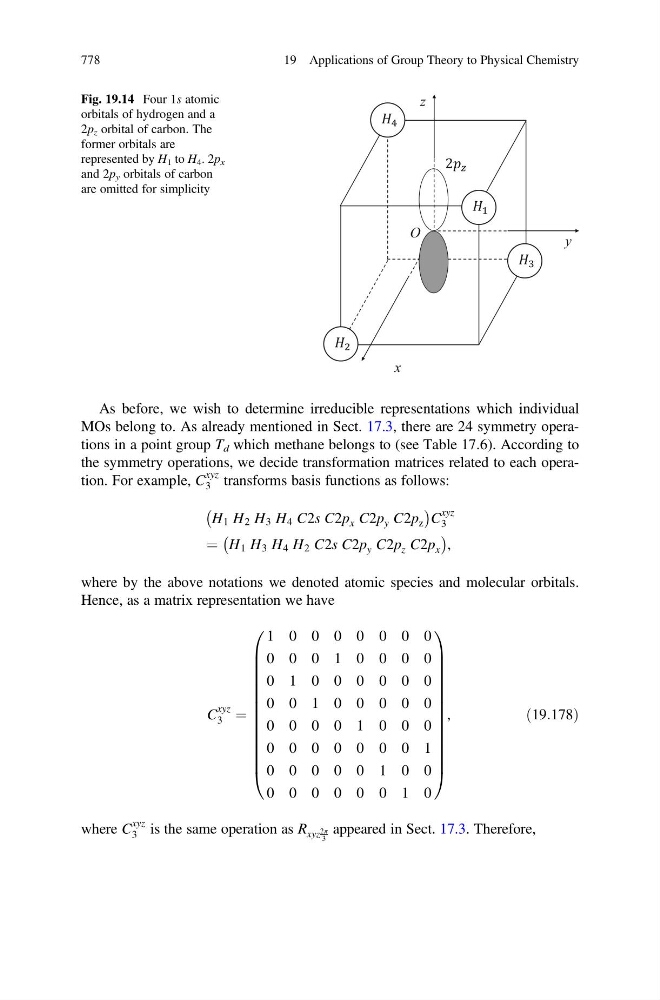
Fig. 19.14 Four 1s atomic
orbitals of hydrogen and a
2p z orbital of carbon. The
former orbitals are
represented by H 1 to H 4 . 2p x
and 2p y orbitals of carbon
are omitted for simplicity
778
19 Applications of Group Theory to Physical Chemistry