

A 1 ! A 1 ,
where the former A 1 indicates the electronic ground state and the latter A 1
indicates the excited state given by B 1 Â B 1 ¼ A 1 . The direct product of them is
simply described as B 1 Â B 1 Â A 1 ¼ A 1 . Consulting a character table again, we
find that z belongs to A 1 . This implies that the allowed transition is polarized
along the z-direction.
Next, we investigate the above optical transition in a semiquantitative manner. In
principle, the transition matrix element T fi should be estimated from (19.175) and
(19.176) that use electronic configurations of two-electron system. Nonetheless, a
formulation of (4.7) of Sect. 4.1 based upon one-electron states well serves our
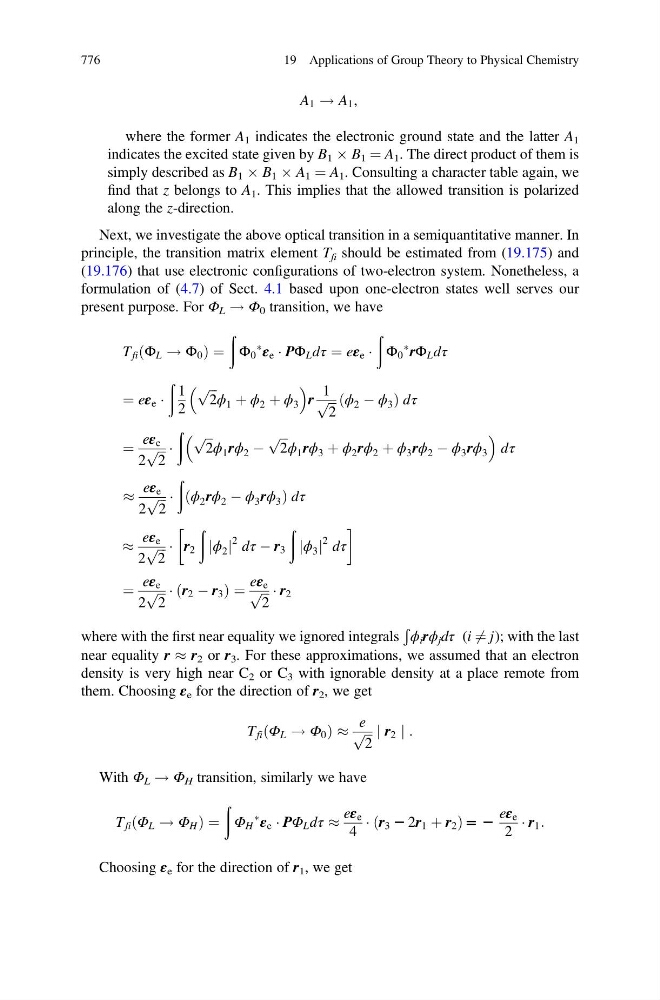
present purpose. For Φ L ! Φ 0 transition, we have
T fi Φ L ! Φ 0
ð
Þ¼
ð
Φ 0
Ã
ε e Á PΦ L dτ ¼ eε e Á
ð
Φ 0
à rΦ L dτ
¼ eε e Á
ð
1
2
ffiffi ffi
2
p ϕ 1 þ ϕ 2 þ ϕ 3
r
1
ffiffi ffi
2
p ϕ 2 À ϕ 3
ð
Þdτ
¼
eε e
2
ffiffi ffi
2
p Á
ð ffiffi ffi
2
p ϕ 1 rϕ 2 À
ffiffi ffi
2
p ϕ 1 rϕ 3 þ ϕ 2 rϕ 2 þ ϕ 3 rϕ 2 À ϕ 3 rϕ 3
dτ
%
eε e
2
ffiffi ffi
2
p Á
ð
ϕ 2 rϕ 2 À ϕ 3 rϕ 3
ð
Þ dτ
%
eε e
2
ffiffi ffi
2
p Á r 2
ð
ϕ 2
j j
2 dτ À r 3
ð
ϕ 3
j j
2 dτ
!
¼
eε e
2
ffiffi ffi
2
p Á r 2 À r 3
ð
Þ¼
eε e
ffiffi ffi
2
p Á r 2
where with the first near equality we ignored integrals
Ð ϕ i rϕ j dτ (i 6 ¼ j); with the last
near equality r % r 2 or r 3 . For these approximations, we assumed that an electron
density is very high near C 2 or C 3 with ignorable density at a place remote from
them. Choosing ε e for the direction of r 2 , we get
T fi Φ L ! Φ 0
ð
Þ%
e
ffiffi ffi
2
p j r 2 j :
With Φ L ! Φ H transition, similarly we have
T fi Φ L ! Φ H
ð
Þ¼
ð
Φ H
Ã
ε e Á PΦ L dτ %
eε e
4
Á r 3 2 2r 1 þ r 2
ð
Þ = 2
eε e
2
Á r 1 :
Choosing ε e for the direction of r 1 , we get
776
19 Applications of Group Theory to Physical Chemistry