

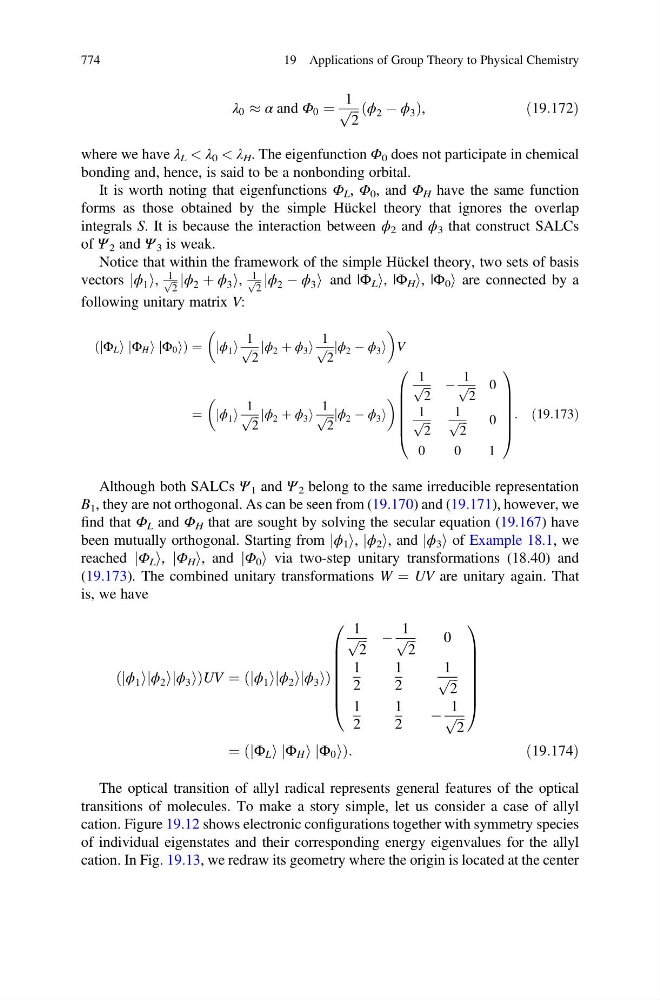
λ 0 % α and Φ 0 ¼
1
ffiffi ffi
2
p ϕ 2 À ϕ 3
ð
Þ ,
ð19:172Þ
where we have λ L < λ 0 < λ H . The eigenfunction Φ 0 does not participate in chemical
bonding and, hence, is said to be a nonbonding orbital.
It is worth noting that eigenfunctions Φ L , Φ 0 , and Φ H have the same function
forms as those obtained by the simple Hückel theory that ignores the overlap
integrals S. It is because the interaction between ϕ 2 and ϕ 3 that construct SALCs
of Ψ 2 and Ψ 3 is weak.
Notice that within the framework of the simple Hückel theory, two sets of basis
vectors ϕ 1
j i,
1 ffiffi
2
p ϕ 2
j þ ϕ 3 i,
1 ffiffi
2
p ϕ 2
j À ϕ 3 i and |Φ L i, |Φ H i, |Φ 0 i are connected by a
following unitary matrix V:
Φ L
j i Φ H
j i Φ 0
j i
ð
Þ ¼ ϕ 1
j i
1
ffiffi ffi
2
p ϕ 2
j þϕ 3 i
1
ffiffi ffi
2
p jϕ 2 À ϕ 3 i
V
¼ ϕ 1
j i
1
ffiffi ffi
2
p ϕ 2 þ ϕ 3
j
i
1
ffiffi ffi
2
p jϕ 2 À ϕ 3 i
1
ffiffi ffi
2
p
À
1
ffiffi ffi
2
p
0
1
ffiffi ffi
2
p
0
1
ffiffi ffi
2
p
0
0
1
0
B
B
B
B
B
@
1
C
C
C
C
C
A
: ð19:173Þ
Although both SALCs Ψ 1 and Ψ 2 belong to the same irreducible representation
B 1 , they are not orthogonal. As can be seen from (19.170) and (19.171), however, we
find that Φ L and Φ H that are sought by solving the secular equation (19.167) have
been mutually orthogonal. Starting from jϕ 1 i, jϕ 2 i, and jϕ 3 i of Example 18.1, we
reached jΦ L i, jΦ H i, and jΦ 0 i via two-step unitary transformations (18.40) and
(19.173). The combined unitary transformations W ¼ UV are unitary again. That
is, we have
ϕ 1 i
j jϕ 2 ijϕ 3 i
ð
Þ UV ¼ ϕ 1 i
j jϕ 2 ijϕ 3 i
ð
Þ
1
ffiffi ffi
2
p
À
1
ffiffi ffi
2
p
0
1
2
1
2
1
ffiffi ffi
2
p
1
2
1
2
À
1
ffiffi ffi
2
p
0
B
B
B
B
B
B
@
1
C
C
C
C
C
C
A
¼ Φ L i
j
jΦ H i jΦ 0 i
ð
Þ :
ð19:174Þ
The optical transition of allyl radical represents general features of the optical
transitions of molecules. To make a story simple, let us consider a case of allyl
cation. Figure 19.12 shows electronic configurations together with symmetry species
of individual eigenstates and their corresponding energy eigenvalues for the allyl
cation. In Fig. 19.13, we redraw its geometry where the origin is located at the center
774
19 Applications of Group Theory to Physical Chemistry
1
ffiffi ffi
2
p ϕ 2 À ϕ 3
ð
Þ ,
ð19:172Þ
where we have λ L < λ 0 < λ H . The eigenfunction Φ 0 does not participate in chemical
bonding and, hence, is said to be a nonbonding orbital.
It is worth noting that eigenfunctions Φ L , Φ 0 , and Φ H have the same function
forms as those obtained by the simple Hückel theory that ignores the overlap
integrals S. It is because the interaction between ϕ 2 and ϕ 3 that construct SALCs
of Ψ 2 and Ψ 3 is weak.
Notice that within the framework of the simple Hückel theory, two sets of basis
vectors ϕ 1
j i,
1 ffiffi
2
p ϕ 2
j þ ϕ 3 i,
1 ffiffi
2
p ϕ 2
j À ϕ 3 i and |Φ L i, |Φ H i, |Φ 0 i are connected by a
following unitary matrix V:
Φ L
j i Φ H
j i Φ 0
j i
ð
Þ ¼ ϕ 1
j i
1
ffiffi ffi
2
p ϕ 2
j þϕ 3 i
1
ffiffi ffi
2
p jϕ 2 À ϕ 3 i
V
¼ ϕ 1
j i
1
ffiffi ffi
2
p ϕ 2 þ ϕ 3
j
i
1
ffiffi ffi
2
p jϕ 2 À ϕ 3 i
1
ffiffi ffi
2
p
À
1
ffiffi ffi
2
p
0
1
ffiffi ffi
2
p
0
1
ffiffi ffi
2
p
0
0
1
0
B
B
B
B
B
@
1
C
C
C
C
C
A
: ð19:173Þ
Although both SALCs Ψ 1 and Ψ 2 belong to the same irreducible representation
B 1 , they are not orthogonal. As can be seen from (19.170) and (19.171), however, we
find that Φ L and Φ H that are sought by solving the secular equation (19.167) have
been mutually orthogonal. Starting from jϕ 1 i, jϕ 2 i, and jϕ 3 i of Example 18.1, we
reached jΦ L i, jΦ H i, and jΦ 0 i via two-step unitary transformations (18.40) and
(19.173). The combined unitary transformations W ¼ UV are unitary again. That
is, we have
ϕ 1 i
j jϕ 2 ijϕ 3 i
ð
Þ UV ¼ ϕ 1 i
j jϕ 2 ijϕ 3 i
ð
Þ
1
ffiffi ffi
2
p
À
1
ffiffi ffi
2
p
0
1
2
1
2
1
ffiffi ffi
2
p
1
2
1
2
À
1
ffiffi ffi
2
p
0
B
B
B
B
B
B
@
1
C
C
C
C
C
C
A
¼ Φ L i
j
jΦ H i jΦ 0 i
ð
Þ :
ð19:174Þ
The optical transition of allyl radical represents general features of the optical
transitions of molecules. To make a story simple, let us consider a case of allyl
cation. Figure 19.12 shows electronic configurations together with symmetry species
of individual eigenstates and their corresponding energy eigenvalues for the allyl
cation. In Fig. 19.13, we redraw its geometry where the origin is located at the center
774
19 Applications of Group Theory to Physical Chemistry